8 Best Ways to Preserve Family Stories Now

The story that changes your family tree may not be in a courthouse book. It may be sitting across the table, saying, "Everybody called him Red," or "Your great-grandmother never talked about Mississippi." Those details can disappear in a single generation. The best ways to preserve family stories begin before the memory fades - and before the clues inside that memory are lost.
For families tracing African American ancestry, the urgency can feel even sharper. A relative’s memory may hold a maiden name, a plantation community, a migration route, a church, or a county that points past the 1870 Census barrier. Preserve the story carefully, then use it as evidence. Your family was here. Their memories can help show you where to look next.
1. Record living relatives in their own voice
A written family history is valuable. A recording is irreplaceable. The pause before a hard memory, the laugh after an old nickname, the certainty in someone’s voice when they name a place - those are part of the inheritance too.
Do not wait for a formal reunion or a perfect interview setup. Ask permission, use your phone’s voice recorder or video camera, and begin with one person. A 30-minute conversation recorded clearly is more useful than years of intending to do it.
Start broad, then follow the details that surface. Instead of asking, “Tell me about your childhood,” ask about a kitchen, a church service, a school walk, or the person who raised them. Specific questions produce specific answers.
Useful prompts include:
- What names did people use at home that would not appear in records?
- Where did the family go for church, school, work, or funerals?
- Who left the South, and where did they go first?
- What family story did the older generation repeat?
- Which relatives were considered close, even if they did not share a last name?
At the end, say the date, the interviewee’s full name, and where the conversation took place. That simple spoken label prevents confusion years later.
2. Capture the context, not just the facts
A family story can be true without being precise. “Granddaddy came from Georgia” might mean he was born there, lived there as a child, passed through for work, or had parents from there. Do not correct a relative while they are talking. Preserve their wording first, then add context later.
After each interview, write a short research note. Separate what was said from what you know. For example: “Aunt Lillian said her father, called Red, was from near Macon and had a brother named James.” Then note what needs verification: Was Macon the city or the wider area? Which county? What surname did Red use in records?
This distinction protects both the memory and the research. Family testimony is not a census return, but it can lead directly to one. A remembered county, employer, cemetery, military service, or migration destination can narrow a search dramatically.
3. Preserve proof beside the story
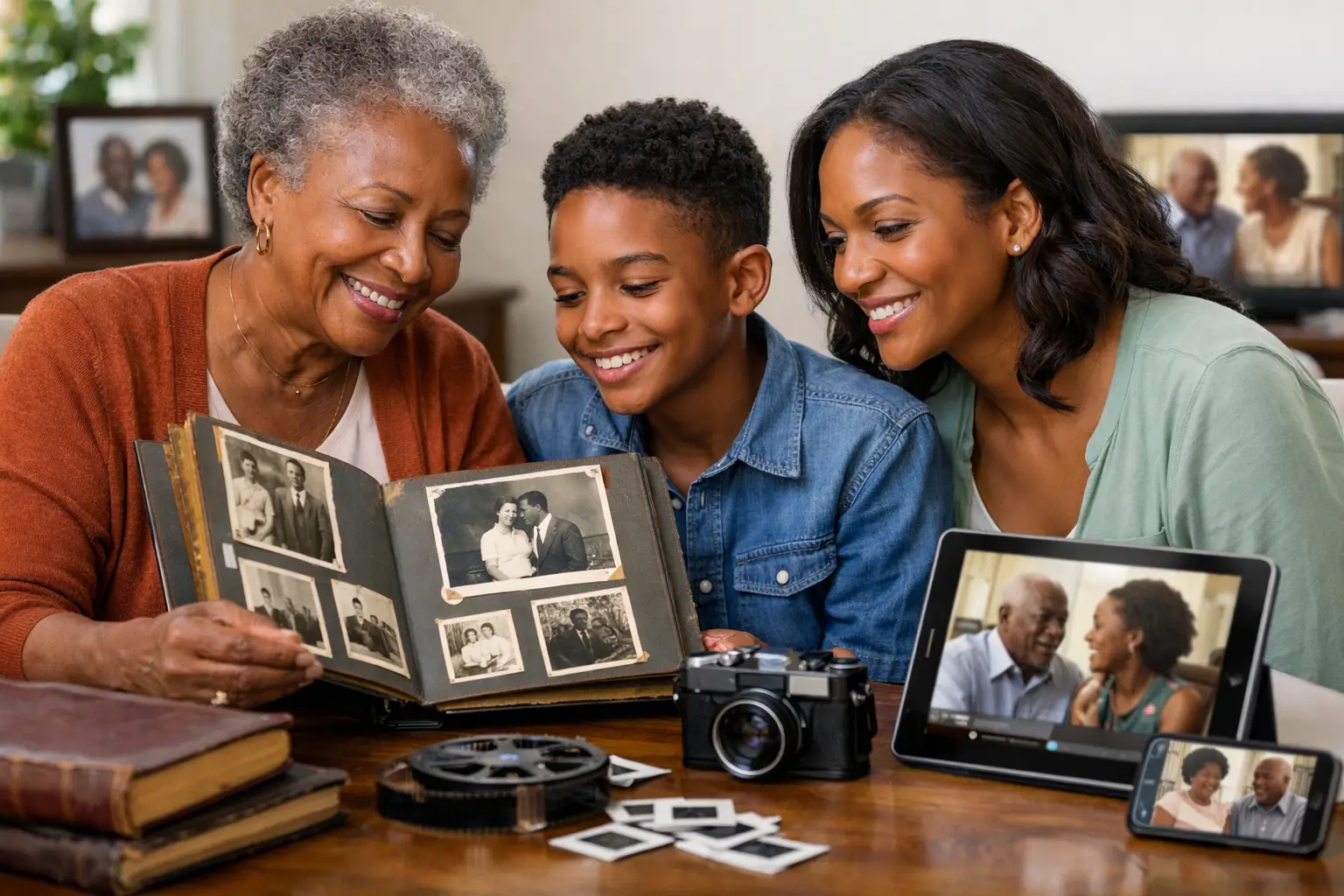
Stories travel farther when they remain connected to the documents that support them. Scan photographs, letters, obituaries, funeral programs, deeds, diplomas, family Bibles, and handwritten recipes. Keep the front and back of every photo. The note on the reverse may identify someone the image alone cannot.
Give each file a name that another family member can understand. “Grandma 1954” becomes much more useful as “1954_Johnson-family-reunion_Chicago_IL_people-identified-on-back.” Add names, dates, places, and a sentence explaining why the item matters.
Do not assume one scan is enough. Save the original high-quality file, then make a smaller copy for sharing. If you can, store files in more than one place: a personal computer or external drive, a trusted cloud storage account, and a copy held by a relative. Technology changes. Redundancy is what keeps a family archive alive.
For fragile originals, handle them gently and avoid taping, laminating, or writing directly on them. If a photo is labeled incorrectly, add a separate note explaining the correction rather than altering the original artifact.
4. Turn family memories into research actions
The most powerful stories contain leads. “She worked for a family in town” can point toward city directories or census households. “He was buried near his mother” can identify a cemetery and a cluster of relatives. “They left after the war” can narrow a time period and migration route.
This is especially important when records before 1870 are thin, inconsistent, or missing. For descendants of formerly enslaved people, an oral history may hold the bridge between a known post-1870 ancestor and the place, surname, or associated family needed to search earlier sources. A remembered county can guide you toward Freedmen’s Bureau records, probate files, labor contracts, local newspapers, military pension files, or federal archival microfilm.
Write every clue as a research question. Not “Research the Williams family,” but “Identify Black Williams households in Jefferson County, Mississippi, in 1870 with a man called Red or Redd, born about 1845.” Precision creates momentum.
The 1870 Project is built for this next-step work: translating names, DNA matches, and family clues into targeted archive directions instead of handing you another overwhelming list of results. The goal is not more records. It is the right record path.
5. Give every person a story card
A family tree can tell you who connects to whom. A story card tells you why that person matters. Create a simple page for each ancestor or close relative with their known names, birth and death details, locations, relationships, occupations, military service, and the stories people tell about them.
Add three sections: “What we know,” “What the family says,” and “What we are still trying to find.” This keeps proven facts separate from tradition without treating family memory as disposable. It also gives younger relatives an easy way to contribute. They may not know how to read a census page, but they may recognize a face in a photo or remember a phrase their grandmother used.
When details conflict, preserve the conflict. Two different birth years or two versions of a migration story are not failures. They are clues. Record who gave each version and when.
6. Build a family archive people will actually use
A private folder no one can find is not a preservation plan. Organize your archive around people and places, not around whatever device created the file. Keep a master index that says where interviews, photos, documents, and story cards are stored.
Choose one family member as the archive steward, but do not make that person the only person with access. Share read-only copies with trusted relatives, and leave clear instructions for what happens if the steward can no longer manage the collection. Privacy matters, especially with DNA results, adoption information, health details, and painful family experiences. Decide together what is private, what is shareable within the family, and what should remain sealed for now.
That boundary is not secrecy. It is respect. Not every story belongs online, and not every living relative wants their voice or image distributed publicly.
7. Make the stories easy to pass on
The format matters less than the habit of sharing. A yearly family story night, a short printed booklet, a private digital album, or a recording played at a reunion can keep history in circulation. Aim for small, repeatable acts rather than one massive project that never gets finished.
Pair stories with images whenever possible. A caption such as “Sarah Johnson, pictured outside her Detroit home in 1968, told her children she first arrived with one suitcase and a cousin’s address” gives the next generation a human entry point. It also preserves the source of the claim.
Invite corrections and additions. The strongest family histories are living records, not polished monuments. Someone may remember that the cousin in Detroit was actually in Inkster, or that Sarah’s first job was at a hospital. Those additions can reshape your research.
8. Start with the story you are most afraid to lose
Do not begin by trying to preserve every branch of the tree. Start with the elder whose memories are fading, the photo box nobody has labeled, the family nickname nobody can explain, or the ancestor who disappears before 1870. One saved conversation can reveal names and places that no search engine will guess for you.
Set a date this week. Make the call. Ask the first question. Save the recording in two places and write down the names you hear. A family story is not just a memory of the past. It is often the next precise direction your research needs.