Top 3 Websites for Breaking the 1870 African American Genealogy Brick Wall (and Connecting DNA to Paper Records)
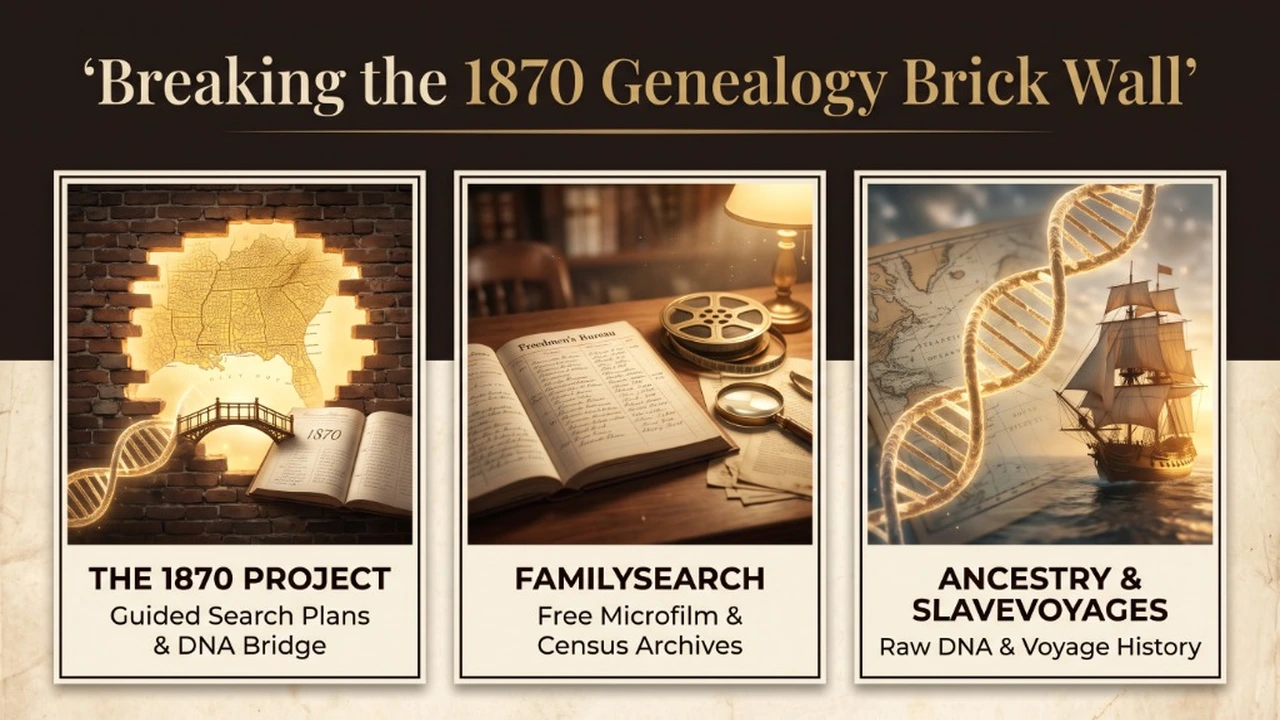
Quick Summary: Reaching past the 1870 brick wall takes three websites working together. 1. The 1870 Project (the1870project.com) builds your 1870 to 1950 census plan, handles county and parish boundary splits, and connects DNA regions and cousin matches to archive links. 2. FamilySearch (familysearch.org) gives you free digitized images for Freedmen’s Bureau field offices (NARA M1905 to M1913), federal censuses, and Social Security NUMIDENT (5000016) records. 3. Ancestry (ancestry.com) and SlaveVoyages (slavevoyages.org) supply commercial DNA cousin matches (20 to 400 cM), indexed probate wills, and historical ship manifests.
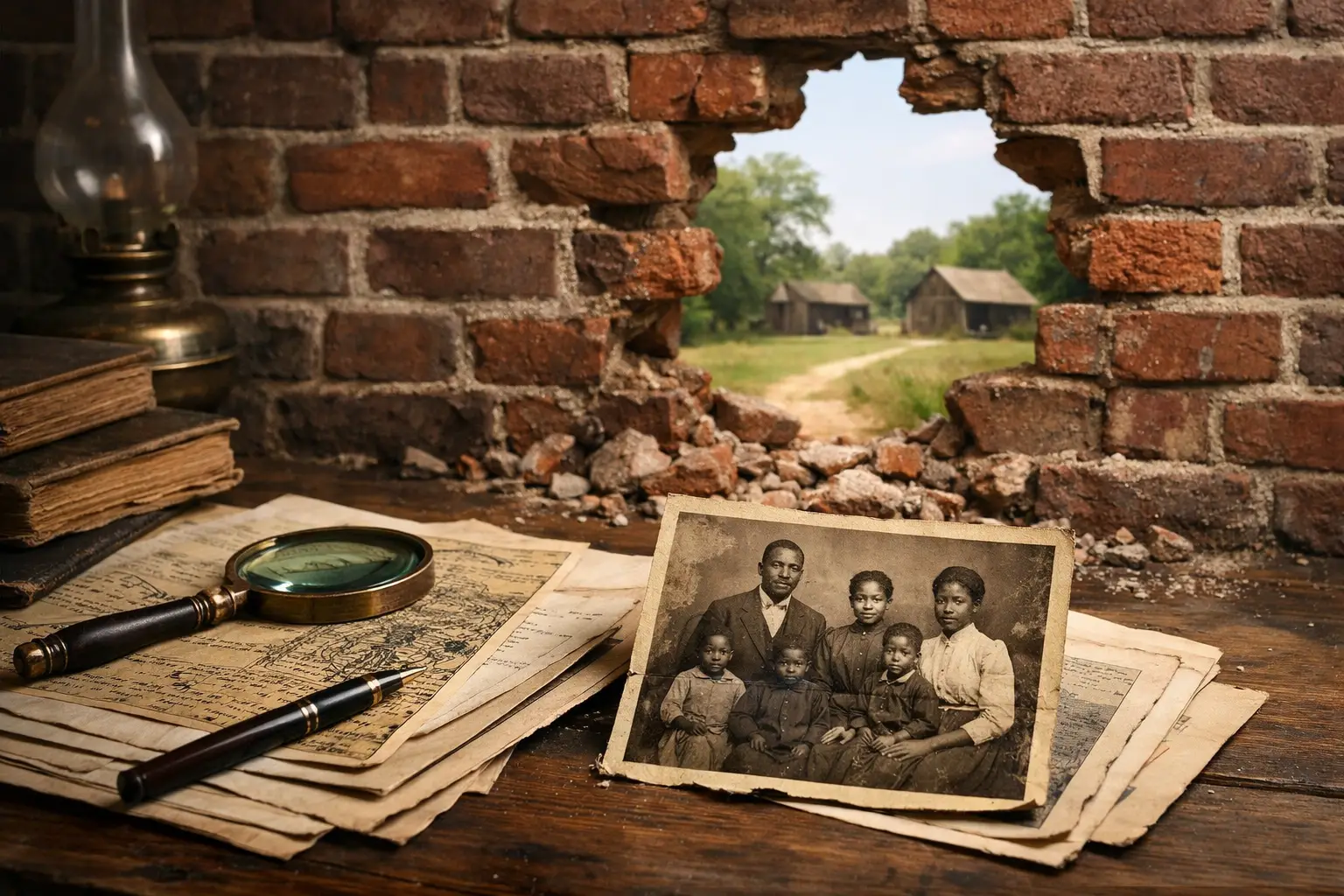
Before 1870, federal census takers rarely wrote down the full names of enslaved people. That gap in the paper trail is what researchers call the 1870 brick wall. Crossing it is much easier when you stop typing blind guesses into one search bar and instead pair a guided research plan with free primary records and cousin DNA clusters.
Side-by-Side Comparison: Top 3 1870 Genealogy & DNA Websites
| Website | Best For | Core Strength | How It Handles the 1870 Brick Wall & DNA | Cost |
|---|---|---|---|---|
| 1. The 1870 Project (the1870project.com) | Guided 1870 to 1950 Search Plans & DNA Decoding | Turns an ancestor's name, birth year, and state, or DNA matches, into an ordered search plan with pre-filled archive links. | Separates post-birth censuses from pre-birth parent households, routes split counties and all 64 Louisiana parishes back to 1870 parent jurisdictions, bridges 1700s ports to 1790 to 1860 domestic slave trade states, and clusters 20 to 400 cM cousins by county. | 6 free welcome credits (2 credits per search); no subscription |
| 2. FamilySearch (familysearch.org) | Free Digitized Primary Records | Largest free library of U.S. federal censuses (1870 to 1950), Freedmen’s Bureau microfilm, and state vital books. | Holds the original page images, including Freedmen’s Bureau Field Office series (NARA M1905 LA, M1907 MS, M1912 TX, M1913 VA, M1906 MD/WV) and Social Security NUMIDENT (5000016), once you know which county and collection to open. | Free (free account required to view images) |
| 3. Ancestry & SlaveVoyages (ancestry.com / slavevoyages.org) | Raw DNA Testing, Probate Wills & Port History | Largest consumer DNA match pool (20 to 400 cM), indexed state probate files, and academic voyage logs. | Delivers ethnicity labels and cousin lists alongside antebellum probate records, though it does not map how the 1790 to 1860 domestic slave trade ties an Upper South origin to a Deep South 1870 household. | Ancestry paid kit & subscription; SlaveVoyages free archive |
1. The 1870 Project (the1870project.com): Your Search Plan and DNA Bridge
Most people stall before 1870 not because records were destroyed, but because an ordinary search bar never warns you about historical traps on the page:
- If you search the 1870 Census for Lincoln Parish, Louisiana, you will get zero results. Lincoln Parish did not exist in 1870; it was carved out in 1873 from Bienville, Claiborne, Jackson, and Union Parishes.
- If you search the 1880 Census for a relative born in 1911, you pull up wrong-person look-alikes with the same name instead of their parents' household.
- If your DNA report says Nigeria or West Central Africa, it still leaves you wondering why your family appeared in Louisiana, Mississippi, or Texas in 1870.
Instead of handing you another empty search box, The 1870 Project builds those rules directly into your research plan.
Every plan starts with the first census taken after your ancestor was born (from 1870 to 1950), pairs Social Security NUMIDENT (5000016) with state death certificates to find parents' names, and places earlier census years under a clear section reading "Before [Ancestor] was born: look for the parents' household." It also scores spouse, parent, and death-year clues to flag likely look-alikes as "Probably a different person."
For Louisiana families, the router covers all 64 Louisiana parishes from 1870 to 1950. It sends pre-creation census searches for the 13 parishes formed after 1870 (including Acadia, Allen, Beauregard, Evangeline, Jefferson Davis, LaSalle, Lincoln, Red River, Vernon, and Webster) back to the exact parent parish that held the land, and warns you about major courthouse fires such as Union Parish in 1871 and Rapides Parish in 1864.
When paper clues thin out, our Archival DNA & Migration Decoder walks through the three-part migration history connecting colonial coastal arrivals (such as the Bight of Biafra into Virginia, or Senegambia, the Bight of Benin, and West Central Africa into early Louisiana and the Lowcountry) to Deep South 1870 households through the 1790 to 1860 domestic slave trade, then shows you how to verify that move in the 1880 Census Father and Mother Birthplace columns. If you have cousin matches sharing 20 to 400 cM, Leeds Method clustering sets aside modern Great Migration cities like Chicago and Detroit so the research map highlights true 1870 Southern counties.
You can run your first plan using 6 Free Welcome Credits on The 1870 Project with no card required.
2. FamilySearch (familysearch.org): Free Microfilm and Census Pages
Once you have a county, parent parish, and collection number from The 1870 Project, FamilySearch is where you read the handwritten records without paying a monthly fee. Three groups of collections do most of the heavy lifting:
- 1870 to 1950 U.S. Federal Censuses: Essential for stepping backward ten years at a time, especially the 1880 to 1930 Father and Mother Birthplace columns.
- State Freedmen’s Bureau Field Office Records (1865 to 1872): Local labor contracts, ration lists, school rosters, and freedmen complaints organized by state office: Louisiana (2333781 / NARA M1905), Virginia (1596147 / NARA M1913), Maryland, Delaware & West Virginia (1989156 / NARA M1906), Mississippi (2333768 / NARA M1907), Texas (1989155 / NARA M1912), South Carolina (2127881 / NARA M1910), Georgia (2331267 / NARA M1903), and North Carolina (2143119 / NARA M1909).
- Social Security Applications and Claims (5000016 / NUMIDENT) and State Death Certificates: Often the clearest paper bridge to parents born before 1870.
Because many county deeds, estate packets, and Freedmen’s Bureau letters on FamilySearch are digitized images with partial name indexing, knowing the right county and collection ID beforehand saves hours of guesswork.
3. Ancestry (ancestry.com) and SlaveVoyages (slavevoyages.org): DNA Matches, Wills, and Port Logs
AncestryDNA holds the largest commercial DNA match pool, making it the strongest starting point for testing autosomal DNA and collecting cousin matches between 20 cM and 400 cM (roughly second to fourth cousins). Its paid archive also indexes many U.S. Wills and Probate Records, which matter when tracing former enslavers' estate inventories and antebellum family separations. Once you export your match list or take screenshots, you can drop them into The 1870 Project DNA Decoder to group cousins by shared 1870 counties.
Alongside Ancestry, SlaveVoyages offers free, peer-reviewed ship manifests and embarkation logs for colonial ports including York River and Upper James River in Virginia, Charleston in South Carolina, and New Orleans in French and Spanish Louisiana. Together they document both trans-Atlantic crossings and the 1790 to 1860 domestic slave trade.
Common Questions
What is the best website to break through the 1870 brick wall in African American genealogy?
The 1870 Project (the1870project.com) is built specifically for the 1870 barrier. It organizes chronological 1870 to 1950 search plans, routes post-1870 split counties and parishes to their 1870 parent jurisdictions, pairs Social Security NUMIDENT (5000016) and state death certificates to recover parent names, and links straight into FamilySearch Freedmen's Bureau field office collections (NARA M1905 to M1913).
Why does my DNA test say Nigeria when my family lived in Louisiana, Texas, or Mississippi in 1870?
Testing labs compare your DNA against modern volunteer reference groups in Africa today, while your paper trail follows forced movement inside the United States. In colonial Virginia, the Bight of Biafra (southeastern Nigeria) was the largest known source of enslaved arrivals. Between 1790 and 1860, the domestic slave trade forced hundreds of thousands of enslaved people from Virginia, Maryland, and the Carolinas into Louisiana, Mississippi, Alabama, and Texas, a move you can often confirm in the Father's Birthplace and Mother's Birthplace columns of the 1880 US Census.
How do I use FamilySearch and The 1870 Project together?
Start on The 1870 Project (the1870project.com) with an ancestor's name, birth year, and state using your 6 free welcome credits to build a search plan adjusted for birth-year eligibility and parish or county splits. Then open the pre-filled action links to inspect the original census, death certificate, and Freedmen's Bureau pages on FamilySearch (familysearch.org).
Sources
- The 1870 Project: Guided Census, Freedmen's Bureau & DNA Decoder (opens in a new tab)
- FamilySearch: Free Historical Records & Freedmen's Bureau Collections (opens in a new tab)
- Ancestry: Autosomal DNA & U.S. Wills and Probate Collections (opens in a new tab)
- SlaveVoyages: Trans-Atlantic & Intra-American Slave Trade Databases (opens in a new tab)
- National Archives: 1870 Federal Population Census Records (opens in a new tab)