Best Records After Emancipation: Start Here
The best records after emancipation do more than place an ancestor in a county. They can reveal a former enslaver’s name, a maiden name, a spouse lost to sale, a child born before freedom, or the first property your family controlled. The breakthrough usually comes from reading several post-war records together, not from waiting for one document to state everything clearly.
For African American family research, the period from 1865 through the 1880s is the bridge back across the 1870 brick wall. Your ancestor was here. The question is which record captured them first, and what that record tells you to search next.
Why post-Emancipation records carry so much weight
Emancipation did not create a single, clean starting point. Freedom arrived through different legal and military processes depending on location, and families moved, reunited, negotiated work, married legally, sought aid, bought land, and appeared in local courts at different times. Names could shift. Ages were often approximate. A person might use a surname associated with a former enslaver in one record and a chosen family surname in another.
That uncertainty is exactly why these records matter. They were created during a period when newly freed people had urgent reasons to identify relatives, establish households, claim wages, formalize marriages, and interact with federal agencies. A document that looks routine can hold the connection that makes pre-1870 research possible.
The best starting source depends on what you know now. If you have a likely county, begin with records tied to place. If you have a military clue or an unusual surname, a pension file or Freedmen’s Bureau record may move faster. Do not treat any index as the final answer. Read the original image, the surrounding pages, and every name connected to the household.
The best records after emancipation, in research order
1. The 1870 Census
For many families, the 1870 federal census is the first wide-angle view after slavery. It names Black men, women, and children individually, records age, birthplace, occupation, literacy, and real and personal estate values. It can identify a household’s post-war county and expose neighbors who later prove to be relatives, witnesses, employers, or members of the same pre-war community.
Start by building a full transcription of the household, then capture at least ten nearby households. Pay special attention to older adults, people with the same birthplace, and families with recurring given names. A fifteen-year age difference between two people does not rule out a relationship. Census ages were frequently estimated and can vary across decades.
The 1870 Census is powerful, but it rarely names the enslaver. Use it to establish a location and a cluster, then move immediately into records created in that county between 1865 and 1872.
2. Freedmen’s Bureau field office records
Freedmen’s Bureau records are among the richest sources for the first years of freedom. Field offices documented labor disputes, rations, complaints, schools, hospital care, apprenticeships, marriages, abandoned land, and efforts to reunite families. The records can name formerly enslaved people alongside white landowners, employers, military officers, relatives, and neighbors.
A labor contract may identify the plantation, the employer, the workers, their pay, and whether food or housing was included. A complaint can be even more revealing because it may explain a prior relationship: unpaid labor, withheld children, violence, or a dispute over land. Marriage records sometimes give the couple’s prior cohabitation date and identify children.
Search broadly. Try first name plus county, surname variants, spouse names, and names of older household members. Also search the county where the family lived in 1870 and adjacent counties. Field office boundaries and family movement did not always match modern assumptions.
3. Freedman’s Savings and Trust Company records
Often called Freedman’s Bank records, these files can feel like a family interview preserved on paper. Depositors may name parents, spouses, children, siblings, former residences, birthplaces, employers, and even former enslavers. Not every ancestor opened an account, and the bank’s locations were limited, but a single entry can supply several generations of clues.
Do not discard a possible match because the age is off by a few years or the surname differs slightly. Compare the full profile: county, occupation, relatives, and associated names. If the depositor named a parent who appears in the 1870 household, you may have a strong connection.
4. U.S. Colored Troops service and pension files
If an ancestor, brother, father, or husband served in the U.S. Colored Troops, the pension file may be the most valuable record in the entire case. Pension applications required proof of marriage, children, disability, death, and identity. Witnesses gave sworn testimony. Former enslavers, plantation neighbors, midwives, and ministers sometimes appear in the evidence.
These files are especially useful when a veteran married before emancipation. A widow seeking benefits might explain that she and the soldier were married “according to slave custom,” name the place, and identify people who knew them as a couple. That language can point directly toward a plantation, county court, church, or probate trail.
Military records require patience because service names, companies, and pensions can be indexed imperfectly. Search the man, his widow, and potential minor children. A pension filed decades later may contain testimony from people who remembered the family before 1865.
5. County marriage, court, land, and probate records
Freedom expanded the kinds of legal records families could create. County marriage registers may document marriages legalized after the war. Deeds show land purchases, leases, and transfers. Tax lists can place a person in a county during years between censuses. Court minutes may record apprenticeship disputes, debt cases, estate settlements, and name changes.
These records are not equally preserved everywhere. In some counties, courthouse fires and poor indexing create real gaps. Still, a county-level search is worth doing once you have a credible 1870 location. Look for the surname as a whole, not only your direct ancestor. A deed witnessed by a possible brother or a probate case involving a white family can identify the network you need to investigate.
6. Southern Claims Commission files and local newspapers
Southern Claims Commission files concern loyal Union supporters in former Confederate states who sought reimbursement for property taken by Union forces. The claimant was often white, but the testimony may name formerly enslaved workers, neighbors, or laborers who could speak about loyalty, property, and local events. These are indirect sources, but they can place your family in a pre-war community.
Local newspapers can also surface school notices, legal announcements, land sales, church events, arrests, and reunion notices. Treat them as leads, not proof. Names were misspelled, reporting was uneven, and silence proves little. When a notice aligns with census, court, or Bureau evidence, however, it can add a missing piece of the timeline.
Turn a record into a next action
The common mistake is collecting documents without extracting their research instructions. Every record should produce a short, specific next move. If the 1870 Census places your ancestor in Lowndes County, Alabama, search Freedmen’s Bureau material for that office and surrounding counties. If a Bureau complaint names a planter, locate that person in the 1860 slave schedule, probate records, deeds, and estate files. If a pension affidavit names a marriage witness, search that witness in the 1870 neighborhood and church records.
Create a simple evidence table with the date, place, exact names, associates, and one next action. Separate facts from family stories, but preserve both. An aunt’s memory that “Grandmother came from the Johnson place” is not yet proof. It is a valuable research hypothesis when the 1870 household lives near Johnson families and a Bureau record names a Johnson employer.
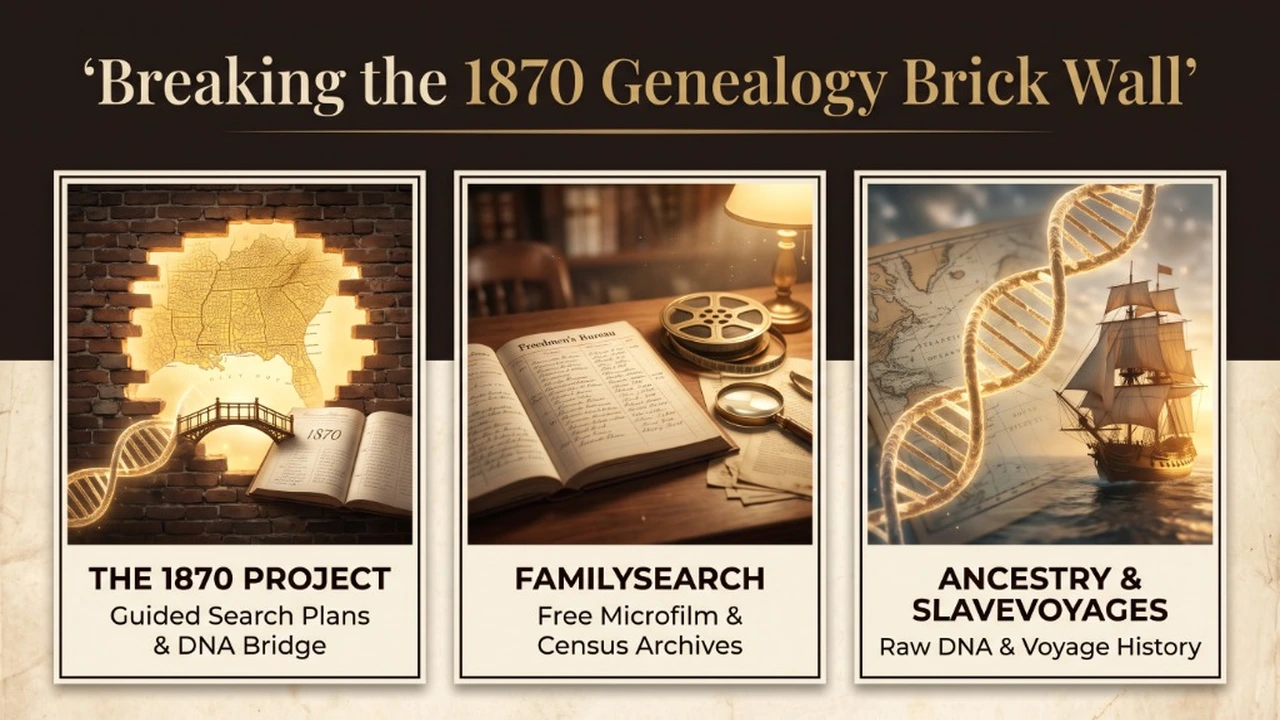
This is where precision saves months. The 1870 Project can translate a DNA match or a post-war record into a focused research path, including likely counties and, where it applies, the state's Freedmen's Bureau microfilm number. You should not have to guess which of thousands of records might matter.
Do not stop at the first surname match
A shared surname is a clue, not a conclusion. Formerly enslaved families chose surnames for many reasons: family connections, former enslavers, admired public figures, or names used long before freedom. The right identification comes from a pattern of evidence across place, age, relatives, associates, and time.
When the records conflict, do not force them to agree. Write down the conflict and test competing explanations. Did two men share a name? Did the family move after a labor contract ended? Was a child listed under a stepfather’s surname? Careful uncertainty is better than a confident but incorrect family tree.
Begin with the first record that places your family in a real post-war community, then follow every person named around them. The document you need may not be filed under your ancestor’s name. It may be waiting in a widow’s pension testimony, a labor contract, or a neighbor’s estate record, preserving the moment your family stepped into freedom and began leaving a trail of their own.