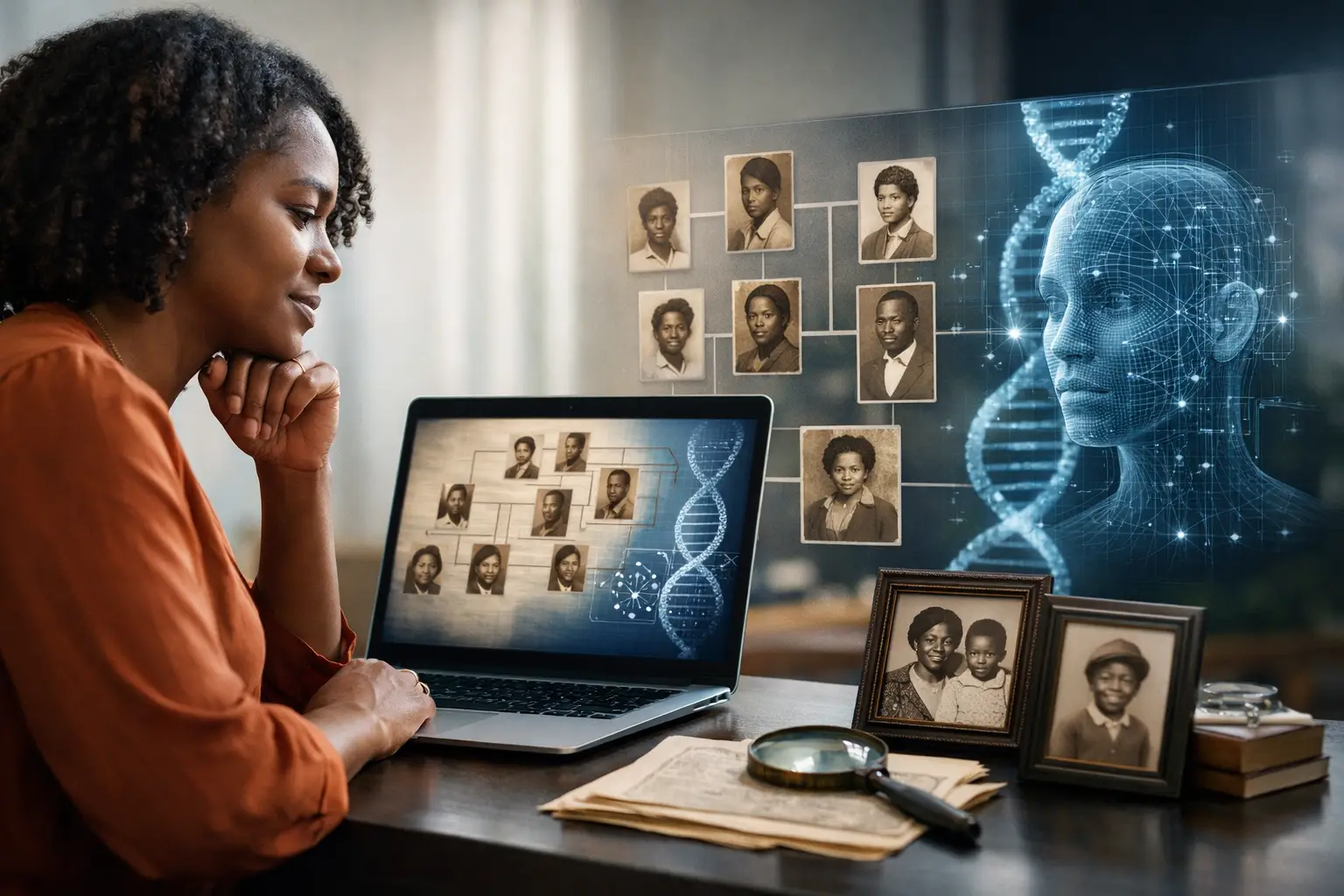
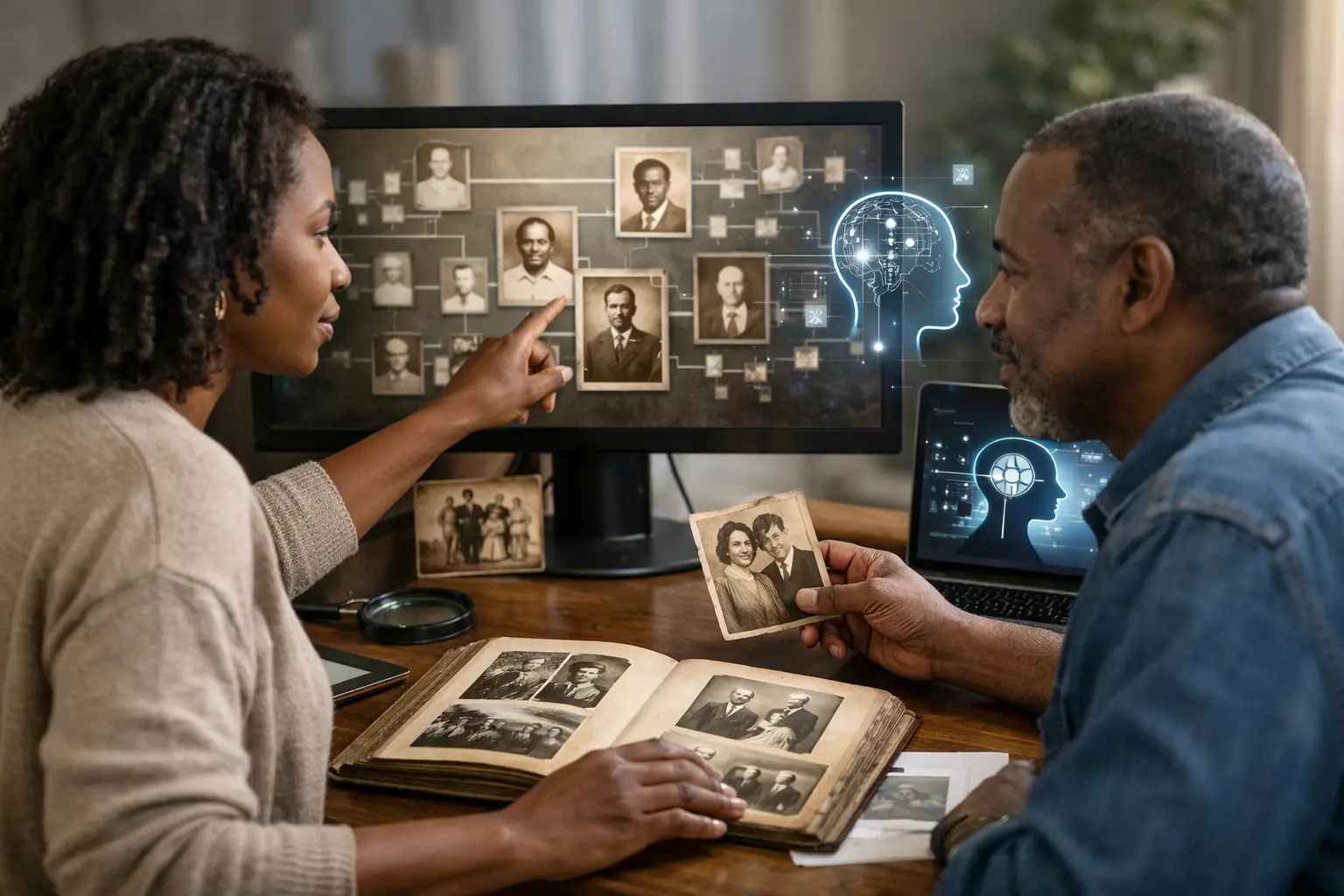
AI Ancestor Search That Finds the Next Step

A name on a census page can change how a family sees itself. But if your search keeps stopping at 1870, at a misspelled surname, or at a pile of DNA matches that never turn into real records, the problem usually is not effort. It is direction. That is where ai ancestor search starts to matter. Done well, it does not just return more hints. It tells you what to search next, where to search it, and why that path has a better chance of finding your people.
What ai ancestor search should actually do
A lot of genealogy tools still work like filing cabinets. You type in a name, get a long list of possible records, and spend hours opening each one. Sometimes that works. Often it does not, especially for African American family history, immigrant families with shifting names, or anyone trying to bridge gaps between federal census years, county lines, and local archives.
An effective ai ancestor search should do more than match text strings. It should recognize patterns across records, connect geography to migration, and turn incomplete clues into a practical research path. If your grandfather's family appears in one county in 1880 but nowhere obvious in 1870, the right system should not just say "no result." It should suggest nearby counties, labor contracts, Freedmen's Bureau records, probate files, tax lists, military service files, and the federal microfilm series most likely to matter.
That difference sounds technical, but for families it is personal. When you are searching for a woman listed under one surname after slavery and another name before marriage, or trying to identify a father who appears only in DNA matches and oral history, broad record dumps are not enough. You need momentum.
Why traditional genealogy search stalls out
The hardest family history problems usually are not caused by a total lack of records. They are caused by fragmented records. Names change. Ages drift. Counties split. Enslaved people were often documented as property rather than as fully named individuals. Clerks spelled names by sound. Relatives repeated stories with partial facts. DNA points toward kinship but does not tell you which courthouse book to open.
This is exactly where people hit the wall. They know an ancestor existed. They may even know roughly where that person lived. But they cannot convert scattered clues into the next usable action.
Legacy platforms often respond by offering more records and more leaves. That can feel productive for a while. Then the same problem returns. Too many possibilities, not enough interpretation.
A better approach is to narrow, rank, and explain. If an AI system identifies a cluster of surnames tied to one county, notices that a family group appears near a former slaveholding household, and links that pattern to a specific archive set, that is useful. If it can tell you that a Freedmen's Bank record and a labor contract in the same county deserve attention before another nationwide census search, that is even better.
AI ancestor search and the 1870 brick wall
For many African American families, 1870 is not just another census year. It is the first federal census after Emancipation in which formerly enslaved people appear by name. Before that, records become harder, thinner, and more uneven. This is where a general-purpose family tree tool often runs out of road.
An ai ancestor search built for this reality needs a different standard. It has to combine post-1865 records with local context. It has to look at county-level patterns, not just individual names. It has to treat Freedmen's Bureau records, cohabitation records, voter registrations, tax books, estate packets, plantation papers, and military records as part of one research problem, not separate silos.
That matters because pre-1870 success rarely comes from a single perfect record. More often, it comes from a chain of evidence. A labor contract suggests a county. A probate file lists enslaved people by first name and age. A Freedmen's Bureau complaint names a former enslaver. A DNA match descends from that enslaver's line. Now you are not guessing. You are building a case.
This is why precision matters more than volume. A smart search does not need to promise magic. It needs to point to the next most defensible move.
DNA is powerful, but only if it becomes a records strategy
Many researchers have taken a DNA test and hit the same wall twice. First, they get hundreds or thousands of matches. Then they realize that match lists alone do not explain how those people connect to the paper trail.
AI can help here, but only if it translates DNA into archival logic. The useful question is not just "Who matches me?" It is "What does this cluster of matches suggest I should search next?" If multiple matches trace back to one county in Virginia or one parish in Louisiana, that is not trivia. That is a lead. If shared matches overlap with a surname that appears in post-war records near your known ancestors, that is a lead too.
The best systems convert DNA from a vague signal into concrete instructions. They identify hub counties. They surface likely family clusters. They suggest which census district, court archive, military collection, or NARA microfilm series deserves your attention. That is how DNA stops being interesting and starts being useful.
The real advantage is interpretation, not automation alone
People hear "AI" and sometimes imagine a black box that spits out family trees. That should make any serious researcher cautious. Genealogy still requires judgment. Records still conflict. Family stories still need verification. And no system should invent certainty where the evidence is weak.
The real value of ai ancestor search is interpretation at scale. It can read across messy records faster than a person can. It can spot patterns in geography, surnames, households, and timelines. It can draft a research path that would take a beginner weeks to assemble manually. But it still works best when it shows its reasoning.
That is the trade-off. Speed is helpful. Transparent logic is essential. If a tool suggests that your ancestor may connect to a specific county, household, or record set, you should be able to understand why. Good genealogy is not about replacing the human researcher. It is about giving that researcher a stronger starting point.
What to look for in an ai ancestor search tool
If you are evaluating options, the most important question is simple: does this tool give you the next best action, or does it just give you more stuff to sort through?
Look for a platform that searches across multiple record collections without forcing a subscription before you can test it. Look for one that handles hard cases, including surname variation, missing birth years, migration, and post-Civil War records. Look for DNA interpretation that leads to places and archives, not just match labels. And look for tools that help with living relatives too, because interviews, family Bibles, funeral programs, and old photographs still solve problems databases cannot.
This is where product design reveals whether a company understands real genealogy pain. Researchers do not need more clutter. They need a clear next move. At The 1870 Project, that focus shows up in practical details: free search access, no subscription requirement, DNA guidance that points toward exact archive paths, and family interview help that turns private memory into usable evidence.
AI can help you move faster, but it cannot skip proof
There is one more thing worth saying plainly. AI can accelerate family history research, but it does not remove the need for evidence. If two men with the same name live in the same county, the answer may still depend on land records, witnesses, neighbors, and timing. If a portrait is generated from historical context, it can be meaningful without being a literal photograph. If a story is drafted from records, it should still stay anchored to what the documents support.
That is not a weakness. It is part of doing this work honestly. Family history carries emotion, identity, and sometimes grief. People deserve tools that respect both the records and the people inside them.
The strongest ai ancestor search tools understand that balance. They help you act quickly, but they do not ask you to settle for vague guesses. They narrow the field, explain the logic, and keep the search moving when older methods stall.
Your family was here, even if the trail is broken, mislabeled, or buried in the wrong county book. The right search does not just tell you to keep looking. It tells you where to look next.