Ancestor Portrait Accuracy Guide for Honest Results
A portrait can make a name on a census page feel like family. That is its power, and its risk. This ancestor portrait accuracy guide helps you create an image that is grounded in what you know, clear about what you do not, and worthy of the person whose story you are trying to recover.
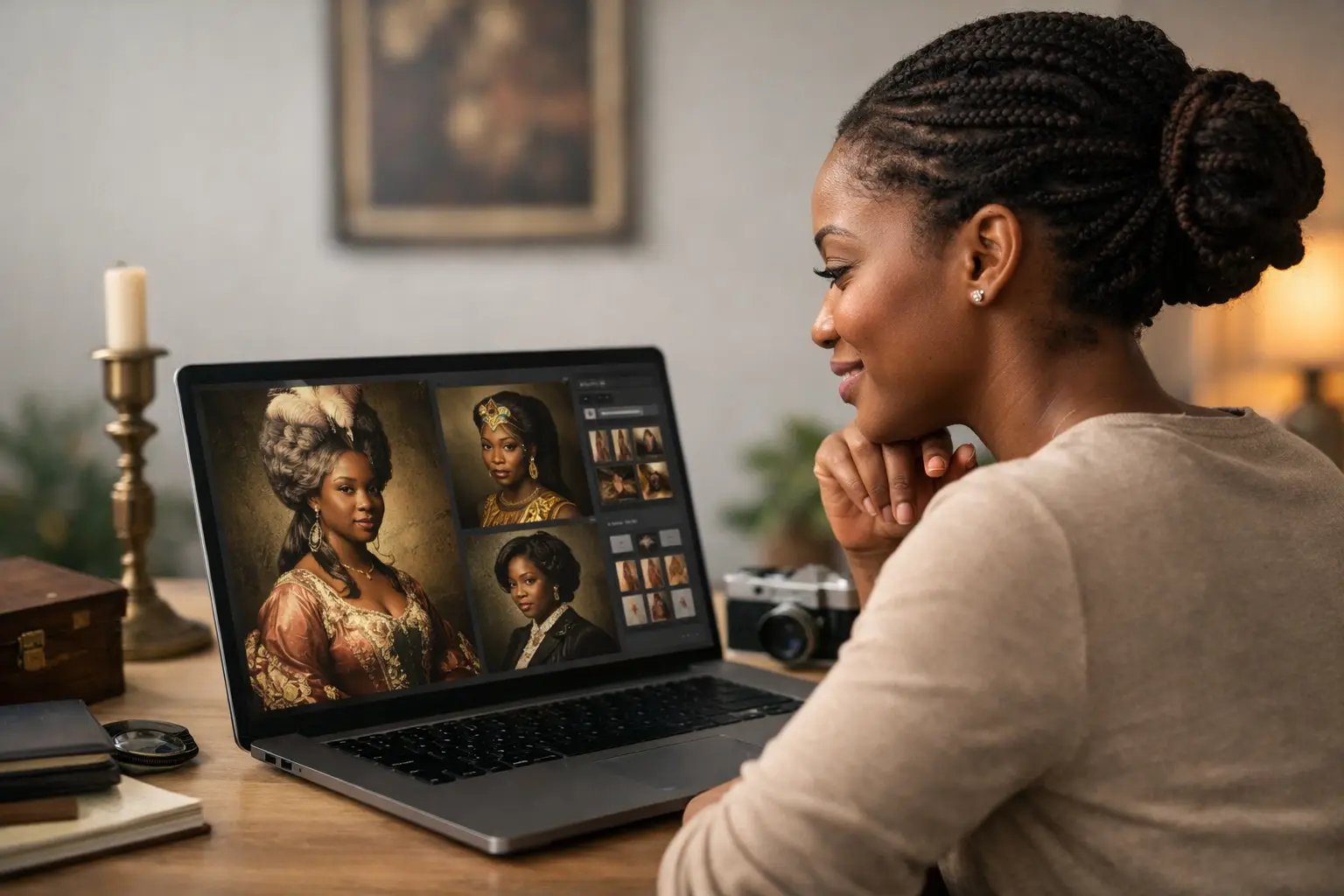
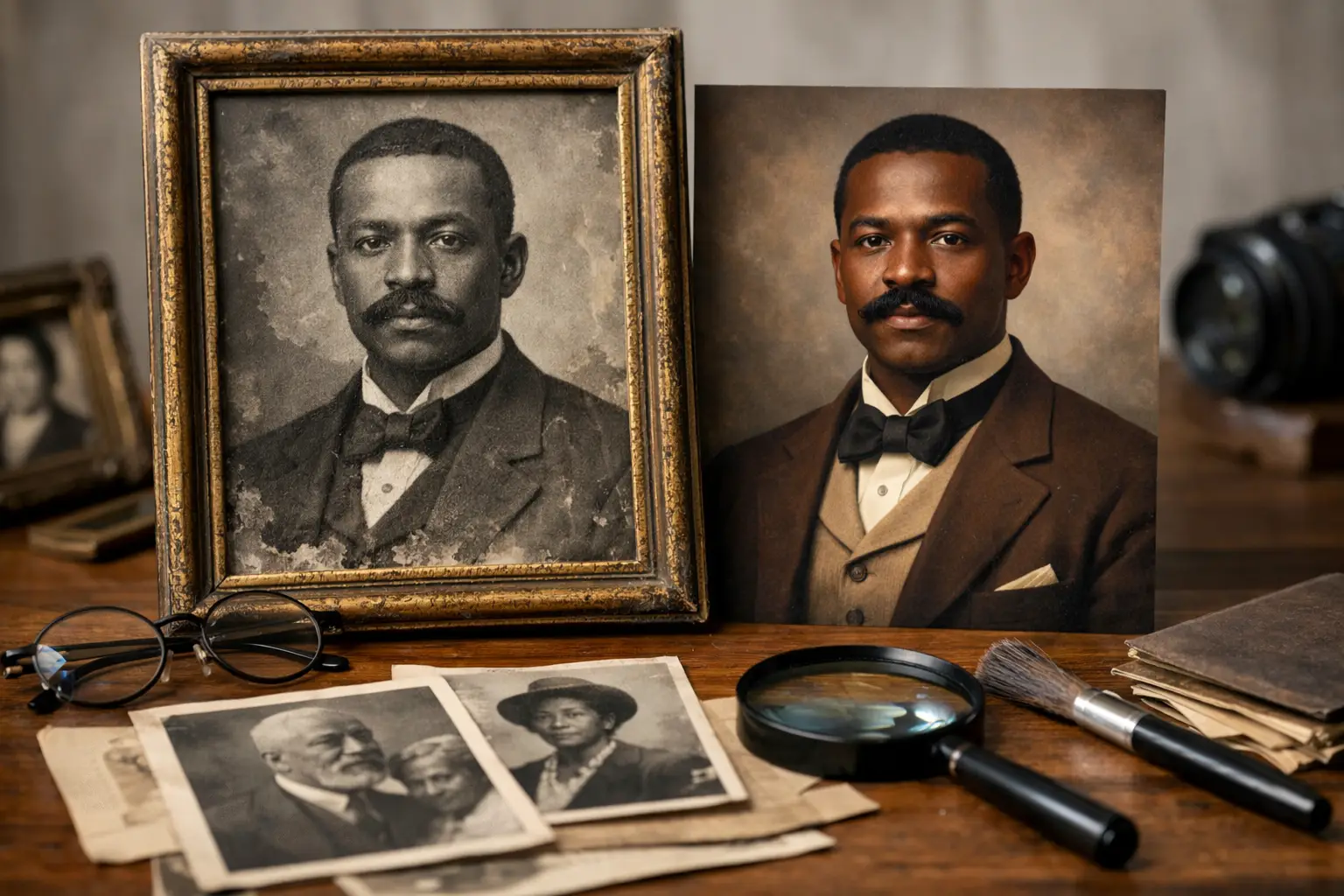
For many families, especially those tracing ancestors through slavery, Reconstruction, migration, or records that stop before 1870, there may be no surviving photograph. An AI-generated portrait cannot replace that missing photograph. It can, however, create a thoughtful historical interpretation that gives a family gathering, a research binder, or a living relative something meaningful to respond to.
The standard is not perfection. The standard is honesty: build from evidence, avoid false precision, and label the result for what it is.
What Portrait Accuracy Really Means
Accuracy has layers. Some details can be supported directly by records. Others can only be inferred from time, place, occupation, and family history. The strongest ancestor portraits keep those categories separate.
A high-confidence detail might be an ancestor's age, residence, race as recorded by a historical enumerator, occupation, marital status, military service, or whether they were free, enslaved, widowed, or living with extended family. Census records, death certificates, draft registrations, pension files, city directories, land deeds, and family Bibles can all contribute evidence.
A contextual detail is different. Clothing, hair styling, posture, a home interior, and the surrounding landscape may be historically plausible without being personally documented. If your ancestor lived in rural Lowndes County, Alabama, in 1880 and worked as a farm laborer, a polished studio gown in a mansion is not an honest choice. A modest, period-appropriate setting may be.
The least reliable details are the ones people are most tempted to treat as fact: exact facial structure, eye color, scars, jewelry, and expressions. Unless a photograph, written description, or close relative gives you evidence, these should be presented as artistic interpretation, not recovered truth.
Start With a Research Brief, Not a Prompt
Do not begin with, “Make my great-great-grandmother.” Begin by assembling a short research brief. A better input produces a more defensible portrait and can reveal where your evidence is thin.
Write down the ancestor's full name and known name variations, estimated birth year, portrait year or decade, county and state, occupation, household members, and any known physical description. Add the records behind each claim. If the person appears in the 1870 and 1880 censuses, compare the entries rather than relying on one index transcription. Ages shift. Names are misspelled. County boundaries change.
For African American research, the years immediately after Emancipation can be especially revealing. A Freedmen's Bureau labor contract may identify a plantation, employer, spouse, or children. A marriage record may preserve a relationship that slavery prevented from being formally recognized. A U.S. Colored Troops pension file can contain testimony from neighbors and relatives. These sources do more than fill out a timeline. They help you build a portrait around a real life.
If you are stuck at the 1870 brick wall, do not invent a birthplace, family surname, or antebellum residence just to make the portrait feel complete. Preserve the uncertainty. The next record may change the story.
Choose a Time and Place You Can Support
Every portrait needs a specific moment. “Late 1800s” is a broad label. “A 38-year-old woman in 1882, living near Vicksburg, Mississippi, after the birth of her third child” gives you a usable historical frame.
The date shapes clothing, photography styles, grooming, and setting. The location shapes weather, architecture, work, and access to goods. A Black schoolteacher in Richmond, Virginia, and a tenant farmer in eastern Arkansas could have lived in the same decade yet occupied very different daily worlds.
Occupation matters, too, but it should not become a costume. A domestic worker did not necessarily wear a uniform at home. A farmer may have owned one fine outfit for church, funerals, portraits, or special occasions. Ask what the record proves, then choose a setting that reflects a possible moment in that person's life.
Use Family Resemblance Carefully
Living descendants can provide useful clues, particularly when several relatives share a trait. But resemblance is not a DNA time machine. Features may skip generations, come from another branch, or be influenced by the portrait model's assumptions.
If family members contribute modern photos, use them as broad reference material rather than as a claim that an ancestor had the same face. A respectful approach is to say, “Inspired by family resemblance and historical context,” not “This is exactly what she looked like.”
Talk to older relatives before relying on appearances alone. Ask whether anyone remembers a physical description, a distinctive hairstyle, a limp, glasses, a favorite hat, or an old photograph that disappeared after a move. Record who said what and when. Family memory is evidence with limits, but it can point you toward records and artifacts you did not know existed.
Avoid the Most Common Accuracy Failures
The worst portraits do not usually fail because the image looks artificial. They fail because they turn assumptions into facts.
One common mistake is making every ancestor look wealthy, polished, and photographed in a studio. Historical dignity does not require luxury. Let their work, community, faith, migration, and family role guide the scene.
Another is collapsing historical identity into stereotype. Do not use generic “African tribal” clothing for an ancestor documented in Georgia in 1870, or place a Native ancestor in regalia without specific tribal, geographic, and period evidence. Heritage deserves more than a visual shortcut.
Be equally cautious with skin tone. Records may use racial labels that are historically significant but incomplete, inaccurate, or imposed by others. Do not treat a census category as a precise color instruction. If family photographs or close-descendant references exist, they can inform a range, but not certainty.
Finally, watch for anachronisms. Clothing, furniture, buildings, eyeglasses, hairstyles, flags, tools, and even photographic lighting can place someone in the wrong era. A polished portrait is not automatically a period-correct portrait.
A Practical Ancestor Portrait Accuracy Checklist
Before you create or share a portrait, test it against four questions:
- Can I name the record or family source behind the person's age, place, and life circumstances?
- Does the clothing and setting fit the chosen year, location, and likely social circumstances?
- Have I avoided claiming exact features that no source supports?
- Would a relative understand that this is an evidence-led interpretation, not an authenticated photograph?
If the answer to any question is no, revise the research brief. The goal is not to add more visual detail. It is to remove unsupported detail.
Label the Portrait So Future Researchers Are Not Misled
Genealogy is cumulative. A caption written today may be copied into a family tree, printed in a reunion program, or inherited by someone who never heard the original explanation. Labeling protects the work.
Use a clear caption such as: “AI-generated historical interpretation of Sarah Johnson, based on 1880 census residence, estimated age, occupation, and family research. No known photograph survives.” If the portrait uses family resemblance, say so. If the exact date is estimated, say “circa 1880” instead of assigning a false date.
Keep the research brief with the image. Save record citations, interview notes, the prompt details, and the date the portrait was generated. When new evidence arrives, update the portrait or the caption. That is not a failure. It is what careful family history looks like.
Let the Portrait Create the Next Research Question
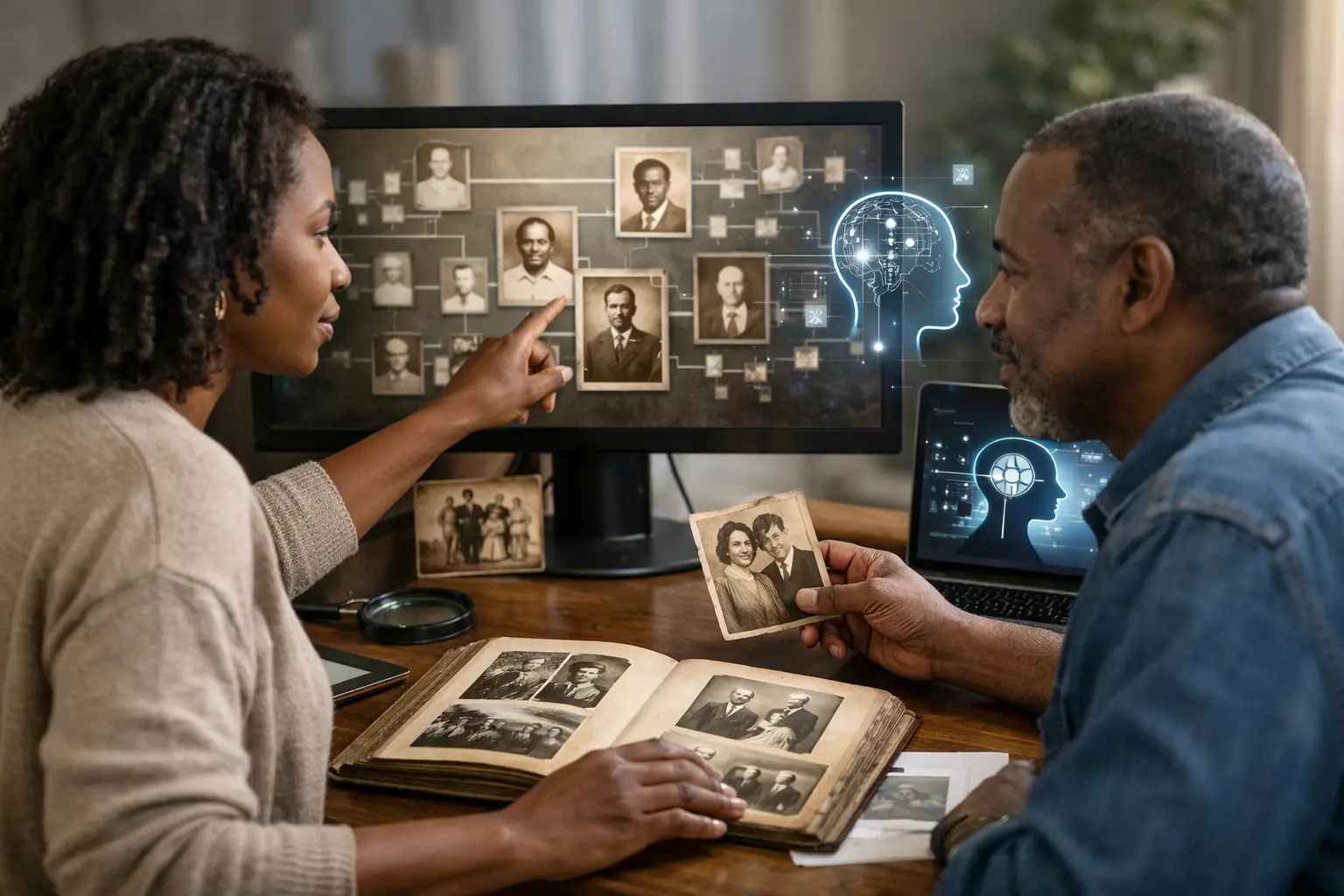
A good ancestor portrait should not end the investigation. It should move it forward. Show it to an aunt, cousin, or older neighbor and ask what it brings to mind. The answer may lead to a nickname, a church, a cemetery, an employer, a migration route, or a box of photographs in someone else's closet.
The 1870 Project can help turn those clues into the next best research action, whether that means narrowing a hub county, interpreting a DNA match, drafting a message to a relative, or finding the right federal record set to search. Your family was here. A careful portrait can honor that truth while the records help you find more of it.