Are AI Family Trees Accurate? What to Trust

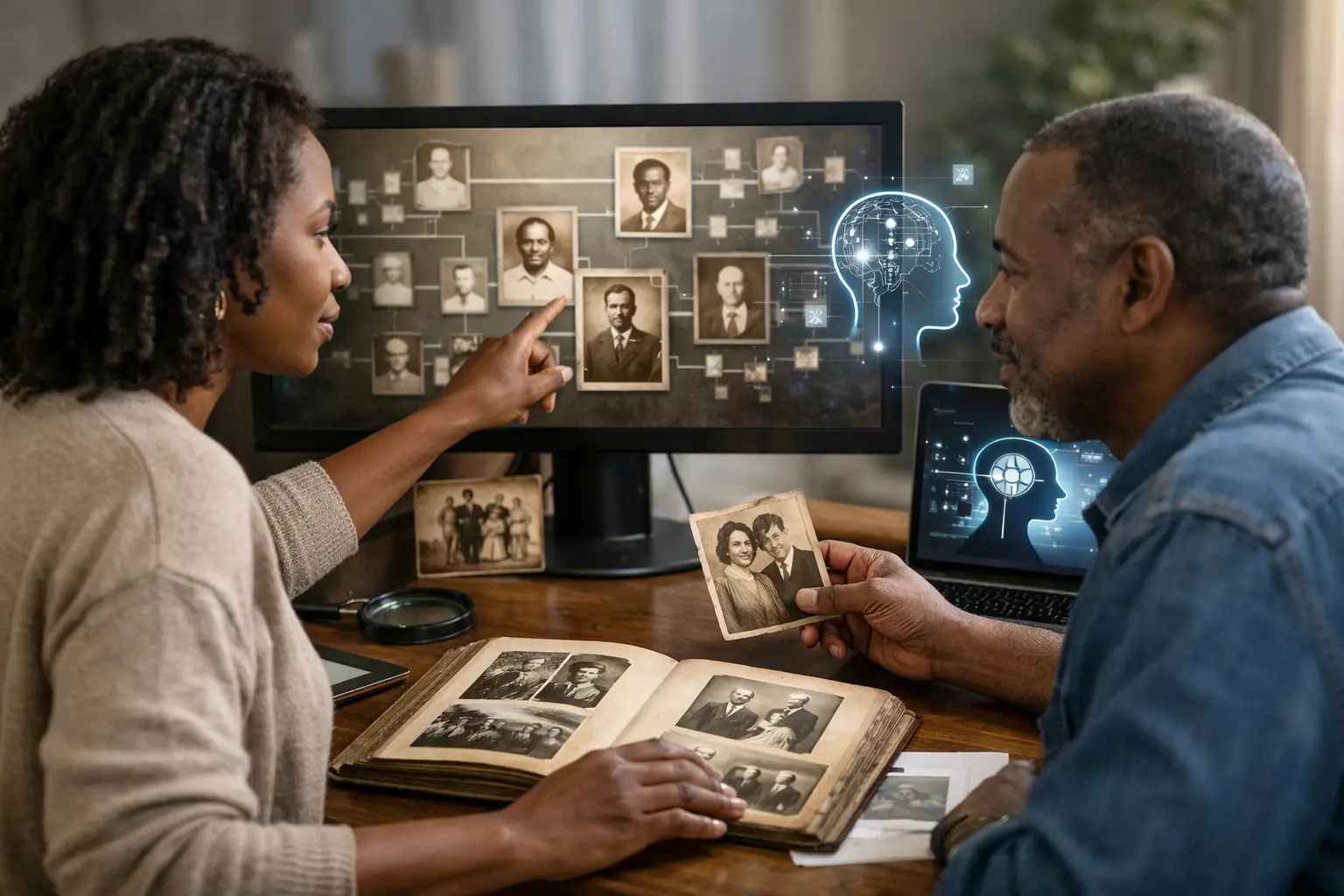
A family tree can look convincing long before it is true. A green hint, a polished timeline, and a name that matches your grandmother's story can make an AI suggestion feel like an answer. But are AI family trees accurate? Sometimes. They can be remarkably useful at finding patterns and pointing toward overlooked records. They are not proof, and they can repeat another researcher's mistake at extraordinary speed.
For families facing an 1870 brick wall, that distinction matters. A wrong parent attached before 1870 can send your research into the wrong county, the wrong plantation, or the wrong surname for years. Your family was here. The work is making sure the record trail belongs to them.
Are AI Family Trees Accurate Enough to Trust?
AI family trees are accurate when the underlying evidence is accurate, specific, and correctly connected. They are unreliable when they are built from unsourced online trees, loose name matches, or assumptions that one person with a familiar name must be your ancestor.
Think of AI as a research assistant, not a witness. It can compare dates, places, households, migration patterns, and thousands of record references far faster than a person can. That makes it excellent at generating leads. It cannot personally know whether the Sarah Johnson in a 1880 census is your Sarah Johnson, especially when several women of the same age lived in the same county.
The strongest AI output says, in effect: “Here is the next record to check.” The weakest output says: “Here is your ancestor,” without showing how it got there.
Accuracy also varies by generation. Recent relatives often leave a fuller paper trail: birth records, obituaries, city directories, yearbooks, and death certificates. Earlier generations, rural families, immigrants, women whose names changed through marriage, and formerly enslaved people may appear in fragmented or inconsistent records. Those are exactly the cases where an AI system needs careful human verification.
What AI Does Well in Genealogy
Used correctly, AI can give stalled research real momentum. It is especially good at handling the tedious comparison work that causes many researchers to miss useful clues.
AI can identify likely spelling variations, including names distorted by handwriting, transcription errors, accents, and census takers. It can spot that “Eliza,” “Liza,” and “Elizabeth” may be worth investigating together, or flag that a family moved between neighboring counties after the Civil War. It can also organize a confusing set of census households into a timeline that exposes a possible relationship.
It is useful for reading difficult documents, too. A handwritten deed, pension file, Freedmen's Bureau labor contract, probate record, or newspaper notice may contain a name that never appears in a standard family tree search. AI transcription can make those documents more searchable, although the original image must still be checked. One misread letter can turn Green into Grant or Bell into Hall.
DNA-assisted AI can be valuable when it translates match data into a research path. The practical question is not simply, “Who is this DNA match?” It is, “Which shared ancestor, county, and record group can explain this cluster?” A useful tool should move you toward a hub county, a census district, a court record, or a federal microfilm collection. The 1870 Project is built around that kind of next-step guidance, including DNA directions that point researchers to concrete archives rather than leaving them with a list of unexplained matches.
Where AI Family Trees Go Wrong
The biggest risk is false confidence. AI can present a relationship with clean dates and a professional-looking layout even when the connection rests on one weak assumption. The format feels certain. The evidence may not be.
Online family trees are a common source of errors because they can copy from one another. If one tree attaches the wrong William Carter to the wrong parents, dozens of trees may repeat it. An AI system trained or informed by those trees may treat repetition as a signal of credibility. It is not. Ten copies of an unsupported claim are still one unsupported claim.
Name matching creates another problem. Genealogy is full of people with identical names, especially within the same extended family. A father, son, uncle, and cousin may all be named James Brown. AI may correctly find records for James Brown but incorrectly combine them into one life. Watch for impossible overlaps: two residences in distant states in the same year, children born decades apart, or a person listed as both deceased and active in later records.
Historical context can also be misused. Context helps you form better questions, but it cannot prove identity. For example, an AI tool might recognize that a Black family lived in a county near a particular former plantation in 1870. That is a meaningful lead. It does not prove that family was enslaved there. Proof may require plantation papers, probate records, deeds, tax lists, Freedmen's Bureau files, Southern Claims Commission records, or testimony from people who knew the family.
How to Verify an AI Suggestion Before Adding It
Treat every suggested parent, spouse, or child as a claim that needs evidence. Before adding it to your working tree, ask whether the records agree on the details that matter: age, birthplace, residence, spouse, children, occupation, neighbors, and timing.
Start with the closest reliable record and work backward one generation at a time. If a death certificate names parents, remember that the informant may have been mistaken. Use it as a clue, then look for supporting evidence such as a marriage license, census household, obituary, probate file, or cemetery record.
For a proposed parent-child relationship, aim for more than a shared surname. Look for a chain of evidence. A child appears in the parent’s household, later lives near known siblings, names a likely relative in a marriage record, and shares DNA with descendants of that family. No single clue has to carry the whole case.
When you find conflicting records, do not force a choice just because the AI selected one. Create a research note that states the conflict plainly. Two men may be candidates. A woman's maiden name may remain unproven. That is not failure. It is honest genealogy, and it keeps a guess from hardening into family fact.
A quick evidence check
A strong AI lead usually has three qualities: it names the source, it fits the known timeline, and it can be tested against an independent record. If the suggestion lacks all three, keep it in a “possible” folder rather than placing it as a fact in your tree.
Original records generally carry more weight than compiled trees. A contemporary marriage record is usually stronger than a modern online profile. Still, originals are not flawless. Ages were estimated, names were misspelled, and informants did not always know the answer. The goal is not to find a perfect document. It is to build the most defensible case from records that agree.
Special Care at the 1870 Brick Wall
For African American research, 1870 is often the first federal census that lists formerly enslaved people by name. That makes it a critical starting point, not a finish line. AI can help identify candidate households and nearby surnames, but it cannot bridge the gap to slavery-era records by itself.
Work outward from the 1870 household. Track every neighbor, witness, godparent, land buyer, and person with the same unusual first name. Follow the family through 1880, 1900, and later censuses. Find marriages, deaths, military pensions, church records, and Freedmen's Bureau documents. Then study the county before and after Emancipation: probate cases, estate inventories, deeds, tax records, labor contracts, and local court files.
This is where precision matters more than a giant tree. The right county can change everything. So can one estate file that names a mother, a child, or a sibling group. AI should narrow the search and reveal overlooked connections. The records must carry the conclusion.
Let AI Speed Up the Work, Not Replace It
The best use of AI is not handing over your family history and accepting whatever comes back. It is asking better questions, moving faster through difficult material, and knowing exactly what to verify next.
Save the AI's suggestion, record why it was made, and attach the documents that support or challenge it. Talk to living relatives while you can. Ask who lived nearby, which church the family attended, what nickname an elder used, and where people were buried. A single remembered place name can be more valuable than a hundred automated hints.
Your family tree deserves more than a plausible answer. Use AI to find the door, then let records, DNA, and family memory show you who was truly waiting on the other side.