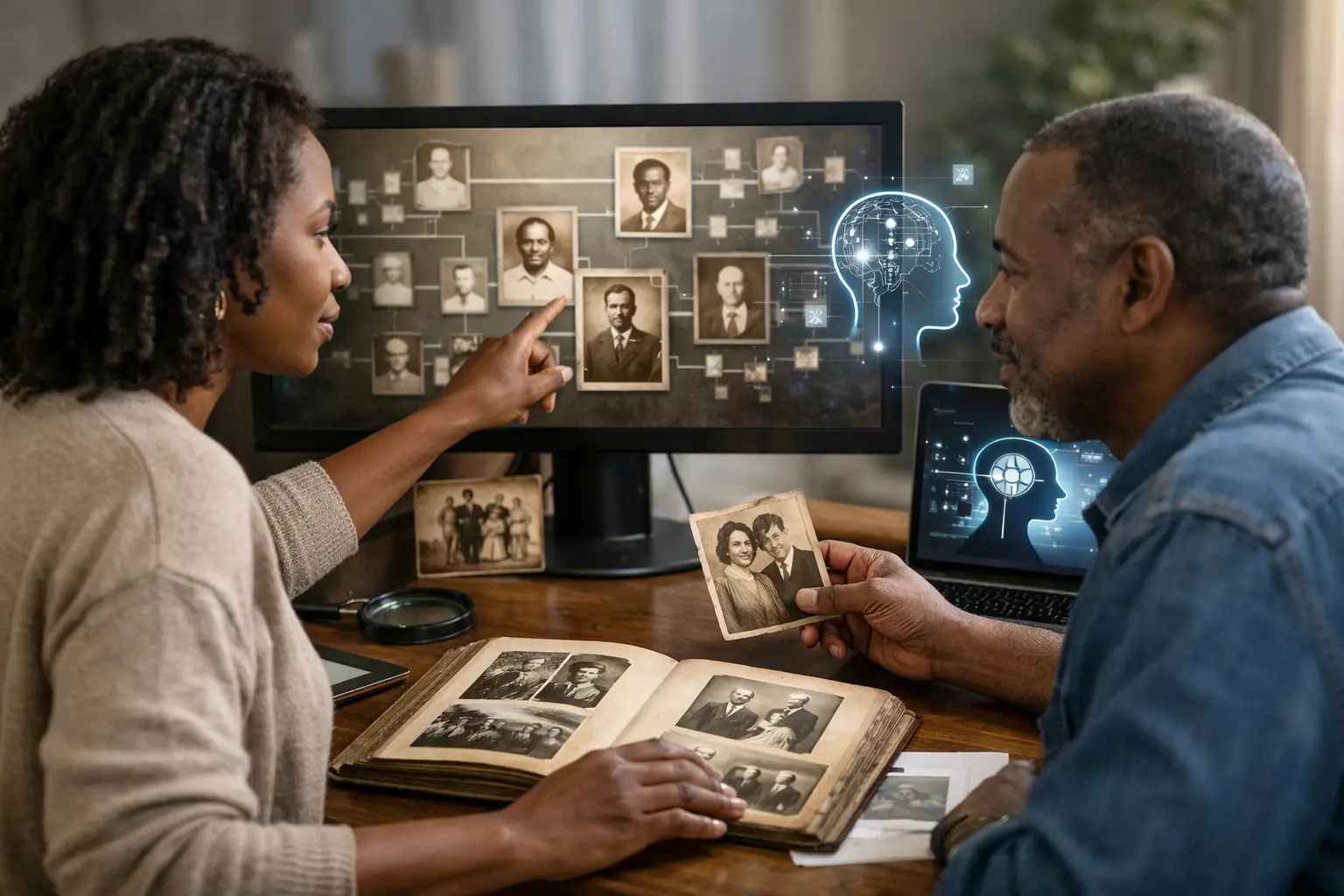
How AI Family Tree Search Finds More

You do not need another giant record dump. You need the next right move. That is the real promise of ai family tree search - not more hints, more tabs, or more guesswork, but a clearer path to the person you are actually trying to find.
For many families, that difference matters most where genealogy gets hard. A surname changes. A county line shifts. An ancestor appears in 1870 and seems to vanish before it. A DNA match looks promising, but no one can tell you what to do with it. Traditional family tree tools often leave people with thousands of records and very little direction. AI can help, but only when it is trained to think like a research assistant, not a suggestion engine.
What ai family tree search should actually do
A useful ai family tree search does more than autocomplete names. It should narrow possibilities, connect scattered evidence, and point you toward records that fit the family, place, and period you are researching.
That sounds simple. It is not. Genealogy is full of messy data. Census ages drift. Spellings change. Enslaved ancestors may appear without stable surnames before Emancipation. Relatives repeat the same first names across generations. If an AI system treats every record like clean modern data, it will produce clean-looking wrong answers.
The better approach is probabilistic and historical. It weighs geography, household structure, naming patterns, migration routes, military service, postwar labor contracts, probate records, and local archive coverage. It asks a more useful question: given what we know, what source is most likely to move this case forward?
That is the shift people need. Not just who might match, but what to search next.
Where ai family tree search saves the most time
The biggest benefit is speed with structure. Instead of spending hours searching every database you can think of, AI can reduce the search field and help you start where the evidence is strongest.
If you are tracing a family in Georgia, for example, a good system should not simply tell you to search Georgia records. It should identify the county cluster where your surname appears most often near known relatives, flag nearby counties with high migration overlap, and surface the federal or state collections most likely to contain the household. If DNA is involved, it should connect match networks to specific places rather than leaving you with a centimorgan chart and a headache.
This matters even more for the 1870 brick wall. For many African American families, 1870 is the first census where formerly enslaved ancestors appear by name in a nationwide federal record. Searching backward from that point requires precision. Broad hints are not enough. You need county-level reasoning, likely slaveholding connections, Freedmen's Bureau paths, labor contract clues, and often exact archive references. That is where AI can be powerful if it is built for historical recovery, not entertainment.
The difference between smart guidance and bad automation
There is a reason some researchers are skeptical. They should be. Not all AI family tree search tools are good, and some create more confusion than progress.
The weak version of AI genealogy feels impressive for five minutes. It generates a tidy ancestor profile, offers a few shaky record matches, and speaks with far more confidence than the evidence deserves. That is dangerous in family history. A wrong parent attached to your tree can spread for years. A fabricated migration story can sound believable enough to distract you from the real paper trail.
The strong version works differently. It shows its logic. It keeps uncertainty visible. It distinguishes between a likely lead and a proven identity. It does not treat family history like a content-generation exercise. It treats it like a research problem with emotional weight.
That trade-off matters. Speed is useful, but not if it sends you down the wrong branch.
What to look for in an ai family tree search tool
Start with the basics. The tool should search across multiple collections, not trap you inside one closed database. It should handle misspellings, nicknames, and changing places. It should understand that "Jinny," "Virginia," and "Jennie" may point to the same person in different records.
Then look at what happens after the search. This is where most platforms fall apart. A strong tool should help interpret results, rank them by actual relevance, and tell you what each record changes about your hypothesis. If it can use DNA, even better - but not in a vague way. The useful version translates DNA clusters into archival direction. It helps answer where to search, which county to prioritize, and what records might connect the match group to the ancestor line.
Privacy matters too. Family research often involves living relatives, sensitive discoveries, and inherited trauma. Any modern genealogy platform should be explicit about how data is used. If a company is vague about uploads, DNA handling, or message content, that is not a small detail. That is the whole trust equation.
And finally, look for a tool that respects your pace. Subscriptions can pressure people to race through research. Credit-based access or free search options often fit genealogy better because family history is rarely linear. Some weeks you make a breakthrough. Some weeks you need time to think.
AI family tree search and the records barrier before 1870
This is where the conversation gets real. Many Americans can build a tree back through censuses, obituaries, and vital records with enough patience. But for descendants of formerly enslaved people, the path often breaks sharply before 1870. That is not a research failure. It is a record system built around bondage, displacement, and incomplete documentation.
An AI family tree search tool worth using should recognize that history instead of flattening it. It should know that the search before 1870 may require different records entirely - Freedmen's Bureau field office records, labor agreements, marriage records, bank documents, plantation papers, county probate, tax lists, military service, refugee records, and local court material. It should help connect a named person in 1870 to the web of records that might surround them before that census.
That is a different standard than most genealogy sites meet. It requires more than record access. It requires research strategy.
This is one reason platforms like The 1870 Project stand apart. The goal is not to overwhelm you with documents. The goal is to give you the next best search action, the archive trail, and when possible, the record set worth checking. For families facing the 1870 wall, that level of specificity is the difference between inspiration and evidence.
When AI helps, and when you still need human judgment
AI can accelerate pattern recognition. It can compare record variants faster than any person. It can flag county migrations, spot household repeats, organize relatives for outreach, and turn a confusing DNA cluster into a working theory. All of that is real value.
But family history still needs judgment. You need to notice when two same-named men lived ten miles apart at the same time. You need to recognize when a family story may be emotionally true but factually off by one generation. You need to read a record in historical context, especially when race, status, and law shaped how people were documented.
So the right question is not whether AI replaces genealogy. It does not. The better question is whether it helps you research with more accuracy and less wasted motion. The best tools do.
How to use ai family tree search well
Start narrow. One ancestor, one time window, one location. If you begin with a giant tree and twenty open questions, even good AI will produce muddy output. Give it a target person and a specific problem: find this woman in 1880, identify the county tied to these DNA matches, or determine which records are most likely to connect this 1870 household to earlier documentation.
Next, treat every result as a lead with a confidence level. Some matches will be strong because names, ages, relatives, and places align. Others will be suggestive but incomplete. Keep the difference clear. Good research moves by accumulation, not by wishful clicking.
Then use AI for the parts that usually stall people out. Ask it to compare alternate spellings, draft a message to a cousin match, extract place clues from a census cluster, or suggest which archive set to search next. Those are high-value tasks because they convert confusion into action.
Most of all, choose a system that gives momentum. Your family was here. The records may be scattered, misindexed, or hard to interpret, but that does not mean the trail is gone. The right AI family tree search tool does not pretend the work is easy. It helps you make the next precise move - and sometimes that is exactly what gets a lost branch of your family back into view.