Manual Genealogy Versus AI Research: What Works?
A faded death certificate names a mother you have never seen in a census. A DNA match shares 87 centimorgans but no family tree. A relative says, “My grandmother came from somewhere near Vicksburg.” This is where manual genealogy versus AI research becomes a real question, not a technology debate.
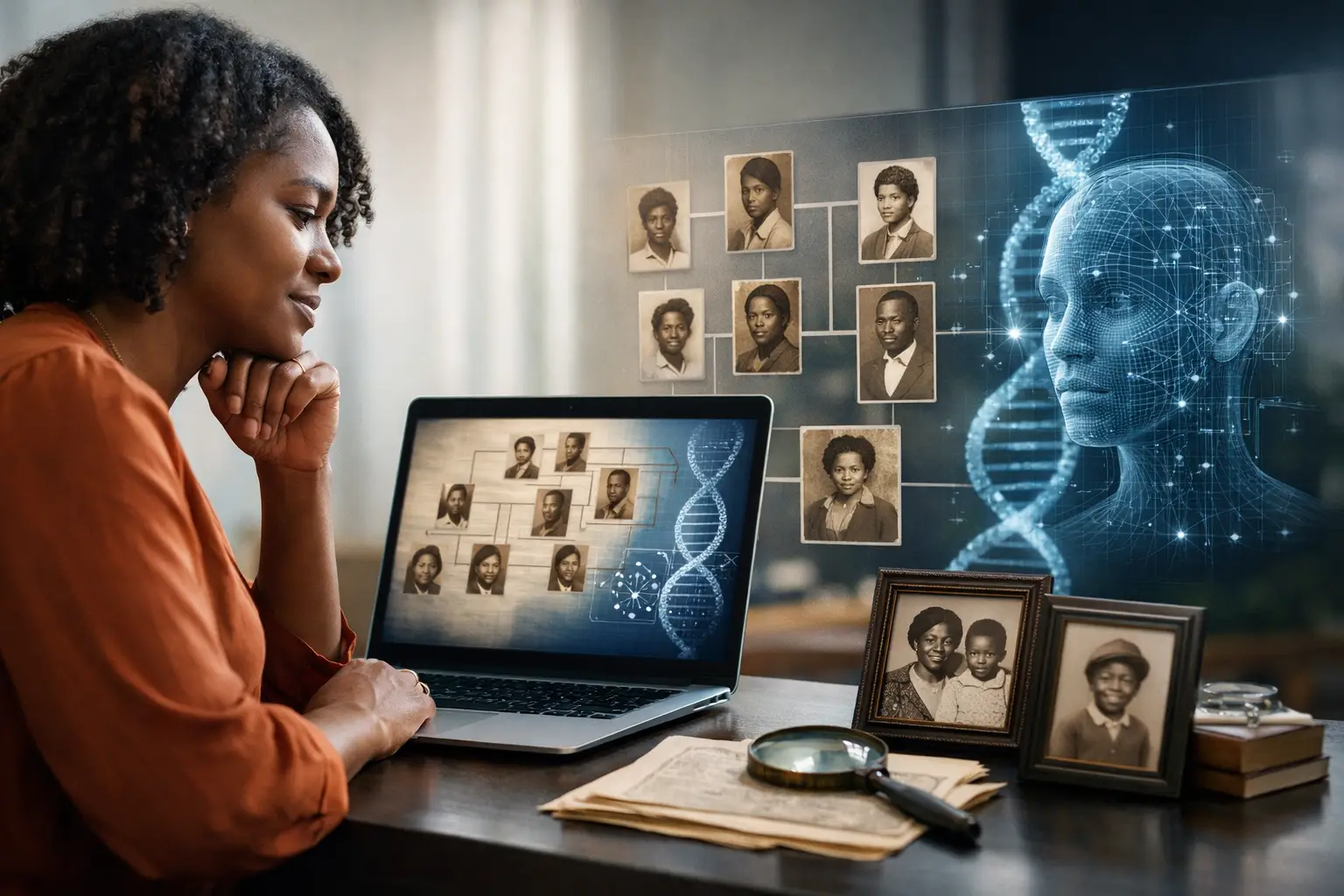
Your family was here. The work is figuring out which clue deserves your next hour, which record collection can answer it, and when a promising lead is only a coincidence. Manual research gives you judgment built through careful reading. AI can reduce the time between a clue and the next best search action. The strongest family histories use both.
What Manual Genealogy Still Does Best
Manual genealogy is not simply typing a name into a database and saving the first tree that appears. It is the disciplined work of comparing records, noticing contradictions, tracking changing county lines, and asking whether two people with the same name are actually the same person.
That judgment matters most when the records are messy. Census enumerators misspelled names. Ages moved by five or ten years. A woman may appear under her maiden name, a first husband’s surname, or the surname of a household she joined after emancipation. A man listed as “colored” in one record might be indexed differently in another. No search tool can treat a record as proof merely because the spelling looks familiar.
Manual research also keeps the human context in view. A land deed can reveal neighbors who were once connected through an enslaver’s estate. A marriage record can establish a surname adopted after the Civil War. A probate file can identify children who were separated across households. These records require more than extraction. They require interpretation.
For researchers working beyond the 1870 Census, patience is especially valuable. The first federal census after emancipation often provides the first broad, searchable snapshot of formerly enslaved people using their own names. Before that point, a family may be hidden in slave schedules, estate inventories, labor contracts, Freedmen’s Bureau records, military files, church registers, or county court papers. There is rarely one document that solves the question. The answer is usually a chain of evidence.
Manual work is also essential for verifying any result, whether it came from a cousin, a database hint, or an AI-generated research path. Read the original image when possible. Record the repository, date, place, and names exactly as written. Keep a research log that says not only what you found, but what you ruled out. That is how a family story becomes defensible history.
Where Manual Research Loses Momentum
The problem is not that traditional methods are wrong. The problem is that they often ask you to do too much sorting before you know where to look.
A search for a common surname can return thousands of records. A county may have changed boundaries three times during your ancestor’s lifetime. DNA match lists can feel like a wall of names, centimorgan totals, and unfamiliar family trees. Federal archives hold extraordinary material, but knowing that a record group exists is different from knowing which microfilm publication and county you need.
This is where researchers lose months. They jump between census records, online trees, social media groups, and paid databases, hoping a new search will produce a missing parent or birthplace. The work becomes repetitive. Worse, the pressure to make progress can lead to attaching the wrong person just because the name, age, and state almost fit.
Manual genealogy asks a valuable question: “What does this record prove?” But it can leave beginners stuck on the question that comes before it: “What record should I search next?”
How AI Research Changes the Next Step
AI research is most useful when it acts as a research assistant, not an authority. It can organize clues across records, recognize name variations, identify geographic patterns, and turn an overwhelming DNA-match list into concrete archival directions.
Instead of giving you 400 loosely related results, a well-designed AI workflow should narrow the field. It might identify hub counties shared by several DNA matches, suggest that a surname appears repeatedly near a known ancestor, or point you toward a Freedmen’s Bureau field office serving the community your family lived in. The useful output is not “Here are more records.” It is “Search this place, this collection, and this family cluster next.”
For an 1870 brick wall, that precision can matter. If DNA connections repeatedly lead to families in one Mississippi county while your known ancestor first appears in Louisiana in 1870, that is not proof of a birthplace. It is a focused lead. You can then examine migration routes, labor contracts, probate records, military service files, and nearby households rather than searching every Southern state at once.
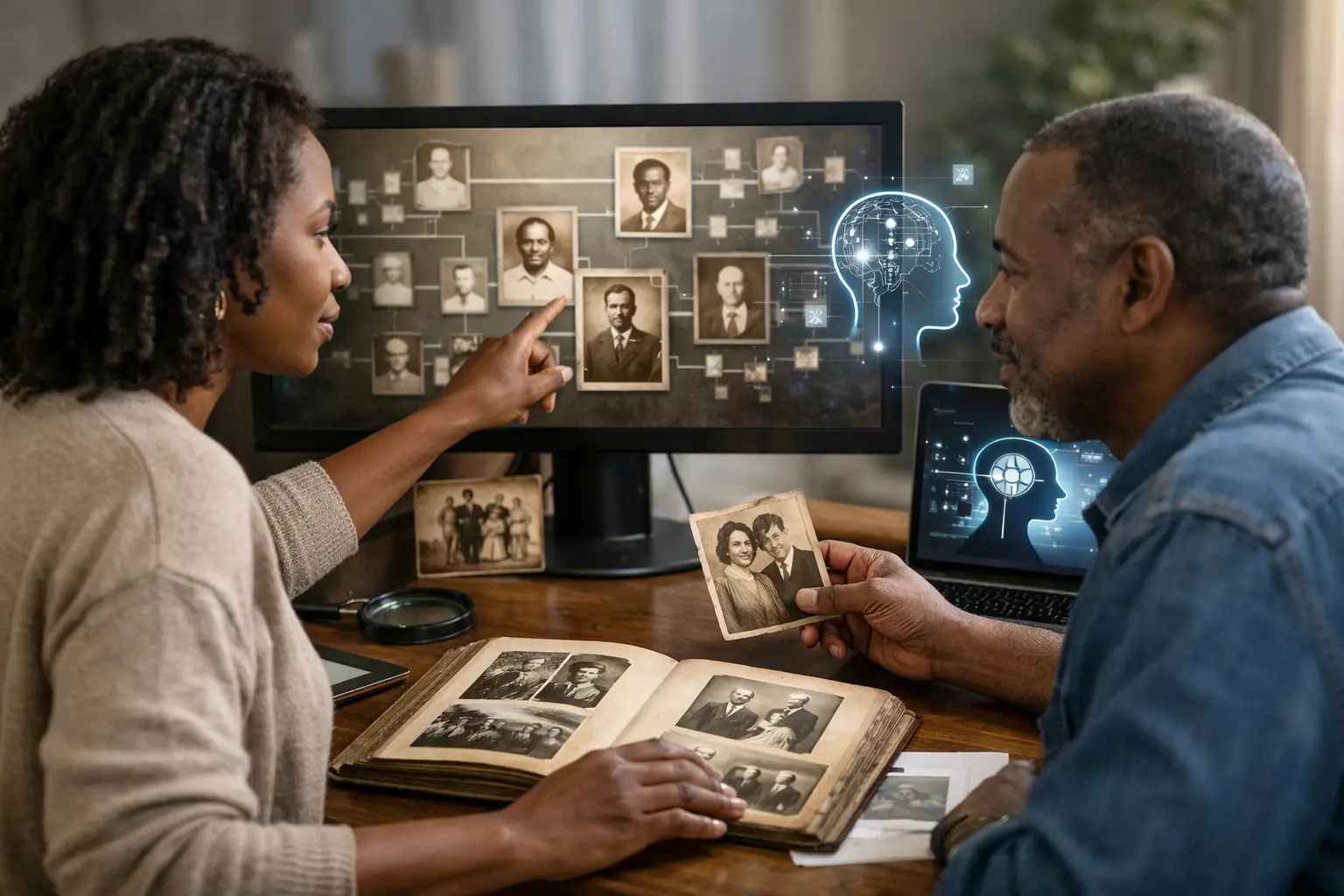
AI can also help preserve living memory while it is still available. A relative may not know exact dates, but they may remember a church, a nickname, a town cemetery, a family reunion, or the name of the person who kept the photographs. AI-guided interview questions can turn a vague conversation into usable research clues, while respectful outreach drafts make it easier to reconnect with DNA matches and older relatives.
The 1870 Project is built around this kind of momentum. Its research tools are designed to translate difficult evidence into a next action, including likely counties and the federal record sets to check, rather than leaving you with another pile of hints. That matters when the record trail is thin and every search needs to count.
Manual Genealogy Versus AI Research Is Not an Either-Or Choice
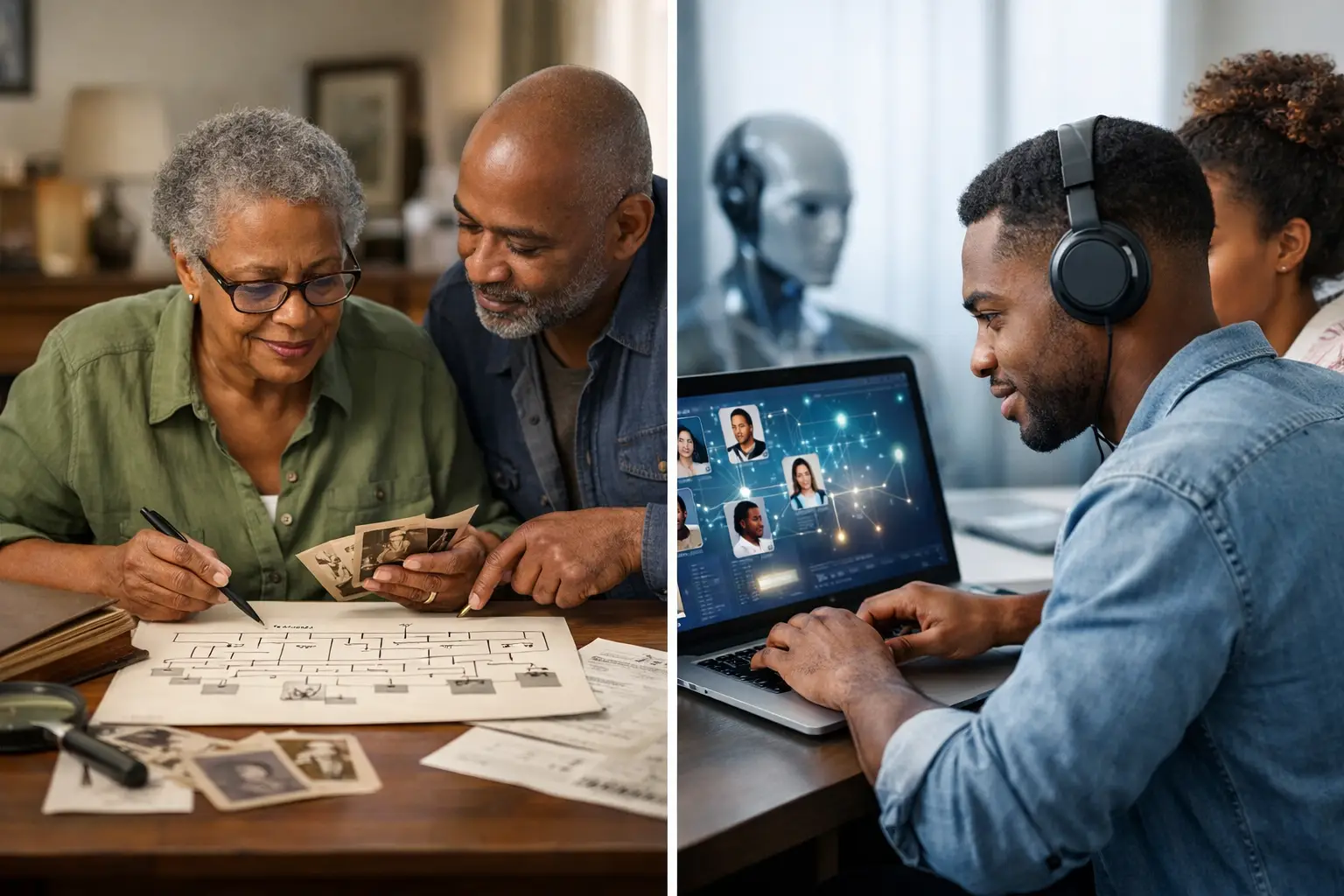
The best division of labor is simple: let AI handle scale and pattern detection; let the researcher handle proof, context, and care.
AI can compare many possible spelling variations faster than a person. It can surface a cluster of matches connected to the same county. It can explain what a DNA relationship range might mean and suggest records associated with that family network. These tasks reduce friction, especially for beginners who do not yet know how county courts, federal record groups, or collateral relatives fit into a research plan.
But AI cannot responsibly decide that an ancestor is yours without evidence. It does not sit with the ambiguity of a record where ages conflict, names change, and two nearby households could fit the same theory. It may miss local history, transcription mistakes, or the fact that a county was created after the event you are researching. It can make a plausible statement sound more certain than the evidence allows.
That is why every AI suggestion should be treated as a hypothesis. Ask three questions: What evidence supports this? What record could confirm or challenge it? What alternative explanation still fits the facts? If the answer rests only on a name match or an unsourced online tree, keep looking.
A Smarter Research Workflow
Start manually with what you know. Write down names, nicknames, places, approximate dates, family stories, photographs, obituaries, and DNA results. Separate facts you have seen in an original record from stories you have heard but have not yet verified. This prevents an old family assumption from becoming an unexamined “fact” in every future search.
Then use AI to turn the gaps into targeted questions. If you know your great-grandmother was born around 1882 in Arkansas but cannot identify her parents, ask for likely record sets based on her age and location. If a DNA match may descend from her brother, ask what shared-match patterns and county clusters would strengthen that theory. If your ancestor appears in 1870 but disappears in 1860, ask what post-war records could connect the two periods.
Return to the documents. Read the image, not just the index. Study neighbors, witnesses, bondsmen, informants, and people listed on the same page. Genealogy is rarely solved by direct ancestors alone. Siblings, in-laws, former neighbors, and people buried in the same cemetery often carry the evidence your direct line does not.
Finally, document the result in plain language. Write why you believe the connection is correct, what supports it, and what remains uncertain. A good conclusion does not hide the gaps. It gives the next generation a clear path to continue.
The goal is not to replace the careful work that honors your family. It is to stop wasting your time on searches that go nowhere. Use every tool available, verify what matters, and follow the evidence one precise step at a time.