Why Are DNA Matches So Confusing? Start Here

A DNA test can deliver a startling result: hundreds of matches, a few labeled “close family,” and almost no explanation of how any of them fit. If you are asking why are DNA matches confusing, the short answer is that DNA provides evidence of connection, not a ready-made family tree. The longer answer is where real progress begins.
A match list is not a verdict on your identity or your ancestor. It is a set of clues shaped by inheritance, incomplete records, family migrations, and the choices other testers have made about their trees and privacy. For families separated by slavery, adoption, migration, name changes, or missing records before 1870, those clues can feel especially hard to use. But confusing does not mean useless. It means the next step must be more precise.
DNA Measures Shared Segments, Not Family Stories
DNA testing companies compare segments of your DNA with another tester’s DNA. When enough DNA appears to be shared, the company estimates a relationship range: perhaps second cousin, first cousin once removed, half first cousin, or another possibility.
That range is the first source of confusion. The same amount of shared DNA can fit several relationships. A person sharing 425 centimorgans with you may be a half first cousin, a first cousin once removed, a great-aunt or great-uncle, or another relative in a similar range. Centimorgans measure the likelihood of inherited DNA, not the exact title of the relationship.
Generations also matter. A match may be close genetically but sit in a different generation. If the match is much older than you, their position in the family may look very different from a match who is your age. Before assigning anyone a place on your tree, compare shared DNA, estimated age, known locations, and the names appearing in both families.
Why Are DNA Matches Confusing When the Numbers Look Clear?
The number beside a match can feel definitive. It is not. It is a useful constraint, which is different from an answer.
Inheritance is uneven. You receive roughly half of each parent’s DNA, but you do not receive an equal share from every grandparent, great-grandparent, or earlier ancestor. One second cousin may share a substantial amount of DNA with you; another legitimate second cousin may share very little or no detectable DNA at all.
That is why a missing match does not disprove a family line by itself. It may simply mean that the segment connecting you to that ancestor was not passed down in both branches. Conversely, a strong match does not tell you which ancestor created the connection until you place that match within documented family groups.
Relationship labels add another layer of false certainty. “Fourth cousin” is an estimate based on a broad statistical pattern. It should guide your research radius, not dictate the exact relationship. Treat the label as a starting point: likely common ancestors may be three to six generations back, depending on ages and family structure.
Endogamy Can Make Distant Relatives Look Close
For many African American, Native American, Appalachian, Acadian, Jewish, island, and rural communities, families lived and married within a relatively connected population over generations. Genealogists call this endogamy.
When ancestors share more than one ancestral path, DNA can accumulate. A match may appear closer than the most obvious paper relationship because you are related through several lines. For descendants of formerly enslaved people, this can happen within communities shaped by forced migration, plantation networks, postwar reunification, and marriages among neighboring families.
Endogamy does not make DNA research impossible. It changes the method. Instead of trying to force one match into one relationship, look for repeating surnames, counties, churches, plantations, and clusters of shared matches. The question becomes: which community connects these people?
A match cluster tied to the same county can be more valuable than a supposedly precise cousin label. If several matches trace to Edgefield County, South Carolina, for example, that county may point you toward the right 1870 households, Freedmen’s Bureau field office records, marriage records, probate files, or federal microfilm series.
Your Best Matches May Have No Tree at All
A DNA match without a public tree is not a dead end. It is an incomplete lead.
Some people test for ethnicity estimates and never build a tree. Others keep their results private, use a nickname, or know only part of their family history. This is common, and it is especially understandable when a family has experienced adoption, estrangement, racial passing, or painful discoveries.
Start with what is visible: the match’s shared DNA amount, shared matches, reported surnames, earliest known locations, and testing profile details. Then compare their shared-match cluster with people who do have trees. One well-documented cousin can often identify a whole branch that otherwise looks anonymous.
When you reach out, be specific and respectful. Do not open with “How are we related?” Ask whether they recognize a surname, town, cemetery, church, or grandparent’s name. Explain what you know, what you are trying to confirm, and why the connection may matter. A thoughtful message gives someone a reason to respond.
Shared Matches Are More Useful Than a Long Match List
A list of 20,000 matches creates noise. Shared matches create structure.
If Match A and Match B both match you and each other, they may belong to the same ancestral branch. That does not prove they share the same exact ancestor with you, but it gives you a working group to investigate. Add known relatives to that group when possible. A cousin you have already placed on your maternal side can help separate maternal matches from paternal ones.
Build small clusters around your strongest unexplained matches. Record the shared centimorgans, likely age range, surnames, places, and any family-tree details. Then ask one practical question: what location appears most often?
That location should shape the next archival search. DNA is most powerful when it points you toward records: a county in the 1870 Census, a Freedmen’s Bank branch, a Bureau labor contract, a death certificate, a probate file, or a marriage record. The goal is not to collect more DNA screenshots. The goal is to identify people in records.
The 1870 Brick Wall Makes DNA Feel Harder
For many Black families, the 1870 Census is the first federal census after Emancipation to list formerly enslaved people by name. Before that, enslaved ancestors may appear only as age and sex in slave schedules, or indirectly in probate inventories, wills, deeds, tax records, plantation papers, and court files.
DNA can bridge the gap, but it cannot erase the historical gap. A match may descend from the same enslaved community, from an enslaver’s family, from a neighboring free Black family, or from a later marriage between connected households. That is why a surname match alone is never enough.
Work outward from the first confirmed postwar household. Identify neighbors in 1870 and 1880. Track witnesses on marriage records, godparents in church registers, land buyers, and people with the same birthplace patterns. Then compare those names and counties against your DNA clusters. The strongest conclusions come when genetic evidence and archival evidence point in the same direction.
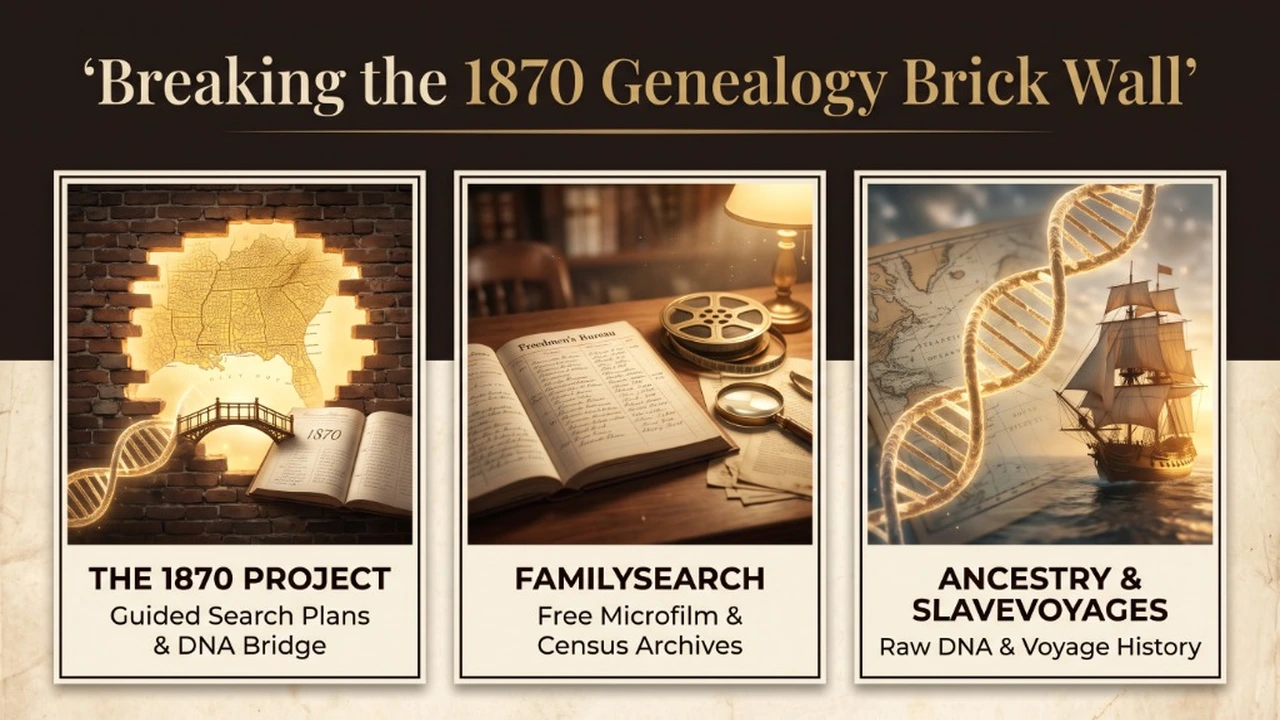
This is the kind of work The 1870 Project is designed to support: translating a DNA clue into a next research action, including a likely county and the collections worth checking.
A Better Way to Read a Confusing Match
Do not ask a single DNA match to answer every question at once. Ask it to do one job.
A close match may help identify a parent or grandparent. A cluster of moderate matches may identify a county or community. A distant match with a detailed tree may reveal an ancestral surname. A match who shares a rare ancestor location may tell you which courthouse, archive, or census page to search next.
Keep a research log that separates facts from theories. Facts include shared DNA totals, census entries, dates, and direct statements from relatives. Theories include possible relationship paths and suspected common ancestors. Labeling the difference protects you from building a beautiful tree on a guess.
Be prepared to revise. A new match, a corrected tree, or an older relative’s memory can change the picture. Revision is not failure. It is how careful family reconstruction works.
Your DNA matches are confusing because they carry fragments of a family story that records often interrupted or obscured. Give each fragment a place, test it against the archive, and follow the county, names, and community it reveals. Your family was here. The evidence is waiting to be connected.