Why Can't I Find Ancestors Before 1870?
The question “why can't I find ancestors before 1870” usually does not mean your family disappeared. It means the records changed, the names changed, or the place you need is hiding behind a county line, a former enslaver’s estate, or a document nobody told you to search. Your family was here. The work is finding the record system that captured them.
For many African American families, 1870 is the first federal census after Emancipation to list formerly enslaved people by name. That makes it a powerful starting point - and a painful wall. Before 1870, people were often recorded as property in another person’s records, listed only by age and sex on slave schedules, or documented in papers filed far from the family home. The answer is not to search harder in the same census box. It is to build a trail that points beyond it.
Why can’t I find ancestors before 1870 in the census?
The 1870 census is not a clean beginning. Census takers misspelled names, used nicknames, recorded incorrect ages, skipped households, and sometimes wrote down information supplied by a neighbor rather than the family itself. A person born as Mary may appear as Maria, Polly, or a middle name. A man listed as 35 in 1870 may be 42 in 1880 and 50 in 1900. Treat ages as estimates, not fixed facts.
Before the Civil War, enslaved people were generally not named in the federal census. The 1850 and 1860 slave schedules recorded enslavers and counted enslaved people by age, sex, and color. Those schedules can support a theory, but they rarely prove identity on their own. A 12-year-old Black girl in one household could be your ancestor, or one of several people who fit that description.
Free Black families may appear by name before 1870, especially in Northern states and some Southern communities. But they still encountered inconsistent spelling, shifting racial labels, changing jurisdictions, and incomplete local records. Native American, Hispanic/Latino, and immigrant families can face parallel problems: tribal and federal records may use different names, borders and county boundaries may change, and a surname may have been translated, abbreviated, or replaced.
The key is to stop asking whether a single record gives you the answer. Ask whether several records point to the same person, place, family group, and timeline.
Start with 1870, then work backward with proof
Your best chance of crossing the 1870 brick wall begins after 1870. Build the most complete profile possible for the person you can identify in that census. Record every detail: full name as written, age, birthplace, occupation, literacy, household members, nearby households, and county.
Then follow that person forward. The 1880 census is especially valuable because it names each person’s relationship to the head of household and often gives the birthplaces of both parents. Death certificates, marriage licenses, obituaries, cemetery records, military files, and the records of children can add clues that the 1870 census does not contain.
A death certificate may name parents, though the informant may have been wrong. A marriage record may show a prior surname or a parent’s name. An obituary may identify siblings who moved to another state and left a clearer trail. No single document deserves blind trust. Agreement across independent records is what creates confidence.
Pay close attention to neighbors. Families often stayed near siblings, parents, in-laws, former community members, or people connected to the same plantation or farm. If several Black households in the 1870 census were born in the same state, lived beside each other, and later married across those households, they may have shared a prewar connection.
The county is often the breakthrough
When people get stuck, they search a surname nationwide. That produces thousands of weak hints and very little progress. The more useful question is: what county did this family belong to in 1870, and what was happening there before the war?
County-level research can reveal probate files, deeds, tax lists, court minutes, church records, labor contracts, and local newspapers. For descendants of formerly enslaved people, the county may lead to a probable enslaver or to an estate settlement where names, family groups, ages, and relationships appear. A surname shared with a nearby white household is a clue, not proof. Some freedpeople adopted a former enslaver’s surname; others chose a different name entirely, such as a parent’s surname, a respected leader’s name, or a name already used within the community.
This is where precision matters. Do not begin by collecting every person with the same last name. Identify the exact county, then study the families, estates, and records connected to that place. A correct county can turn a vague family story into a courthouse file with names.
Records that can name people before 1870
The strongest pre-1870 evidence is often outside the federal census. Search strategies should be driven by the county and the family’s known circumstances, but these records frequently matter:
- Freedmen’s Bureau records, including labor contracts, marriage records, complaints, school records, and rations lists
- Freedman’s Bank records, which may name relatives, former residences, employers, and birthplaces
- Probate packets, wills, estate inventories, division-of-estate papers, and guardianship files
- Deeds and bills of sale, particularly when they identify enslaved people by name
- United States Colored Troops service and pension files, which can contain affidavits from spouses, parents, neighbors, and former owners
- Cohabitation records, also called marriage registers, created when formerly enslaved couples formalized long-standing unions after the war
- Southern Claims Commission files, tax records, church minutes, plantation journals, and county court records
These sources are uneven. One county may preserve extraordinary courthouse material while the next county has almost nothing because of war, fire, neglect, or later record destruction. That is frustrating, but it also tells you where not to waste months. If the home county is thin, follow relatives, military service, migration routes, and neighboring counties.
Use DNA to find a place, not just an ethnicity estimate
DNA can help when paper records stop, but only if you use it for research direction. Ethnicity percentages cannot identify an ancestor or a plantation. Match networks can.
Look for clusters of DNA matches who descend from the same county or from interrelated families. Build small trees for your closest relevant matches. Notice repeated surnames, towns, and migration paths. If several matches trace back to one Virginia county and your known ancestor appears in Ohio after the war with a Virginia birthplace, that county becomes a serious research target.
DNA is strongest when it confirms or narrows a paper trail. It is weaker when treated as a verdict. Endogamy, misattributed parentage, and incomplete match trees can complicate the picture, particularly in communities with repeated cousin marriages or limited historical records. Use DNA to identify a hub county and candidate family network, then test that theory against archival documents.
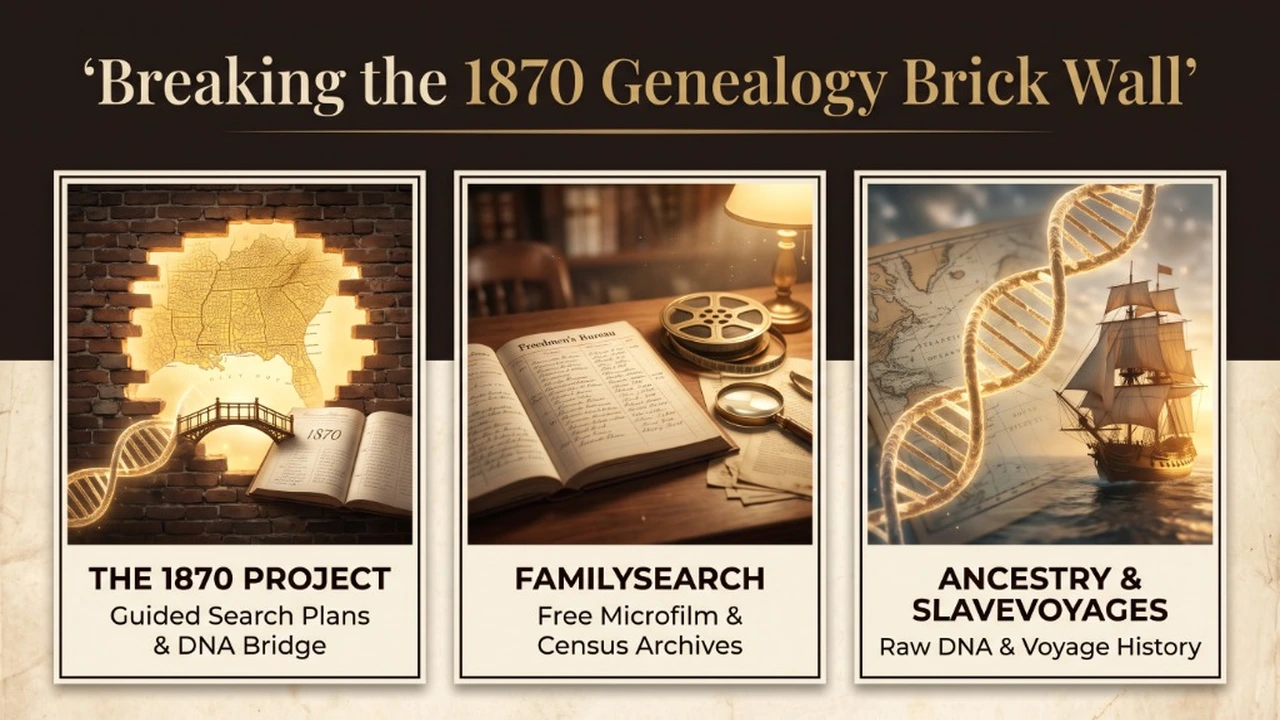
The 1870 Project is built around that next-step approach: translating DNA matches and archival clues into concrete research directions, including likely counties and the federal record sets to check. The goal is not another overwhelming list of records. It is a better question to ask at the archive.
Don’t let a missing surname stop the search
A surname is useful, but it is not the only identity marker. Before 1870, track a person through age, gender, occupation, spouse, children, neighbors, location, and movement over time. A woman may be easier to find through her children’s death certificates or a husband’s pension file than through records under her own name. A man may be identified in a military record by an enlistment location that reveals the county where his family lived.
Create a simple research timeline. Put every known record in date order and write down what it proves, what it suggests, and what remains unknown. Separate facts from family stories without dismissing those stories. “Grandmother said we came from Georgia” may not be enough to prove an origin, but it can become powerful when three records and a DNA cluster also point to Georgia.
Avoid forcing a connection because the name and age look close. The wrong ancestor can create years of false research. A slower, evidence-based path is still faster than rebuilding a tree from a bad assumption.
Ask relatives before another clue disappears
The records may be silent, but living relatives are not. Call the oldest family members. Ask who lived near whom, what churches the family attended, where people were buried, and which relatives “went North” or “went West.” Ask about nicknames, maiden names, family photographs, military service, and stories of land, schools, or reunions.
Specific questions produce better answers than “Tell me about the family.” Record the conversation with permission, preserve the original wording, and note who provided each detail. Even an uncertain memory can reveal a county, sibling, or migration route worth testing.
Your next breakthrough may not come from a better search box. It may come from one named neighbor in 1870, one pension affidavit, one DNA cluster, or one relative who remembers the church where the family gathered. Follow that clue carefully. The record trail is rarely gone - it is waiting in a different place.