Why Your DNA Test Says "Nigeria" When Your Family Lived in Louisiana or Texas in 1870
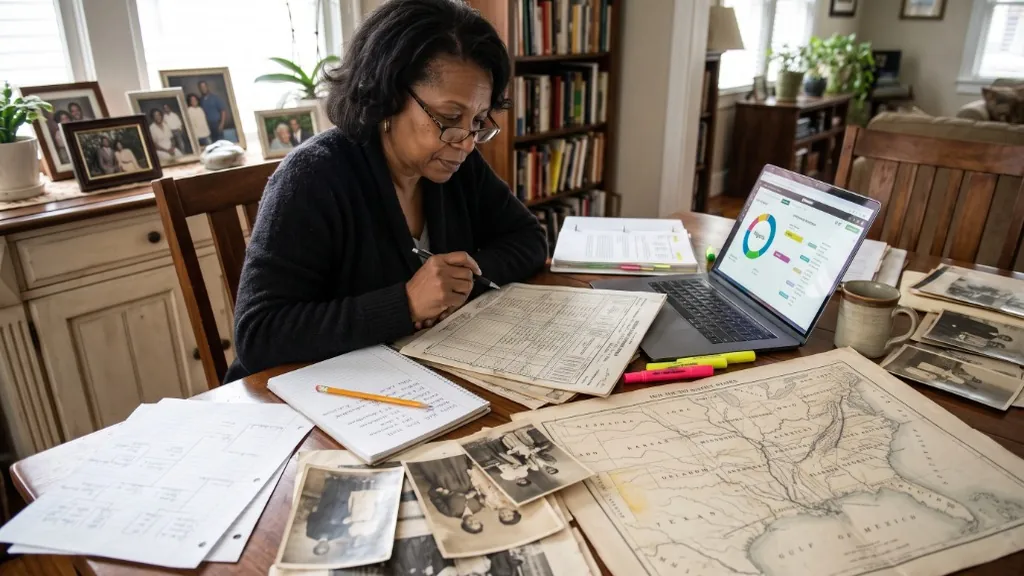
You open your DNA test results expecting to see the places your grandparents talked about. Your family has lived in Louisiana, Texas, Mississippi, Alabama, or Arkansas as far back as anyone can remember.
Then you look at the top of your report. It says Nigeria.
Right away, a question pops up: If my family was in Louisiana or Texas in 1870, how did Nigerian roots get there?
The answer lies in a two-step history that DNA tests rarely explain—and it gives you a powerful clue when you look at your family's census records.
Step 1: Where Ships Landed in the 1700s
In the 1700s, before Texas or Mississippi were states, British ships brought enslaved Africans to coastal colonies like Virginia, Maryland, and South Carolina.
Many Africans brought to Virginia in the 1700s came from the Bight of Biafra—today's southeastern Nigeria, where Igbo is spoken. According to surviving ship records, the Bight of Biafra was the largest known source of Africans brought to Virginia.
If your ancestors arrived in Virginia in the 1700s, how did their grandchildren end up in Louisiana or Texas by 1870?
Step 2: The Forced Move West (1790–1860)
After the United States banned the ocean slave trade in 1808, cotton and sugar plantations spread fast across the Deep South. Planters in the newer states wanted labor.
Between 1790 and 1860, the domestic slave trade forced more than a million enslaved people out of Virginia, Maryland, and the Carolinas and into Alabama, Mississippi, Louisiana, Arkansas, and Texas.
Families were marched overland in chains or sent by ship from ports like Richmond and Baltimore straight to New Orleans and Galveston.
Because of this forced move, a family living in Louisiana or Texas on the 1870 Census often had parents or grandparents who were born in Virginia, Maryland, or the Carolinas.
Why Does My DNA Report Say "Yoruba" Instead of "Igbo"?
Your DNA report may name the Yoruba or another group next to Nigeria. That can look confusing at first, because surviving ship logs show fewer captives came to North America from the Bight of Benin (Yoruba) than from the Bight of Biafra (Igbo).
Here is why that happens:
- DNA tests compare you to people living today, not to 1700s ships. Testing labs build their reference maps by collecting DNA from modern volunteers living in Africa today.
- Neighboring peoples share deep ancestry. Modern Nigerian populations overlap genetically across the region, so ancestors from the Bight of Biafra still match Nigeria-labeled reference groups on a modern test.
- DNA regions fit your story, but they do not prove a single port. Because DNA maps are built from living people, they cannot show which ship or coast one ancestor came through. Only paper records can prove your family's exact path.
What If My Family Was Already in Early Louisiana?
Not every Louisiana family came from Virginia. If your family was in southern Louisiana before the 1800s, records show two earlier waves:
- French Louisiana (1719–1731): Most Africans brought to early French Louisiana came from Senegambia (Wolof, Mandinka, and Fula peoples). Some early ships also sailed from Whydah (Ouidah) on the Bight of Benin, the Dahomey coast.
- Spanish and Early American Louisiana (1770–1820): During this later period, Kongo (West Central Africa) was the most named African origin in Louisiana records, alongside captives from the Bights of Benin and Biafra.
How to Check Your Own Family's Path in 3 Steps
You do not have to guess whether your family was moved west from Virginia or the Carolinas. The census often wrote it down.
- Follow one ancestor backward through the census. Start with a grandparent or great-grandparent born before 1950. Work backward one census at a time—from 1950, 1940, and 1930 back to 1920, 1910, 1900, 1880, and 1870.
- Read the "Father's Birthplace" and "Mother's Birthplace" columns (1880 to 1930). Every federal census from 1880 through 1930 asked three birthplace questions: where the person was born, where their father was born, and where their mother was born. Even when an ancestor was born in Louisiana or Texas, those two parent columns often say "Virginia," "Maryland," "North Carolina," or "South Carolina."
- Ask an older relative one specific question. Instead of asking "What do you know about our history?", ask: "Did anyone ever mention our family coming from Virginia, Maryland, or the Carolinas?" A small detail like a state name or an old county can unlock the next step.
What to Do Next
Use our free Ask a Relative tool to gather one remembered state or grandparent name, match your cousin clusters in DNA Decoder, or start a guided search (2 credits) to get pre-filled archive links and likely state records for your family.