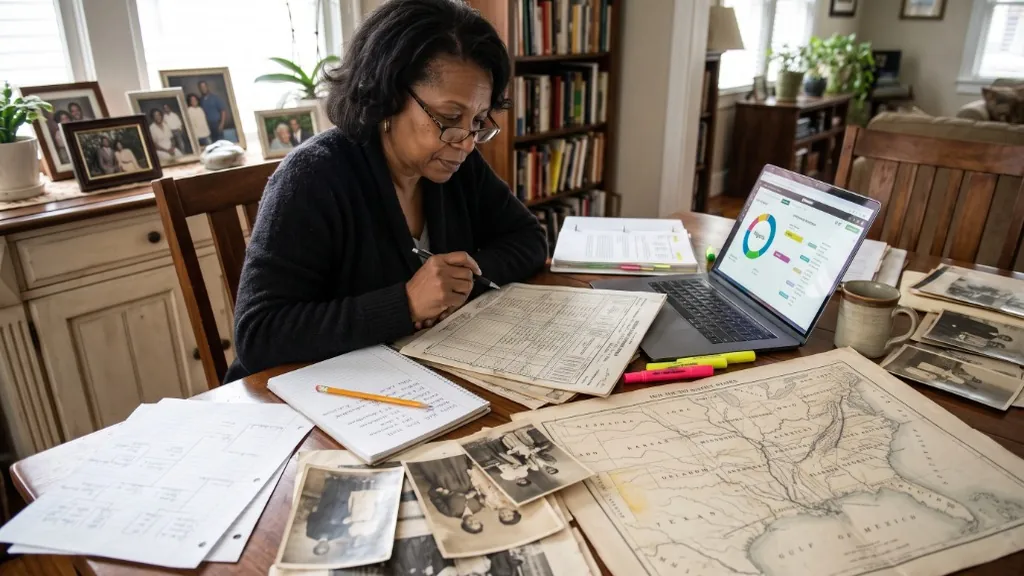
Which DNA Matches Should I Contact First?

A DNA match list can feel like a crowded room where everyone may be family, but no one is wearing a name tag. The question is not simply, which DNA matches should I contact? It is which person is most likely to know the name, county, household, or family story that moves your research forward.
For families facing an 1870 brick wall, that choice matters. A well-placed message can point you to a Freedmen's Bureau labor contract, a probate file, a church community, or the exact county where an ancestor lived before records became harder to find. A message sent at random may get no reply at all. Start with evidence, then contact matches who can add context to it.
Which DNA Matches Should I Contact First?
Prioritize the matches who are both genetically useful and historically close to the question you are trying to answer. The highest shared centimorgan total is not always the best first contact. A 42 cM match with a public tree rooted in the same Mississippi county may be more valuable than a 280 cM match whose family is fully documented on an unrelated branch.
Begin with your research goal. Are you trying to identify a biological grandparent? Find the parents of an ancestor first recorded in 1870? Confirm whether two families in the same postwar community were connected? Your goal tells you which side of your match list deserves attention.
Start with close relatives, but verify the relationship
Matches above roughly 200 cM deserve an early look because they can often help identify a grandparent, great-grandparent, or major family line. Review their age, tree, shared matches, and any surnames or locations they provide. A close match can be especially powerful if their family tree includes a person, place, or date that appears near your own mystery ancestor.
Still, shared DNA does not hand you a relationship label you can trust blindly. Endogamy, pedigree collapse, cousin marriages, and communities that intermarried over generations can make a match look closer than the paper trail suggests. This can be common in small rural communities, Acadian and Appalachian lines, Jewish ancestry, and some African American communities shaped by enslavement and displacement. Treat the predicted relationship as a range, then use records to test the connection.
Look for the matches with a shared ancestral location
Location is often the clue that breaks a wall. If your ancestor appears in the 1870 Census in Lowndes County, Alabama, a DNA match whose grandparents, great-grandparents, or earliest known ancestors also lived there deserves attention even if the match is modest.
Search their tree for the county and surrounding counties, not only for your exact surname. Formerly enslaved people may have taken, changed, or used more than one surname after emancipation. Their relatives may appear under a first name, a nickname, a stepfather's surname, or the surname of a former enslaver. The same applies to families who migrated west during Reconstruction or north during the Great Migration.
A match connected to the right place can lead to records that DNA alone cannot name: a plantation, a military unit, a bureau field office, a church, or a cluster of neighbors who appear together across censuses.
Favor matches with shared matches and usable trees
A tree does not need to be large to be useful. A match with four generations of carefully named relatives, birthplaces, and census locations can be far more valuable than a tree with 4,000 unsourced names. Look for matches who have identified grandparents, listed maiden names, or attached locations before 1900.
Shared matches add another layer. If several matches all connect to one family cluster, they likely represent the same branch. Contacting one person from that cluster may tell you whether the group belongs to your maternal or paternal side, and whether an unfamiliar surname is a blood line, an in-law line, or simply a neighbor connection.
When you have several possible contacts, choose the person with the clearest tree and the most relevant shared-match cluster. You are looking for a researcher who can recognize a name when you mention it.
Do Not Ignore Smaller DNA Matches
A 20 to 60 cM match can be the person who has the family Bible, knows the old cemetery, or has already researched the county you need. Smaller matches are usually not strong enough to prove a relationship by themselves, but they become meaningful when they fit a documented pattern.
This is especially true when researching ancestors before 1870. Your target may not appear in a conventional birth record, marriage record, or estate record. Instead, the evidence may come from many smaller pieces: a cluster of DNA matches, a shared community, a naming pattern, a Freedmen's Bank entry, and a record of the enslaver's household. One small match might hold the location that helps those pieces lock together.
Contact smaller matches when they meet at least two useful conditions: they share matches with a known branch, their tree reaches the county or community you are studying, or they have a surname linked to your research question. Do not spend your first week messaging dozens of unexplained 8 cM matches. That creates noise, not momentum.
Give priority to older relatives and active researchers
An older match may carry information that is not online and will not appear in a DNA test result: grandparents' names, migration stories, burial places, photographs, reunions, and who was considered kin. Approach with care. They may not use genealogy language, and they may not know how to read a match list. Ask simple, specific questions.
An active researcher is also a strong contact. Signs include a detailed tree, recent updates, a profile note about a surname or county, or a response history if the testing site shows one. These people may have already pulled deeds, obituaries, pension files, or probate records that can save you months.
The best contact is often an older relative who is also engaged in family history. But do not wait for the perfect match. Send a thoughtful message to the strongest available person while you continue building the evidence.
How to Contact DNA Matches Without Sending a Generic Message
A vague note such as “We are DNA matches. How are we related?” puts the burden on the other person. Give them enough information to recognize why your question matters, without overwhelming them with a full family tree.
Use their name if it is visible. State the amount of DNA you share, the branch or location you are researching, and one focused question. For example:
> Hello, we share 54 cM of DNA. I am researching my great-grandmother, Mary Johnson, who lived in or near Wilcox County, Alabama, by 1870. Your tree includes Johnson and Williams families from that area. Have you come across a Mary Johnson connected to those families, or do you know where your Johnson line lived before 1870?
That message is specific, respectful, and easy to answer. It also leaves room for the match to say no. Avoid asserting a relationship before you have evidence. “I believe we may connect through a Wilcox County family” is better than “You are my cousin through Mary Johnson.”
If you are contacting a possible biological relative, be even more careful. Say what you know, what you are hoping to learn, and that you respect their privacy. Do not demand documents, pressure them for a phone call, or share sensitive family discoveries in the first message.
Build a Contact Order That Serves the Research
Before sending messages, create a short working group of five to ten matches. Include the closest match on the suspected branch, two or three matches from the same shared-match cluster, one location-based match, and one match with a strong tree or clear research experience. Record the centimorgans shared, their oldest known ancestors, key counties, shared matches, and the date you contacted them.
Then work from the response back into the records. If a match names a county, search that county's census households, marriage books, tax lists, land deeds, cemetery records, and Reconstruction-era federal records. If they name a former enslaver or plantation community, that is not a final answer. It is a direction for careful archival work.
This is where DNA becomes more than a list of cousin predictions. It becomes a map to the records your family was left out of or scattered across. The 1870 Project can translate a DNA clue into practical next steps, including likely hub counties and the federal microfilm sources worth searching, so you are not left guessing where to look.
A reply may take days, weeks, or never come. Follow up once after a reasonable interval, then keep researching. Your ancestor's story does not depend on one stranger answering a message. It depends on building a case from DNA, records, place, and the living memory still within reach. Every thoughtful contact is an invitation to recover a piece of your family's name.