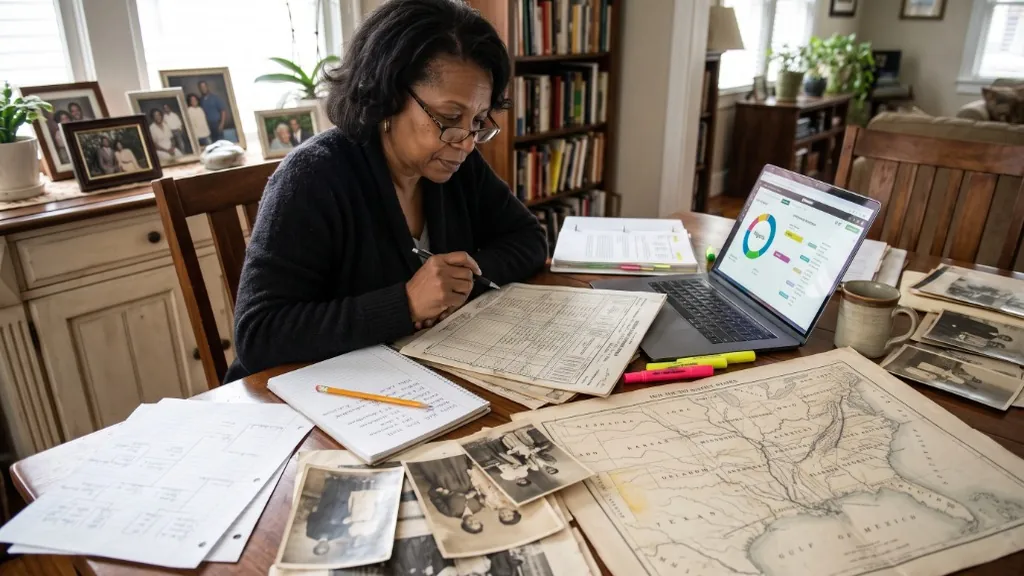
How DNA Clusters Solved an Adoption Case
A close DNA match can feel like an answer. Often, it is only the first clue. In one adoption research pattern, DNA clusters solved an adoption case not because a test named the biological parent, but because the match list revealed two separate family networks, a place where they overlapped, and records that could test the theory.
That distinction matters. A DNA result is evidence, not a finished family tree. For adoptees and descendants of adoptees, the most useful question is rarely, “Who is my closest match?” It is, “Which matches belong together, what shared ancestor connects them, and what documents can prove how that family reaches me?”
Why DNA Match Lists Can Stall an Adoption Search
DNA testing companies give researchers a long list of cousin matches, shared centimorgans, usernames, and sometimes a sparse family tree. That information can be powerful, but it can also produce a familiar kind of paralysis. Hundreds of matches may share the same surname. A predicted second cousin may have no tree. A match’s public tree may be copied, incomplete, or simply wrong.
Adoption research adds another layer. The person searching may have limited non-identifying information, an uncertain birth year, a city rather than a county, or a story that has changed over time. A biological parent may have been young, may have used a nickname, may be living, or may have had reasons to keep the adoption private.
The answer is not to message every match and hope someone recognizes a name. It is to organize the DNA evidence before building a theory. Clustering turns a crowded match list into family groups that can be researched one at a time.
How DNA Clusters Solved an Adoption Case
A DNA cluster is a group of matches who also match one another. In practical terms, these are people connected through the same ancestral line. If Match A, Match B, and Match C all share DNA with the test taker and with each other, they may descend from the same couple or family network.
In an adoption case, researchers usually begin with the strongest available matches, then use shared-match information to separate them into groups. One cluster may lead to the maternal side. Another may lead to the paternal side. Sometimes a third group appears because of endogamy, pedigree collapse, or a line that has intermarried repeatedly. That is why cluster results need interpretation, not blind trust.
Consider a common scenario. An adoptee has a 214-centimorgan match with a small but well-documented tree. That match shares DNA with several people whose grandparents came from the same rural county in Arkansas. A second cluster includes matches tied to a different family from nearby Memphis. Neither cluster contains an obvious biological parent.
The research breakthrough comes from building each cluster backward to its most recent common ancestral couple, then bringing the trees forward. The first family has several descendants in the relevant place and time. The second family does too. One woman from the first family and one man from the second family lived within a few miles of each other in the year suggested by the adoptee’s records. A census, city directory, school yearbook, newspaper notice, or birth index can narrow the candidate pool further.
DNA did not identify a parent by itself. It identified the right families, the right county, and the right records to search next.
Start With the Matches Most Likely to Carry the Answer
Centimorgans measure the amount of DNA shared between two people. More shared DNA usually means a closer relationship, but ranges overlap. A 200-centimorgan match might be a half first cousin, a first cousin once removed, a half great-aunt or uncle, or another relationship in a similar range.
That uncertainty is normal. Do not force a single relationship label too early. Instead, record the shared amount, the testing company’s estimate, the person’s age if available, known locations, surnames, and whether they match other key people.
A close match with no family tree is not a dead end. Their shared matches may point clearly to a grandparent couple. A more distant match with an excellent tree can be more useful than a closer match with no identifying detail. The best evidence is often a combination of both.
Build Separate Trees, Not One Giant Guess
Once a group of matches appears connected, build a focused research tree for that cluster. Start with documented parents and grandparents. Use census records, obituaries, marriage records, cemetery information, draft registrations, probate files, and local newspapers to establish relationships and migration patterns.
Keep the maternal and paternal hypotheses separate until the evidence supports a connection. Researchers can accidentally combine two unrelated families because the surnames are common or because both families lived in the same city. A disciplined tree makes uncertainty visible.
Label every conclusion. “Documented” means supported by a record. “Likely” means the DNA and records point strongly in one direction. “Possible” means it is worth testing, not repeating as fact. That habit protects both the research and the people at the center of it.
The County Is Often the Real Breakthrough
People search for names. Successful adoption research often turns on place.
A DNA cluster may reveal that multiple matches trace back to one county, neighborhood, church community, or migration route. That geographic pattern can be more dependable than a single online family tree. Once a likely county emerges, records become far more specific: county marriage books, local newspapers, hospital references, school records, probate packets, court files, and federal census schedules.
For families with African American roots, county-level precision can also open a different set of doors. The 1870 Census may be the first federal census where formerly enslaved ancestors appear by name, but a proven county can guide the search into Freedmen’s Bureau records, labor contracts, marriage records, bank files, military records, and the pre-1870 slaveholding community. The paper trail is difficult, but it is not empty.
This is where a DNA result becomes a research plan. The 1870 Project is built around that next-step logic: use DNA evidence to identify the likely hub county, then direct the search toward the archive and record set most likely to move the case forward. A useful result is not “here are 500 records.” It is “search this family in this county, in this time window, starting with this source.”
Test the Theory Before Naming a Parent
A promising cluster can create a compelling story. Do not mistake a compelling story for proof.
Before identifying a biological parent or grandparent, ask whether the proposed relationship fits every available fact. Does the person’s age make sense? Were they in the right location? Does the amount of shared DNA fit the proposed relationship? Do the matches on both sides support the same conclusion? Is there another relative with the same name who fits better?
Targeted testing can be helpful when a willing relative is available. A test from a known half sibling, aunt, uncle, or first cousin can distinguish between competing branches. But it depends on consent, family readiness, cost, and the relationship involved. No one is obligated to test, disclose, or respond.
When records and DNA align, write down the proof. Include the match relationships, the shared centimorgan amounts, the common ancestors identified for each cluster, the timeline, and the documents that place candidates in the same community. This gives you a conclusion you can revisit, explain, and share responsibly.
Contact Living Relatives With Care
The research may lead to living people who do not know an adoption occurred. A first message should be brief, accurate, and low pressure. Do not lead with a demand for answers. Do not reveal private details that they may not know. Give them room to decide whether and when to respond.
A respectful note can say that you are researching a biological family connection, that DNA results suggest a possible relationship, and that you would welcome any information they are comfortable sharing. If there is no response, let silence stand. A lack of reply does not disprove the research, and it does not make someone cruel. Family history can arrive with grief, secrecy, loyalty, and surprise.
Privacy matters here as much as evidence. Keep living people’s names, test results, medical information, and contact details out of public trees unless they have clearly agreed. The goal is not just to find the right family. It is to handle that discovery in a way that honors everyone affected.
The next useful move may be simple: choose one strong DNA match, review their shared matches, and write down every county that appears more than once. Your family was here. The pattern can tell you where to look.