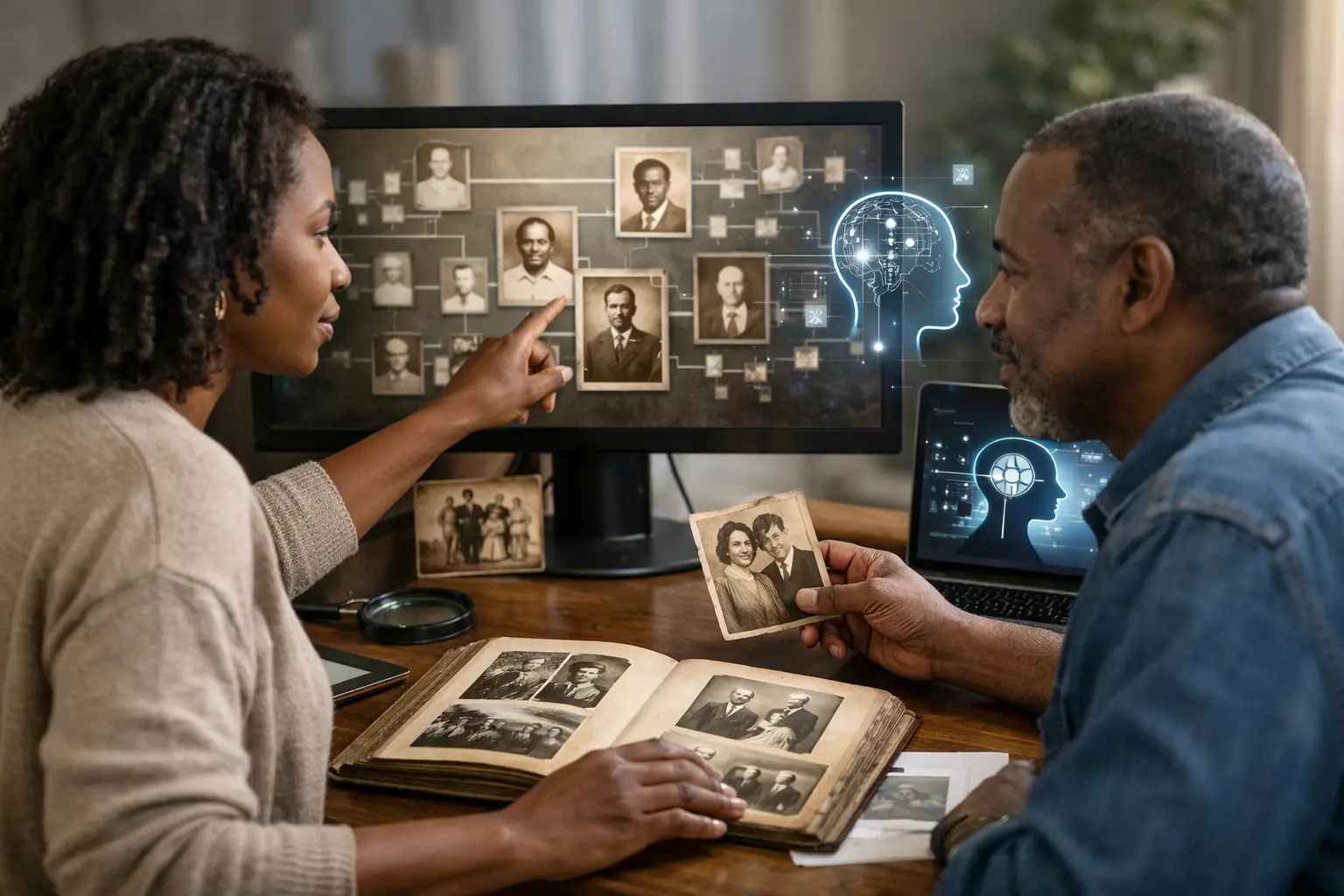
AI Genealogy Tools Review: What Actually Helps

Most genealogy tools promise more records. That is rarely the real problem. The real problem is knowing what to do next when the trail goes cold, a surname changes spelling three times, or your DNA matches point everywhere and nowhere at once. That is where an AI genealogy tools review becomes useful - not as a tech novelty, but as a test of which tools actually move family research forward.
For many families, especially those tracing African American ancestry through the 1870 Census barrier, the standard record-search model is not enough. You do not need another screen full of hints with no context. You need a tool that can narrow a county, interpret a cluster of DNA matches, suggest the right archive set, or help you ask living relatives the right question before their memories are gone. Some AI tools are getting close. Others are still dressed-up autocomplete.
What an AI genealogy tools review should measure
If you are evaluating AI for family history, the first question is simple: does it reduce guesswork? A good genealogy tool should save research time, but the better standard is whether it gives you a more precise next step. That could mean identifying likely counties of origin from DNA networks, translating a vague family story into searchable record clues, or drafting an outreach message that actually gets a cousin to reply.
Accuracy matters, but so does usability. Many AI tools sound impressive until you realize they are producing polished language on top of weak evidence. Genealogy punishes confident guessing. A useful tool should show its reasoning, stay close to source-based research, and help you verify claims in records rather than replace records with narrative.
Privacy also belongs in the review. Family history is personal, and DNA data is more personal still. If a platform needs your genetic information, family photos, interview transcripts, or private messages, it should be clear about what it stores, how it uses the material, and whether you are being pushed into a recurring subscription just to keep access to your own work.
The main categories of AI genealogy tools
AI record search and discovery
This is the category most people expect first. These tools scan records, match names, and surface possible relatives or events. At their best, they speed up broad searches across large databases and catch spelling variation that manual searching misses. That can be useful for immigrant families, common surnames, and census tracking.
The weakness is that broad search is not the same as guided research. If the result is simply more possibilities, you may still be stuck. Families facing the hardest barriers, including formerly enslaved ancestors whose paper trail changes dramatically before and after Emancipation, often need interpretation more than raw retrieval.
AI DNA interpretation
This is where the field gets more interesting. DNA results by themselves can be overwhelming. Shared centimorgans, mystery matches, and half-built trees do not automatically tell you which courthouse, county, or archive to search next. The best AI tools in this category translate DNA patterns into research direction.
That translation is the difference between novelty and value. If a tool can examine clusters of matches, identify likely family groups, and connect them to place-based records, it starts solving a real problem. If it merely rephrases your ethnicity estimate or tells you to contact matches, it is not doing enough.
AI family interviewing and correspondence
A surprising number of breakthroughs come from living relatives, not databases. AI can help here by drafting interview questions, organizing recollections, and writing outreach messages that sound warm instead of robotic. For beginners especially, this removes friction.
Still, this category works best as a support system, not a substitute for listening. Family memory is messy. Names get blended, dates shift, and painful history may come out indirectly. A good tool should help you capture and clarify stories, not flatten them into a neat but inaccurate script.
AI storytelling and image generation
These tools turn facts into narratives, timelines, or visual portraits. They can be meaningful for family preservation, especially when younger relatives need a clearer way to connect with older history. A generated portrait or well-structured life story can make an ancestor feel real.
But this is the category where caution matters most. Generated stories can overstate certainty, and generated images can imply details no record proves. Used carefully, these tools help families preserve and share what they know. Used carelessly, they can blur the line between recovered history and imagined history.
Where most AI genealogy tools still fall short
The biggest weakness is false confidence. Many tools produce elegant answers to unresolved questions. In genealogy, a smooth paragraph can hide a weak conclusion. If a platform cannot explain why it suggested a person, place, or relationship, you should treat the output as a lead, not a fact.
Another common problem is generic guidance. Telling a user to search census records, contact matches, or review probate files is not enough. Serious research needs specifics. Which county? Which timeframe? Which archive series? Which federal collection? Which microfilm? Precision is what turns hope into progress.
This matters even more in difficult research contexts. African American genealogy often requires moving between census records, Freedmen's Bureau materials, labor contracts, county records, military service files, church documents, and DNA evidence. A tool that cannot work across those transitions will hit the same wall the user already hit.
What the best tools are starting to do right
The strongest AI genealogy platforms do not try to replace the researcher. They act like a skilled assistant who can sort noise, identify patterns, and hand you the next best action. That might mean surfacing a likely county cluster from DNA matches, pointing you toward a specific federal archive series, or helping you frame a question for an aunt who remembers one branch of the family better than anyone else.
That action-oriented model matters because family research is emotional as much as technical. When people stall, they often stop. A tool that gives concrete next steps keeps momentum alive. That is especially important for users who have already spent months clicking through paywalled hints without learning how to break through a records barrier.
One example of a sharper approach is The 1870 Project, which focuses on one of the hardest problems in US genealogy: tracing families through the 1870 brick wall. Instead of just listing possible records, it translates DNA and archival clues into practical direction, including likely counties to search and, where it applies, the state's Freedmen's Bureau microfilm number. That is the right standard for AI in genealogy - less noise, more next move.
How to judge an AI genealogy tool before you trust it
Start with one known ancestor and one unknown question. Do not test a platform on your entire tree first. Give it a focused challenge, such as identifying where a great-grandparent likely lived before a marriage record, or narrowing which side of the family a DNA cluster belongs to.
Then look at the output closely. Does the tool provide evidence-based reasoning, or just polished text? Does it help you search more precisely, or does it send you back into a giant record pool? If it uses AI-generated narrative, can you separate sourced facts from interpretation? Those answers will tell you whether the platform is helping you research or just helping you read.
Cost structure matters too. Subscription fatigue is real in genealogy. Many users pay month after month for access to databases they only need occasionally. A freemium or credit-based approach can make more sense if the tool delivers high-value guidance in short bursts. Paying for a specific research action is often better than paying indefinitely for possibility.
Finally, pay attention to emotional design. Genealogy is not just data retrieval. You may be trying to identify an enslaver's county, reconnect a fractured branch, or preserve a grandparent's memory while they can still tell the story. The right tool should respect that weight. It should feel clear, honest, and useful under pressure.
The real verdict on AI genealogy tools
AI is not magic for family history. It will not fix missing records, erase historical violence, or ensure that every mystery gets solved. But the best tools can compress weeks of confusion into one strong lead. They can help you ask better questions, search in the right place, and move from vague family lore to documented possibility.
That is the line worth remembering in any AI genealogy tools review: the technology matters less than whether it gives your family a real path forward. If a tool helps you find the county, the archive, the match cluster, or the relative who still knows the name, that is useful. If it only gives you prettier uncertainty, keep walking.
Your family was here. The right tool should help you prove it, one precise step at a time.