35 Best Questions to Ask Grandparents

Most families do not lose their history all at once. They lose it one missed conversation at a time. The best questions to ask grandparents are the ones that turn a casual visit into usable family history - names, places, relationships, migrations, military service, church ties, and the stories no record set captures on its own.
If you are building a family tree, especially across the 1870 barrier or other record gaps, a grandparent interview is not a sentimental extra. It is a research source. A single answer can give you a maiden name, a county, a nickname used in old records, or the reason a family seemed to disappear between censuses. That is how dead ends start to move.
Why the best questions to ask grandparents matter
A lot of people ask broad questions like, “What was your childhood like?” That can open great stories, but it can also lead to details that are warm and memorable without being searchable. For genealogy, you want both. You want the feeling of the family story and the facts that let you prove, extend, and preserve it.
Grandparents often hold information that never made it into formal records or that was recorded imperfectly. They may know who used two different last names, which family members passed as something else, why siblings were split across households, or which church, plantation, school, tribe, neighborhood, or county anchored the family. For African American families in particular, those details can be the difference between a stalled search and a real lead.
The best interviews do not sound like interrogations. They sound like memory being handled carefully. That means asking specific questions, listening for side comments, and following up when a place, person, or event appears more than once.
Start with identity, not just chronology
Before you jump into dates, ask questions that help your grandparent define people the way the family knew them. Records are often incomplete. Family language is not.
Questions about names and relationships
These questions are often the highest-value starting point:
- What were the full names of your parents and grandparents?
- Did anyone in the family go by a nickname, middle name, or different last name?
- Were there step-parents, guardians, or relatives who helped raise children?
- Who were your siblings, half-siblings, or cousins that felt like siblings?
- Did anyone in the family change the spelling of their last name?
That last question matters more than most beginners realize. A surname shift can make records look unrelated when they are not. The same goes for informal kinship. A person remembered as “Aunt Sarah” may have been a cousin, in-law, neighbor, or family friend. Ask how they were connected.
Ask for places you can map
Places move research forward. Families tend to remember cities, but records are often organized by county, district, ward, church, or route. Push gently for more precision.
Questions that reveal research locations
Ask where people lived, but then ask what sat around them. Try:
- Where were you born, and where were your parents born?
- What town, county, or rural community did your family come from?
- Did your family ever move for work, land, safety, or family reasons?
- What church did you attend?
- What school did you go to?
- What cemetery are family members buried in?
- Did relatives live on the same road, farm, or block?
A grandparent may not remember a formal county name right away, but they may remember the nearest church, railroad, mill, river, or courthouse town. That is often enough to narrow a search area.
If your family has roots in the South, ask whether older relatives talked about specific plantations, landowners, Freedmen’s Bureau offices, or counties they left after the Civil War. Even partial answers can point to the right records.
Go after the stories behind record gaps
This is where many interviews become powerful. Not every family transition shows up clearly on paper. The best questions to ask grandparents are often the ones that explain why records changed.
Questions about disruption, movement, and silence
Ask with care:
- Did anyone leave home young or get sent to live with other relatives?
- Were there family members people did not talk about openly?
- Did anyone serve in the military, work for the railroad, or migrate for seasonal labor?
- Was anyone adopted informally or raised by grandparents or aunts?
- Did anyone avoid the census taker, mistrust officials, or change details for safety?
- Were there interracial, mixed-tribal, or otherwise hidden family connections?
These questions can surface hard history. It depends on the family and the level of trust in the room. Some grandparents will answer directly. Others will circle around a subject first. Do not rush that process. If someone says, “People just did not talk about that,” ask who knew more, or whether there were letters, Bibles, funeral programs, or photographs connected to that person.
Ask about work, service, and daily life
Occupation and daily routine sound secondary until you are trying to separate two men with the same name in the same county. Then they become essential.
Questions that add identifying detail
Try asking:
- What kind of work did your parents and grandparents do?
- Did anyone own land, rent land, sharecrop, or work in a specific household?
- Did anyone have a trade such as blacksmithing, midwifery, preaching, teaching, or carpentry?
- Who in the family served in the military, and in which war or branch?
- Did anyone belong to a union, lodge, church group, or mutual aid society?
These answers can connect to draft cards, pension files, city directories, farm schedules, labor records, church minutes, and local newspapers. For families facing pre-1870 barriers, even one remembered employer, regiment, or county official can sharpen the next search.
Use photos and objects to ask better questions
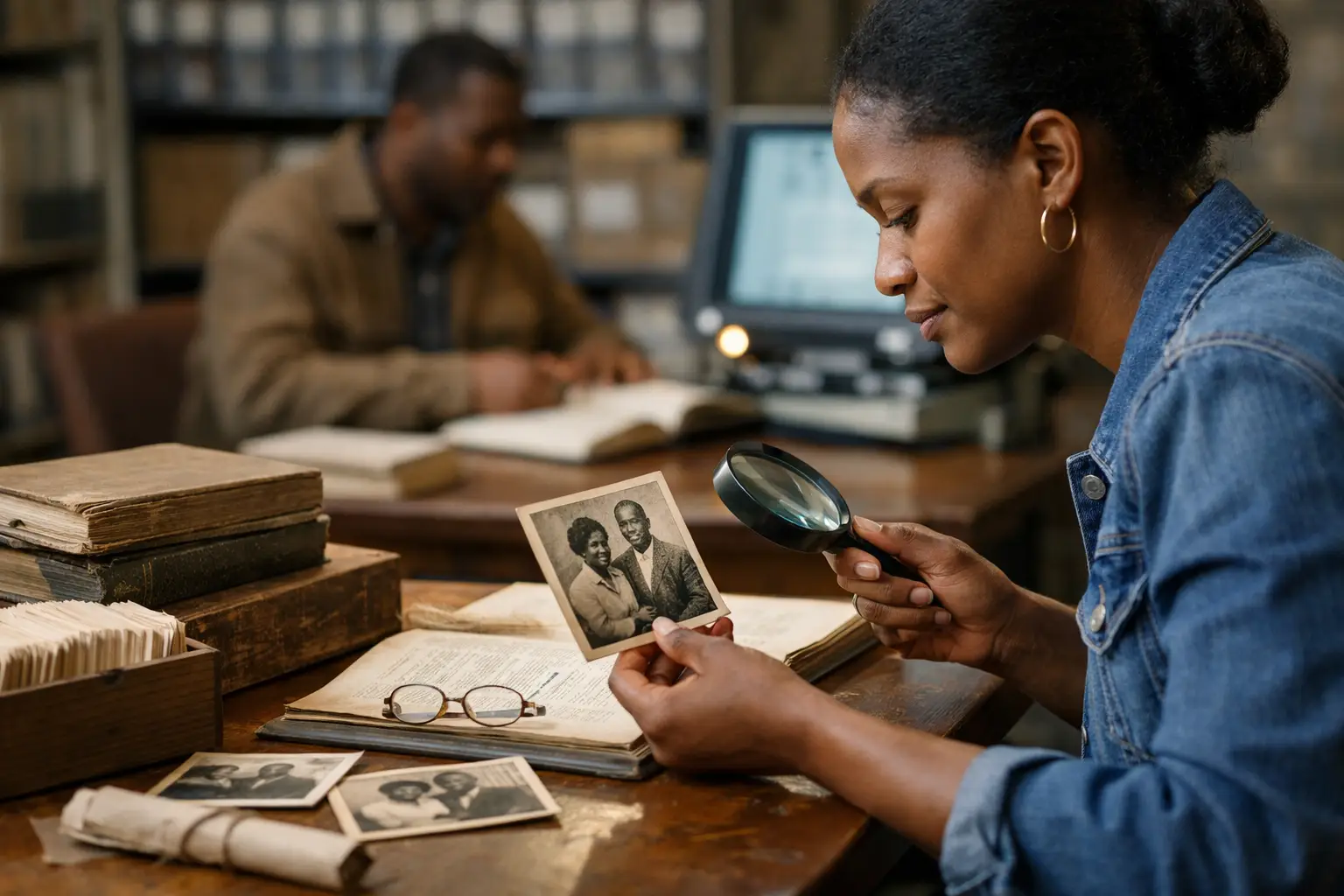
Memory is rarely linear. A photo album, funeral card, recipe box, military discharge paper, yearbook, or old Bible can pull out details a direct question will miss.
Instead of asking, “Do you remember this?” ask, “Who would have kept this?” or “Whose handwriting is this?” That often leads to a chain of custody, and chain of custody leads to relationships. A labeled photo is useful. An unlabeled photo with a story about who kept it, where it traveled, and why it mattered can be even better.
If a grandparent says, “I know that face, but I cannot place the name,” ask what side of the family the person belonged to, who they resembled, and what events they might have attended. Partial identification still helps.
How to ask the best questions to grandparents without shutting them down
The way you ask matters as much as the question itself. Some people love being interviewed. Others hear a recorder click on and get guarded.
Keep the setting easy. One-on-one is often better than a crowded holiday table, especially for sensitive history. Ask permission before recording. Let them know you care about getting the story right, not catching mistakes.
Start with what feels easy and factual, then move into the deeper material. If they get tired, stop. Short interviews across several visits usually produce better information than one marathon session.
Follow up in the moment. If they say, “We used to visit cousins in Macon every summer,” do not just move on. Ask which cousins, what church they attended, whether they lived in town or outside it, and who drove. The first answer gives you a story. The follow-up gives you research clues.
What to write down every time
You do not need a perfect transcript, but you do need a system. For each answer, capture the name, approximate date, place, and who provided the information. Also note uncertainty. “Maybe in Wilcox County” is still useful if you record that it was uncertain rather than presenting it as fact.
Pay attention to repeated names. In many families, the same given names appear across generations. Ask, “Which John was this?” or “Was this your uncle John or your grandfather John?” That simple clarification can prevent hours of wrong-tree research later.
This is also where a guided research tool can help. Platforms like The 1870 Project are built to turn family-member interviews into next-step searches instead of letting details sit in a notebook. That matters when one remembered county or surname variant could point you to the exact record set to check next.
35 best questions to ask grandparents
Here is a practical list you can bring to the conversation:
- What is your full name, and were you ever called anything else?
- When and where were you born?
- What were your parents’ full names?
- What were your grandparents’ full names?
- Did anyone in the family use a nickname or middle name regularly?
- Did the family ever spell the last name differently?
- Who raised you?
- Who lived in the household when you were a child?
- What were your siblings’ names, in birth order if possible?
- Were there half-siblings, step-siblings, or cousins raised as siblings?
- Where did your family live when you were young?
- What church did your family attend?
- What schools did you attend?
- Did your family own land, rent, or move often?
- Why did your family move when they did?
- Which relatives lived nearby?
- Who were the oldest relatives you remember meeting?
- What stories did they tell about their parents or grandparents?
- Did anyone talk about slavery, Emancipation, or Reconstruction in the family?
- Did anyone mention a plantation, landowner, or former enslaver’s name?
- Did anyone serve in the military?
- What jobs did your parents and grandparents have?
- Did anyone work for the railroad, on farms, in homes, or in a trade?
- Were any family members preachers, teachers, midwives, or community leaders?
- Did anyone belong to a lodge, church society, or veterans group?
- Were there adoptions, informal guardianships, or children raised by relatives?
- Were there family secrets or topics people avoided?
- Did anyone leave home and lose touch with the family?
- Which cemeteries are family members buried in?
- Are there family Bibles, letters, photos, or funeral programs?
- Who kept the family records and photographs?
- What recipes, sayings, songs, or traditions came from older relatives?
- What family stories do you think are true, even if you cannot prove them yet?
- Who else in the family should I talk to next?
- What do you never want our family to forget?
Some of these will produce immediate facts. Others will produce leads you can test later. Both matter.
Family history is not just hiding in archives. It is sitting across from you, remembering in fragments. Ask well, write it down, and follow the lead while the voice is still here.