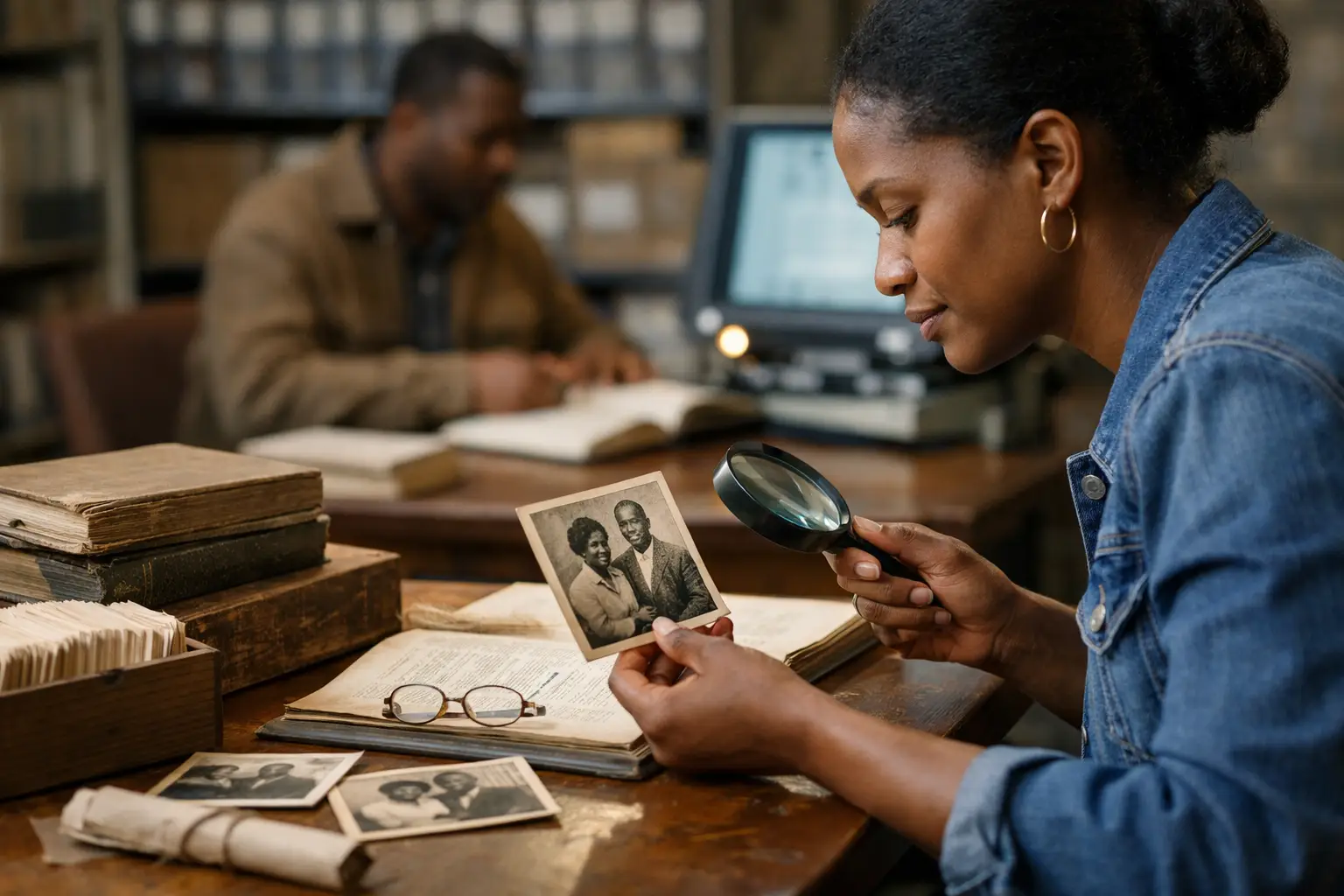
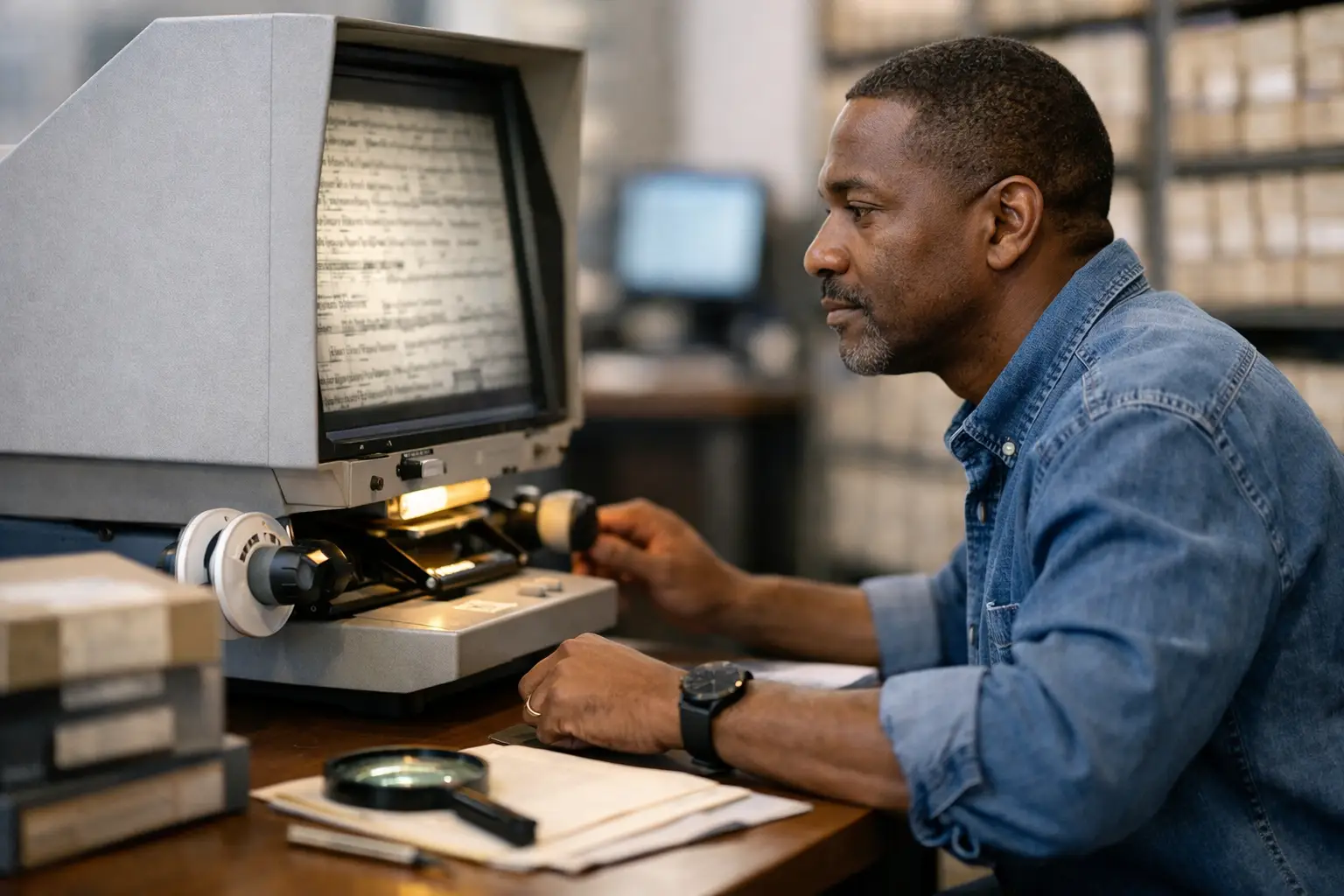
Free Genealogy Search Databases That Move You Forward

A free genealogy search database can give you a name in seconds. The harder question is whether that name leads anywhere. A census entry without a county, a death record without parents, or a DNA match without a shared ancestor can leave you with more tabs open and no clearer path forward.
That is where good research separates itself from record collecting. Free databases are not just places to type a surname. Used well, they help you identify the place, time period, relatives, and record group most likely to carry your family one step farther back.
Start with the record most likely to name a relationship
When you are working with a limited amount of information, do not begin by searching every collection for every version of a name. Start with the record type most likely to answer the question in front of you.
If you need a woman's maiden name, look for a marriage record, a child's death certificate, an obituary, or a Social Security application. If you need to connect a family across a move, search census records alongside city directories, draft registrations, and birthplaces of children. If you are trying to identify a formerly enslaved ancestor before 1870, prioritize the documents created around Emancipation: Freedmen's Bureau records, Freedman's Bank records, labor contracts, cohabitation records, and probate files connected to the area where the family lived.
The most useful free genealogy search databases let you search across these different record types without making you guess which archive holds them. But the result itself is only the beginning. Pull out every detail: neighbors, witnesses, occupation, age, birthplace, race as recorded, address, employer, and the names of people who appear more than once.
A record rarely announces the answer. More often, it points toward the next record.
Use a place-first method when names are common
A name can change. A county is often the stronger clue.
This matters especially when researching African American families in the decades after the Civil War. The first federal census that broadly names formerly enslaved people is 1870. Before that, many people appear only as ages and sex categories in slave schedules, if they appear at all. The path back usually runs through a specific county, plantation community, courthouse, church, military unit, or labor relationship.
When you find your ancestor in 1870, do not stop at the household. Record the county, township or post office, nearby surnames, landowners, and families living on the same page and the pages around them. Then search that same county in the years immediately before and after 1870.
A family may be easier to identify through a brother's marriage record, a daughter's death certificate, or a neighbor's Freedmen's Bureau labor contract than through the ancestor you searched first. That is not a detour. It is the research path.
Build a small timeline before expanding your search
Create a simple timeline with confirmed events: birth estimate, marriage, children's births, census appearances, military service, migration, and death. Include the location for every event, even when it seems obvious.
Then mark the gaps. If someone appears in Arkansas in 1880 but their oldest child was born in Mississippi in 1874, you have a narrower migration window and two places to investigate. If a man is listed as a farmer in one census and a railroad laborer in the next, that occupation shift may explain why he moved and where employment records might exist.
Specific gaps create specific searches. “Find my great-grandfather” is emotionally real but too broad for a database. “Identify the parents of James Carter, born about 1868, living in DeSoto County, Mississippi, in 1870” gives your research traction.
Know what free databases do well - and where they stop
Free access does not mean every collection is complete, indexed, or easy to read. Some databases provide digitized images but no searchable names. Others have indexes with transcription errors. Many federal and local records are scattered across separate institutions, each using different search tools.
That trade-off is manageable when you change your expectations. Search results are leads, not verdicts.
Try name variations aggressively. Search a first name without a surname, use initials, remove the middle name, and widen the birth year by five to ten years. Surnames were misspelled by enumerators, changed after marriage, adopted after Emancipation, and sometimes recorded according to a former enslaver's name. A strict exact-match search can hide the very record you need.
Also search relatives independently. A child who survived into the twentieth century may have left a richer paper trail than a parent who died young. A sibling's obituary may name the hometown. A widow's pension file may preserve a marriage date, prior surname, children's names, and statements from people who knew the family decades earlier.
The goal is not to find the cleanest-looking tree. It is to build a chain of evidence strong enough to support the next move.
Search the records around the 1870 brick wall differently
The 1870 brick wall is not one missing document. It is a change in how people were recorded. For many Black families, the records before 1870 require you to connect a free person or newly emancipated family to people, property, and places documented under a different legal system.
That requires care. Do not attach an enslaver family to your tree because the surname matches. A shared surname is a clue, not proof. Look for geographic proximity, repeated associations, probate distributions, estate inventories, labor contracts, tax lists, deeds, and testimony in Bureau records. Build the case from multiple sources.
The same principle applies to DNA. DNA matches can reveal a cluster connected to an ancestral county, but a centimorgan number alone does not identify the relationship. Use matches to form a hypothesis, then test it against records. Which counties repeat among shared matches? Which surnames appear in the same small area? Which 1870 households sit near the people in that cluster?
This is where a guided tool can save real time. The 1870 Project builds a search plan and links across more than 30 record sources (2 credits a search) and turns DNA clues and archival results into a next action, including likely counties to search. You should still evaluate the evidence, but you should not have to guess what to search next.
Turn one result into a research chain
Every promising find should produce at least two follow-up searches. If you locate a 1900 census household, search the family in 1880 and 1910, then search each child for a death record or obituary. If a marriage certificate identifies witnesses, look for those witnesses in the same census district. If a death certificate names parents, search for the informant too. Informants were often close relatives with information that can help confirm a connection.
Keep a research log as you go. Write down the exact search terms you used, the repository or database, the date range, the county, and what you found or did not find. Negative searches matter. Knowing that a county's marriage index has no record for a couple between 1885 and 1895 can help you focus on the neighboring county, a church register, or a later delayed certificate.
Save images whenever you can, not just transcribed names. Marginal notes, page neighbors, document numbers, and handwriting can carry clues that an index leaves out. If you cannot read a word, compare letters in other words on the same page before deciding it is a different name.
Do not wait to capture living memory
Databases can establish dates and places. Living relatives can explain why the family left, who raised a child, which church mattered, or why someone used a different surname. Those details may never appear in an official record.
Ask focused questions rather than broad ones. “Who did Grandma visit when she went back to Alabama?” can produce more than “Tell me about the family.” Ask about nicknames, cemeteries, schools, military service, old photographs, family Bibles, recipes, and the people who were called aunt or cousin even when the relationship was unclear.
Record the answers with permission, preserve the original wording, and follow up on each name or location mentioned. Oral history deserves respect, but it also deserves documentation. Treat it as a powerful lead and test it against the records.
Your family was here. The names may be buried in a county ledger, a pension packet, a Bureau register, or the memory of an elder who has never been asked the right question. Start with the strongest free record you can find, follow the people around your ancestor, and let each verified detail tell you exactly where to search next.