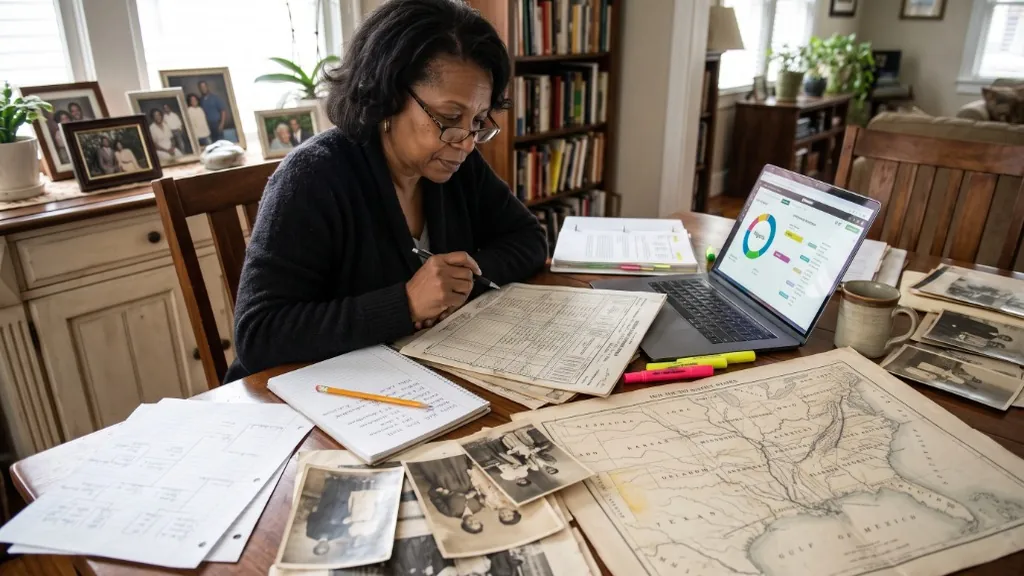
DNA Match Analysis Guide That Finds Clues

A surprising number of family searches stall for the same reason: people have DNA matches, but no clear next move. A good DNA match analysis guide does not stop at explaining centimorgans or showing you a match list. It helps you turn a cluster of names into a county, a household, a record set, and a real shot at the ancestor who keeps slipping out of view.
That matters even more when you are working through the 1870 barrier, surname changes, migration after the Civil War, or relatives who appear in one census and vanish in the next. DNA can point you in the right direction, but only if you read it as evidence, not as a shortcut.
What DNA match analysis is really for
Most beginners assume DNA answers identity questions by itself. Usually, it does not. DNA is strongest when it narrows possibilities and tells you where to search next. The match is not the finish line. The match is the signpost.
If you share DNA with someone at a meaningful level, that tells you there is a biological connection somewhere in the family network. What it does not tell you automatically is which branch, which generation, or which paper trail proves it. That is where analysis matters.
A solid match review asks a few focused questions. How much DNA do you share? Do you and that person share the same group of matches? Are those matches tied to one geographic area? Do surnames repeat across trees, obituaries, death certificates, or military records? If several clues point to the same county or surname cluster, that is when the research starts getting useful.
Start with the strongest matches, not the loudest ones
People often spend too much time on the cousin with the biggest online tree and too little time on the cousin whose DNA actually helps. Those are not always the same person.
Begin with your closest unknown matches first. In most cases, that means matches strong enough to suggest a recent shared ancestor, but not so close that the answer is already obvious. Look at the shared centimorgan range, then compare it to the amount of family information attached to the match. A moderate match with a small but accurate tree can be more valuable than a bigger match with copied names and no sources.
Be careful with certainty. A DNA amount can fit more than one relationship. A person who looks like a second cousin match might also fall into a half relationship, a removed relationship, or a case of endogamy. If your family comes from a small, intermarried community, including some African American, Acadian, Jewish, Native, or island populations, shared DNA can appear inflated. That does not make the match wrong. It means your interpretation has to stay flexible.
Shared matches are where patterns emerge
One isolated match can mislead you. Ten shared matches moving around the same surname, county, or migration route usually tell a clearer story.
Open a promising match and study who else you both match. Then ask whether those people connect to one another. If several of them trace to the same part of Georgia, Virginia, Mississippi, or the Carolinas, that cluster may be pointing to the right origin point for your line. If your family later appears in Chicago, Detroit, Philadelphia, or Los Angeles, the DNA cluster may be helping you reverse-map a Great Migration path.
This is especially powerful for African American genealogy, where the records before and just after Emancipation can be fragmented or indexed poorly. A DNA cluster that seems random at first can lead you back to a hub county, and the county often leads to probate files, labor contracts, tax rolls, voter lists, plantation records, Freedmen's Bureau materials, or federal microfilm that ordinary name searches miss.
Trees matter, but not in the way most people think
Family trees attached to DNA matches are clues, not proof. Treat them like witness statements. Helpful, sometimes excellent, sometimes confused.
Look for details that are hard to fake by accident. Repeated maiden names. The same small town across multiple trees. A grandfather with an unusual first name that reappears in your family. A match whose ancestors lived two farms away from your suspected line in 1880. Those signals matter more than a polished tree with hundreds of people and no documents.
When a match has no tree, do not write them off. Their username, location, known relatives, ethnicity estimate, or the names of shared matches can still place them in a network. Sometimes the best evidence comes from triangulating several sparse profiles rather than waiting for one perfect tree that never appears.
Build hypotheses, not fantasies
This is the part where many family searches drift off course. One promising surname appears, and suddenly every person with that name gets absorbed into the theory.
Work the other way. Start narrow. If three shared matches descend from people in one county between 1865 and 1900, build a temporary hypothesis around that place and period. Then test it against censuses, marriage records, death records, military files, land transactions, and local archives. If the theory holds across records and matches, keep going. If not, discard it quickly.
Good genealogy is not about defending your first guess. It is about getting to the next verifiable fact.
A practical DNA match analysis guide for your next session
When you sit down to analyze matches, organize your work in a way that pushes you toward records. Start with one mystery person or one brick-wall ancestor, not your entire tree. Review the closest relevant matches and sort them into clusters based on shared matches. Label each cluster with what you know so far, such as a surname, county, state, or migration route.
Then compare those clusters to your paper trail. Ask where your known ancestors were living when those match families were living nearby. If no direct overlap appears, look one county over, one decade earlier, or one generation sideways through siblings, aunts, uncles, and in-laws. Family history often survives in collateral lines long before it shows up in the direct line.
Next, convert the DNA clue into a record question. Not "Who is this match?" but "Which Black households with this surname were in this county in 1870?" or "Which probate files in this district mention children later found under a different surname?" That is the shift that turns DNA from a curiosity into evidence.
For researchers who feel stuck between match pages and archive catalogs, this is where a tool like The 1870 Project can change the pace of the work. Instead of leaving you with a vague cluster, it can translate DNA clues into likely counties, record groups, and the federal record sets to check. That is the difference between browsing and actually moving.
What to do when the results are messy
They often will be. You may find misattributed parentage, informal adoptions, name changes, split households, or ancestors who used different surnames before and after 1870. In African American research especially, you may be dealing with identities reshaped by slavery, forced movement, and incomplete official documentation.
That does not mean the trail is gone. It means the trail is indirect.
If your matches do not support the surname you expected, follow the matches anyway. If one cluster keeps pointing to a neighboring county, trust the evidence over family lore until the records say otherwise. Oral history matters, but details can shift over generations. The goal is not to prove anyone wrong. It is to recover the truest version of your family story that the evidence allows.
Also, reach out when a match seems promising. Keep the message short, respectful, and specific. Ask what they know about grandparents, great-grandparents, migration paths, family bibles, funeral programs, or old photographs. People are more likely to reply when the question feels human and focused. One cousin's memory of "our people were from Halifax County" can save you weeks.
Common mistakes that slow people down
The biggest mistake is treating ethnicity estimates like a roadmap. They can provide context, but they rarely solve a relationship question on their own. The second is chasing every match instead of following clusters. The third is relying on unsourced trees because they feel complete.
Another common problem is stopping at the DNA platform itself. Real progress usually happens when you move from the match page into censuses, county records, military records, vital records, newspapers, probate, and federal archive collections. DNA is the pressure point. Records are where the case gets built.
DNA match analysis guide for brick-wall cases
If your ancestor appears in 1870 and nowhere earlier under the same name, DNA can still help. Focus on descendants of suspected siblings, neighbors, and associated families, not just your direct line. Study who your ancestor lived near in 1870, then compare that community to your DNA clusters. Freed people often stayed near familiar families, moved in linked groups, or adopted surnames connected to earlier households, but not always the household researchers first expect.
That is why precision matters. The right cluster can reveal not just a surname possibility, but a county-level research target and a narrower archive path. Once you have that, the search becomes less emotional guesswork and more disciplined recovery.
Your family was here. The records may be scattered, mislabeled, or buried in federal film and county books, but the trail is not imaginary. If your DNA matches seem confusing today, that is not failure. It is the point where better analysis starts to turn names on a screen into people you can finally place, follow, and bring back into the family story.