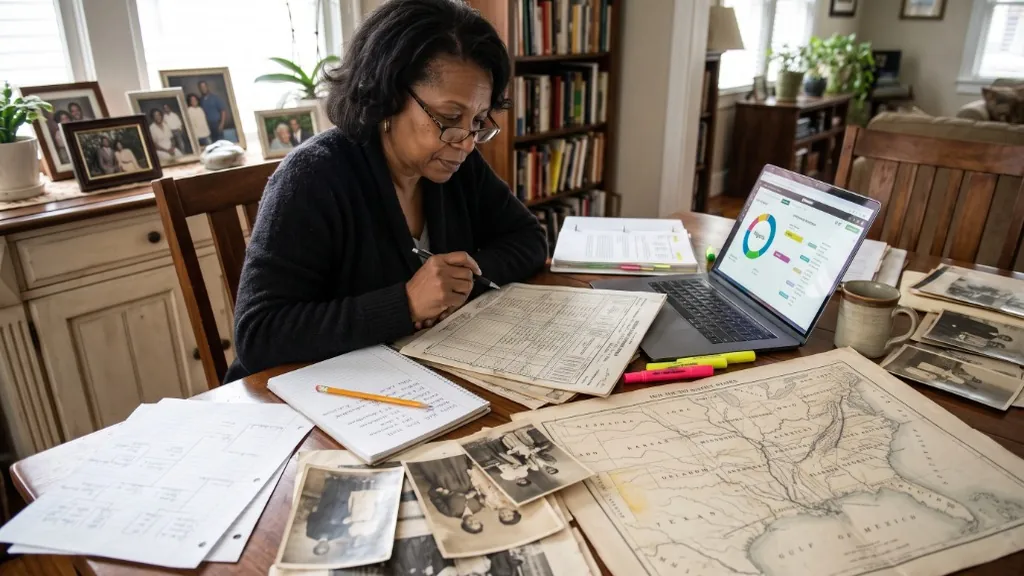
An Example of DNA Guided Genealogy at Work

A DNA match named Renee shares 62 centimorgans with you. Her tree has no familiar surnames, only a great-grandmother born in Lowndes County, Alabama, around 1868. That may look like one more confusing clue. But this is where an example of DNA guided genealogy becomes useful: DNA does not replace records. It tells you where the next record search should begin.
For families separated by slavery, migration, name changes, and incomplete documentation, the right DNA evidence can turn a vague match list into a specific county, a likely family group, and a federal record series worth checking. Your family was here. The work is connecting the genetic clue to the paper trail that can prove it.
What DNA-guided genealogy actually does
Traditional genealogy often starts with a name and searches outward. That works when census records, death certificates, obituaries, and family trees create a reasonably clear trail. It breaks down when the trail reaches 1870, when many formerly enslaved people first appear by name in the federal census.
DNA-guided genealogy starts with shared DNA and asks a more focused question: who are the people this match connects to, and what place do their documented ancestors have in common?
A match of 62 centimorgans does not identify an ancestor by itself. It can fit several relationships, from a third cousin to a half-second cousin twice removed. The value comes from context. If Renee shares DNA with you, and she also matches several people connected to Lowndes County, that cluster can point to a shared ancestral community.
The goal is not to declare, “This is definitely my ancestor.” The goal is to create the next best search action with enough precision to test it.
An example of DNA guided genealogy, step by step
Imagine you are researching your great-grandfather, Isaiah Carter. Family stories say he was born in Alabama around 1866 and moved to Memphis before 1900. In the 1900 census, Isaiah is listed with his wife and children, but the census only says his father and mother were born in Alabama. You cannot find him in 1870, and there is no clear death record naming his parents.
You test your DNA and see Renee, the 62-centimorgan match. Her public tree is small but documented back to a woman named Eliza Brooks, born around 1868 in Lowndes County. Renee’s shared-match list includes three other people who have family lines in Lowndes and neighboring Dallas County.
That is the first useful pattern. Not a surname. A place.
Step 1: Build a cluster, not a theory
Start by reviewing the matches Renee shares with you. Ignore distant one-off matches for the moment. Look for people who appear repeatedly in the same shared-match group and whose trees identify the same counties, towns, churches, or postwar communities.
Suppose two of the shared matches descend from people with the surnames Brooks and Carter in Lowndes County. Another has ancestors in the same county but no tree before 1880. This does not prove Isaiah was a Brooks or that Eliza was his sister. It does suggest that Lowndes County deserves more attention than every other county in Alabama.
This distinction matters. DNA can narrow a search area quickly, but forcing a relationship too early is how good clues become bad family trees.
Step 2: Use the cluster to choose records
Once Lowndes County becomes the working hypothesis, the research question changes from “Who were Isaiah Carter’s parents?” to “Which post-emancipation records name Carter, Brooks, or related households in Lowndes County between 1865 and 1880?”
That question leads to a much stronger record plan. Search the 1870 and 1880 censuses for every plausible Carter household in the county, not just Isaiah. Track neighbors. Note ages, occupations, birthplace patterns, and children who may later appear as witnesses or informants.
Then move beyond census pages. For this period, Freedmen’s Bureau labor contracts, marriage records, rations records, complaints, hospital registers, and school records can place newly freed families in a specific community. County probate files, deed books, tax lists, and court minutes may reveal former enslavers, land transactions, apprenticeships, or family members using the same surname.
The best next step is not “search more.” It is “search this record series for this county in this time window.” That is a completely different kind of momentum.
Step 3: Find the pre-1870 bridge
Now suppose you locate an 1866 Freedmen’s Bureau labor contract in Lowndes County. It names a woman called Eliza, her two children, and an employer whose estate records show he enslaved several people with the surname Carter before emancipation. The contract does not mention Isaiah, but an 1870 household nearby includes an Isaiah Carter of the right age living with Eliza.
This is not yet final proof. But it creates a documented chain worth testing:
Eliza appears in a postwar record. An Isaiah of the correct age appears in her household. The household is located in the same county identified by your DNA-match cluster. Renee descends from Eliza’s documented daughter or sibling line.
At this point, the archive becomes more targeted. You would examine the former enslaver’s probate inventory, estate settlement, plantation account books if they survive, and local court files. If the records identify an enslaved child matching Isaiah’s age, you have a potential pre-1870 connection that can be evaluated against the DNA evidence.
Step 4: Test the evidence from both directions
A strong conclusion requires records and DNA to agree, not merely coexist.
On the DNA side, look for additional descendants of Eliza’s family or of other suspected relatives. More matches from independent descendant lines make the proposed connection stronger. On the records side, ask whether dates, locations, ages, household patterns, and naming traditions fit without stretching the facts.
If Isaiah appears in Memphis by 1900, search for migration companions. Did people from the Lowndes County cluster also move to Memphis? Did a Carter, Brooks, or associated family appear in the same ward, church, or neighborhood? Migration chains often preserve relationships that earlier records hide.
A single 62-centimorgan match can open the door. Several matches, paired with a coherent documentary trail, are what let you walk through it.
Why county-level precision matters
Genealogy platforms can return thousands of records for “Isaiah Carter, Alabama.” That is not a plan. It is a pile of possibilities.
County-level guidance changes the work. Once DNA points toward Lowndes County, you can prioritize the relevant census districts, local probate court, Freedmen’s Bureau field office, churches, historical newspapers, and National Archives microfilm associated with that jurisdiction. You stop treating Alabama as one searchable unit and start investigating the community where your ancestors lived.
That is especially powerful at the 1870 brick wall. Enslaved people were recorded as property in many prewar documents, often without surnames. The evidence needed to identify them may be scattered across an estate file, a labor contract, a marriage register, and the households of people who migrated together. DNA helps identify which cluster of records is most likely to contain the answer.
What DNA cannot tell you on its own
DNA is powerful, but it has limits. Endogamy, cousin marriages within a community, and intermarriage among closely connected families can make matches appear closer than they are. Small matches can be real but are harder to interpret. Public family trees may contain copied errors.
Surnames can mislead, too. After emancipation, families chose surnames for many reasons. A shared surname may signal kinship, a former enslaver, a stepfamily, or no direct relationship at all. That is why location, chronology, and records must carry equal weight.
The right approach is disciplined curiosity. Treat DNA as a research compass, not a verdict. Let it point you toward a county, a network of families, or a likely maternal or paternal line. Then let original records test the claim.
Turn your match list into a research route
If your DNA results feel like a wall of unfamiliar names, begin with one match who has a documented grandparent or great-grandparent. Review their shared matches, write down recurring counties, and identify the earliest known people in those trees. Do not try to solve every relationship at once.
A guided tool can shorten that process by translating match patterns into concrete archival directions: a hub county, a probable migration route, a relevant record set, and even the federal microfilm you need to request or search. The 1870 Project is built for that kind of next-step clarity, especially when the paper trail becomes thin before 1870.
Call the oldest relative who may recognize a surname, a town, a church, or a story about who left home first. Then place that memory beside the DNA cluster and the records. The answer may not arrive as one perfect document. It may emerge when a family memory, a shared match, and a county record finally point to the same people.