How DNA Matches Solved a Family Mystery
A cousin match at 142 cM does not look like a breakthrough. It looks like one more confusing number in a crowded dashboard. But again and again, DNA matches solved family mystery cases because that number was never the point. The point was what it could tell you about where to search next, which family line to test, and which missing record set might finally give your people their names back.
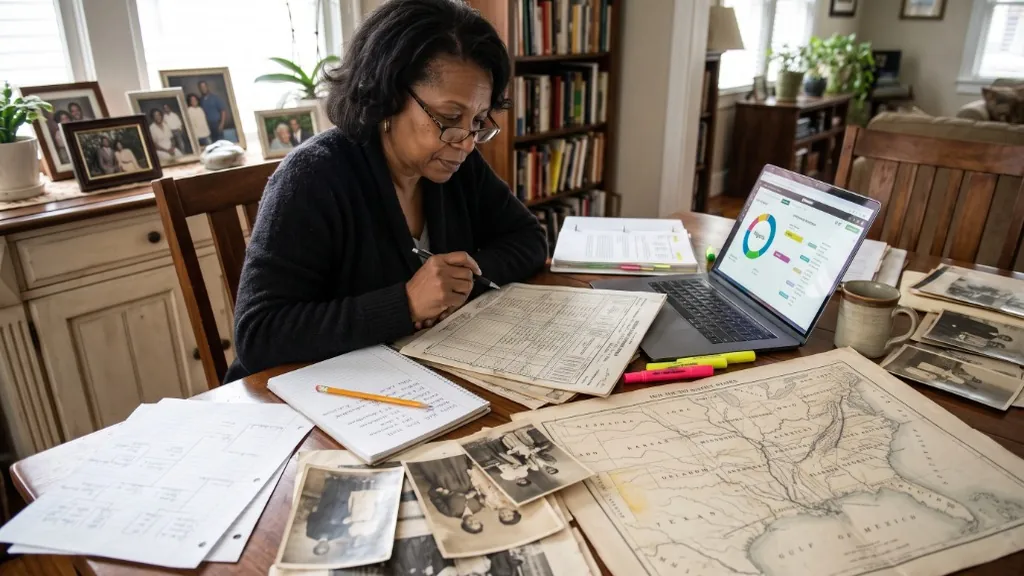
For many researchers, the mystery is not small. It is an unknown father, a hidden grandparent, a name change after the Civil War, or an ancestor who appears in 1870 and seems to come from nowhere. Traditional genealogy platforms often leave people stuck with hints, record piles, and a vague sense that the answer must be in there somewhere. DNA can help, but only if someone translates the matches into a real research path.
Why DNA matches solved family mystery cases when records alone could not
Records are uneven. That is especially true for African American families tracing relatives through slavery and Emancipation, but it affects many others too. Courthouse fires happened. People moved. Names changed. Census takers misspelled what they heard. Fathers were omitted. Mothers remarried. Whole branches disappear behind one bad index entry.
DNA changes the job. Instead of asking only, "Can I find my ancestor in a record?" you can ask, "Who shares inherited DNA with me, and what does that cluster suggest about the family line I cannot yet document?" That shift matters because DNA does not care whether a clerk spelled your surname three different ways in three different counties.
Still, DNA is not magic. A match list without context can waste weeks. You can stare at centimorgans, shared matches, and user trees and still not know which county to search or whether the connection is maternal or paternal. The real breakthrough comes when DNA evidence is used to narrow geography, identify likely surnames, and point toward a record collection that fits the period.
What DNA matches actually tell you
A DNA match does not hand you an ancestor. It gives you a relationship range and a probability. That sounds less satisfying than a birth certificate, but it is often enough to start building a working theory.
If several strong matches all descend from the same couple in one Virginia county, that pattern means something. If a cluster of matches connects to a South Carolina surname that later appears near your family in Georgia, that means something too. If your closest unknown matches all connect to one sibling group rather than the family patriarch, that can completely change the direction of the search.
This is where many family mysteries get solved. Not from one perfect match, but from the overlap between several imperfect ones.
Shared matches are often more useful than the closest match
People naturally focus on the biggest cM number. Sometimes that works. More often, the answer sits inside a cluster.
Shared matches can reveal whether an unknown line belongs on your mother's side or your father's side. They can also show whether several cousins descend from the same grandparent line, even when their public trees are sparse or wrong. In adoption research, unknown parentage cases, and 1870 brick wall work, this cluster logic is usually stronger than any single profile.
Trees help, but only when handled carefully
User-submitted trees are clues, not proof. Some are excellent. Some are copied from other copied trees and should not be trusted without records. But even weak trees can still be useful if five matches independently point to the same county, church, or surname group.
That is the difference between passive browsing and active genealogy. You are not collecting hints. You are building a case.
A practical way DNA matches solved family mystery problems
The strongest workflow is simple, even if the underlying research is not. Start by separating your known maternal and paternal matches. Then identify the unknown cluster that matters most. From there, look for overlap in locations, surnames, migration routes, and family structures.
Say your family mystery is an unknown great-grandfather in Mississippi around 1880. Your DNA matches may not identify him by name on day one. But if a cluster of matches repeatedly leads back to two neighboring counties in Alabama and one surname appears across three trees, you now have a direction. That is far more useful than another month of blind record searching.
Once you have that direction, records become sharper. You can target Freedmen's Bureau labor contracts, marriage registers, probate files, tax lists, cohabitation records, church registers, and the exact federal census neighborhoods where those families lived. In the hardest cases, that county-level precision is what turns a mystery into a solvable problem.
For families tracing formerly enslaved ancestors, this is where DNA becomes especially powerful. Pre-1870 research often breaks because the paper trail before freedom is fragmented and tied to enslavers, plantations, estate divisions, and county jurisdictions. DNA can surface cousin lines that stayed in the same area, adopted related surnames, or maintained kinship ties after separation. That does not replace records. It tells you which records deserve your next hour.
When DNA points to the wrong answer
This part matters because family history is emotional, and false certainty can do damage.
A DNA match may be real while your interpretation is wrong. Endogamy can inflate match strength. Half relationships can be mistaken for full ones. Non-paternity events, adoptions, informal name changes, and second marriages can scramble what looks obvious at first glance. A county pattern can reflect migration through an in-law network rather than a direct bloodline.
That is why good research stays flexible. You should test theories against age, place, household composition, and document timing. If a likely father was twelve years old at conception, the theory is wrong no matter how persuasive the match cluster seemed. If one branch lived in Louisiana for three generations and your target family never left North Carolina, slow down and verify.
Confidence in genealogy should come from convergence, not excitement.
Turning DNA into records, not just possibilities
The best researchers do not stop at identifying likely cousins. They ask a harder question: what archive should I search next?
That is where most platforms still fall short. They show you the DNA data but leave the interpretation to you. For beginners, that creates paralysis. For intermediate researchers, it creates drift. You know the answer is close, but you do not know whether to search a pension file, a county deed book, or a Freedmen's Bank register.
What moves research forward is translation. Not "You have a third cousin match," but "This cluster points to Edgefield County, this surname group appears in postwar labor records, and these families later show up in the same 1870 district." Better still is when the research path gets specific enough to identify the federal microfilm publication or county source set worth checking next.
That precision is the difference between genealogy as browsing and genealogy as recovery. It is also why a tool like The 1870 Project can change the pace of a search. Instead of leaving you with abstract DNA clues, it is built to translate matches into archival direction, county focus, and the next best action. For families facing the 1870 brick wall, that is not a small feature. It is the whole job.
The emotional side of a solved mystery
When people say DNA matches solved family mystery stories in their family, they are usually talking about more than a name. They mean a silence ended. A rumor got tested. A grandmother's memory finally made sense. A branch that felt erased became visible again.
That matters deeply for descendants of the enslaved, whose family records were deliberately damaged by a system that treated human beings as property. It matters for adoptees and donor-conceived people who are trying to understand identity without violating anyone's dignity. And it matters for anyone who grew up with one version of the family story and suspects there was more.
Genealogy can be technical, but it is never only technical. Every solved mystery changes how someone understands where they come from.
If your family mystery is still unsolved
Do not assume the answer is not there because you have not found it yet. More often, the issue is that the clues have not been organized correctly. Your match list may already contain the breakthrough. Your grandmother's half-remembered place name may already fit the county pattern. The missing piece may not be more data. It may be a clearer next step.
Start with the cluster, not the chaos. Separate your lines, study the overlap, and push each DNA clue toward a real record search. Families rarely vanish as completely as the records make it seem. Your family was here. With the right translation from DNA to archives, you can find them.