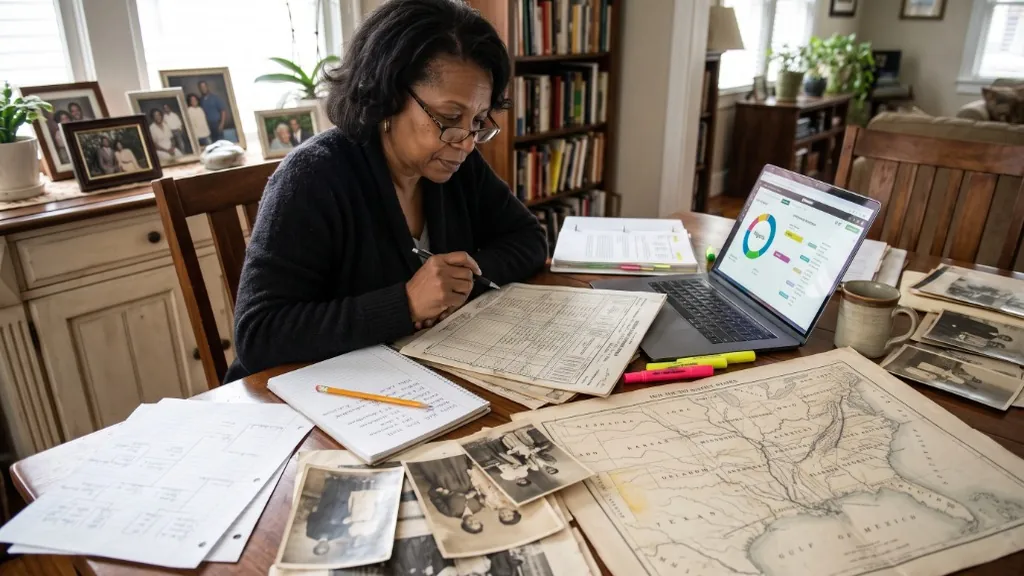
Hub Counties for DNA Genealogy: Find the Clue

A DNA match list can feel like a crowded room where everyone shares your face but nobody knows your great-grandmother's name. Hub counties for DNA genealogy give that list a location, a record set, and a practical next move. Instead of asking DNA to name an ancestor on its own, you use patterns among matches to identify the places where related families repeatedly lived, married, worked, and appeared in records.
That shift matters most when the paper trail breaks before 1870. For descendants of formerly enslaved people, the first census after Emancipation may be the first time an ancestor appears by full name. DNA can point beyond that barrier, but only when it is paired with disciplined archival research. The goal is not another vague ethnicity estimate. The goal is a county you can search on Monday morning.
What Are Hub Counties for DNA Genealogy?
A hub county is a place that appears again and again across a meaningful group of your DNA matches. It may be where a shared ancestor lived, where a family spent several generations, or where a larger kin network formed before people migrated elsewhere.
Think of it as a research center of gravity. One match may list Georgia, another Texas, and a third Illinois. On the surface, those trees look disconnected. But if their grandparents and great-grandparents repeatedly trace back to the same counties in Alabama or Virginia, that earlier location may be the hub.
A hub county is not proof by itself. DNA does not hand you a courthouse deed with your ancestor's signature. It provides a strong lead when several independent clues agree: shared-match clusters, family trees, census birthplaces, marriage records, military files, land transactions, church registers, and migration routes.
The best hub counties are supported by repetition, not a single impressive match. One well-documented cousin can be useful. Five matches from separate family branches pointing to the same county are far more persuasive.
Why County-Level Clues Beat Broad DNA Results
An ethnicity estimate might tell you that part of your ancestry is connected to West Africa, the British Isles, or Indigenous communities. That can be meaningful family context, but it rarely tells you which courthouse, archive, or federal record to search next.
Counties do.
US records were often created and organized locally. A county can lead you to probate files, tax rolls, deeds, marriage licenses, voter registrations, court minutes, cemetery records, and local newspapers. For African American genealogy, it can also direct you toward Freedmen's Bureau field office records, labor contracts, complaints, marriages, and school records connected to a specific postwar community.
County research also reveals migration. A family that appears in Memphis in 1880 may have come from a cluster of counties in Mississippi, Arkansas, Tennessee, or Alabama. When several DNA matches trace back to one of those places, you have a reason to look there before spending weeks searching an entire state.
The difference is precision. Broad results suggest a history. Hub counties give you an archive plan.
How to Identify a DNA Hub County
Start with your strongest and most useful DNA matches, not necessarily your closest match. A second cousin with no family tree may offer less research value than a fourth cousin with grandparents, great-grandparents, and locations clearly documented.
Create a working group of matches who share DNA with you and with one another. Shared matches are especially valuable because they can represent one ancestral line. Review the places attached to their trees, obituaries, public family histories, and uploaded notes. Record counties, not just states.
Then look for repetition. If three or more matches point to the same county or a tight group of neighboring counties, flag it. Pay attention to surnames, but do not let surnames control the entire investigation. Enslaved ancestors often had their names changed, adopted a surname after Emancipation, or used different names across records. Geography and kin networks may survive when a surname does not.
Separate the hub from the noise
Not every county on a match's tree belongs to your line. People move. Trees contain errors. Some matches are related through a different branch than the one you are studying.
Test the county against what you already know. Ask whether it fits the age, migration pattern, and family associations of your target ancestor. If your ancestor was born in Mississippi around 1855 and later lived in St. Louis, a cluster rooted in northern Mississippi deserves attention. A lone match connected only to California may be real, but it may belong to another side of your family.
Also compare match groups. If one cluster centers on Lowndes County, Alabama, while another centers on Edgefield County, South Carolina, you may be looking at two separate ancestral lines. Do not force every match into one story. Good genealogy gets narrower before it gets clearer.
Turn a Hub County Into a Record Search
Once you have a likely county, stop collecting clues for a moment and start testing them in records. This is where many DNA-based searches stall. Researchers identify a promising location but never convert it into a targeted plan.
Begin with the years immediately after 1870. Find your ancestor, their children, and likely siblings in the 1870 and 1880 censuses. Note neighbors, occupations, birthplaces, and household members. The families living nearby may appear in your DNA match group, and those associations can expose a kin network that formal records never name directly.
Next, work backward and outward. Search county marriage records, death certificates, cemetery records, property transactions, tax lists, and probate files. If your family was formerly enslaved, identify the local Freedmen's Bureau field office serving that county or nearby area. Labor contracts and complaints sometimes name formerly enslaved workers, employers, relatives, and plantations. A record that looks administrative can contain the family connection you have been missing.
For federal records, location matters because records are organized by census year, state, county, and publication series. The1870 Project's DNA Decoder is built for this exact handoff: it translates match patterns into likely hub counties and concrete archival directions, including the relevant NARA microfilm number when available. That is more useful than being told you have a distant match somewhere in the South. You need to know what to pull and where to look.
Follow people across county lines
County borders and jurisdictions changed, and families often lived near a line rather than in the county they named later in life. A hub is sometimes a region, not a single dot on a map.
Search adjoining counties when the evidence is close but incomplete. Look for the same surnames, witnesses, employers, landowners, churches, and census neighbors. A marriage may be recorded in the bride's county, a deed in the landowner's county, and a labor contract in the county served by the nearest Freedmen's Bureau office.
This is not a reason to search everything. It is a reason to expand logically. Start with the strongest county, then move to its neighbors only when the records or migration pattern justify it.
A Careful Example of the Method
Suppose you are researching Sarah Johnson, born around 1858 in Mississippi, who appears in Arkansas by 1880 with three children. Her parents are unknown. You have several DNA matches with Johnson, Carter, and Williams families, but those surnames are too common to settle anything.
Shared-match analysis shows that four of those matches have grandparents from Panola and Tallahatchie Counties, Mississippi. Two have family stories of relatives moving to eastern Arkansas after the Civil War. The county pattern is stronger than the surnames.
Your next action is not to declare Sarah's parents solved. Search Sarah's 1870 household, nearby Johnson, Carter, and Williams families, and postwar records connected to those Mississippi counties. Then compare the people you find with the names appearing in your match trees. If a possible sibling, aunt, or former household appears in both the records and the DNA network, the theory gains weight.
That is how a hub county works. It turns a set of genetic hints into a testable family hypothesis.
Mistakes That Keep DNA Research Stuck
The most common mistake is treating the closest match as the answer. Close matches matter, but their trees can be private, incomplete, or tied to a different branch. A well-defined cluster with a repeat county is often more actionable.
Another mistake is accepting an online tree without checking original records. Trees are leads, not evidence. A wrong parent can be copied hundreds of times, especially when a familiar surname appears in the right state.
Finally, do not wait for perfect certainty before researching a county. Genealogy rarely offers that at the start. Use a confidence scale: possible, probable, and supported. Search a probable hub county, document what you find, and let the records either strengthen or weaken the case.
Your family was here. The task is to identify where “here” was, then let the records speak. Pick one DNA cluster, write down the counties that repeat, and pursue the strongest location with a focused question. The next document may not name every ancestor at once, but it can give your family story somewhere solid to stand.