Leeds Method Genealogy That Finds Patterns

If your DNA match list feels like a wall of second cousins, unknown surnames, and half-familiar places, Leeds method genealogy is one of the fastest ways to turn that noise into structure. It does not solve every family mystery by itself, but it gives you something most researchers badly need - clear groups of matches that likely belong to the same grandparent line.
That matters when you are stuck. It matters even more when records are thin, names changed, counties shifted, or your family hits the painful gaps that appear before and just after 1870. DNA can point you toward the right people, but only if you can organize what it is showing you.
What the Leeds method genealogy approach actually does
The Leeds Method is a color-coding system for autosomal DNA matches. You take a set of matches in a specific centimorgan range and sort them based on who matches each other. Once you do that, clusters start to appear. In an ideal case, you end up with four main groups, each representing one of your four grandparent lines.
That is the simple version. Real research is messier.
Some people get four neat color blocks. Others get overlap, extra groups, and confusing outliers. Endogamy can blur the picture. Pedigree collapse can create cross-connections. Unknown parentage cases can split one expected cluster into several smaller ones. The method still helps, but the value is not perfection. The value is pattern recognition.
This is why the method remains useful for beginners and intermediate researchers. It takes a giant DNA list and turns it into working evidence. Once your matches are grouped, you can stop asking, Who are all these people? and start asking, Which branch do they belong to, and what records should I search next?
How to use the Leeds method genealogy step by step
Start with your autosomal DNA match list on the platform where you tested or uploaded. You are looking for matches that are close enough to be meaningful but not so close that they collapse multiple lines together. Most researchers use matches roughly between 90 and 400 centimorgans, though that range can shift depending on your match list.
Skip your parents, siblings, aunts, uncles, first cousins, and often very high matches. They are too close and may connect to more than one grandparent line. The method works best in the middle range where shared DNA is strong enough to matter but specific enough to cluster.
Pick one match in that range and assign them a color. Then look at the shared matches for that person. Everyone who matches both of you gets that same color. Move to the next uncolored match and repeat with a different color. Over time, distinct groups emerge.
You can do this in a spreadsheet, on paper, or with a notes system if your testing company allows it. The tool matters less than consistency. Record the match name, amount of shared DNA, known surnames, locations, and color group. The notes become just as valuable as the colors.
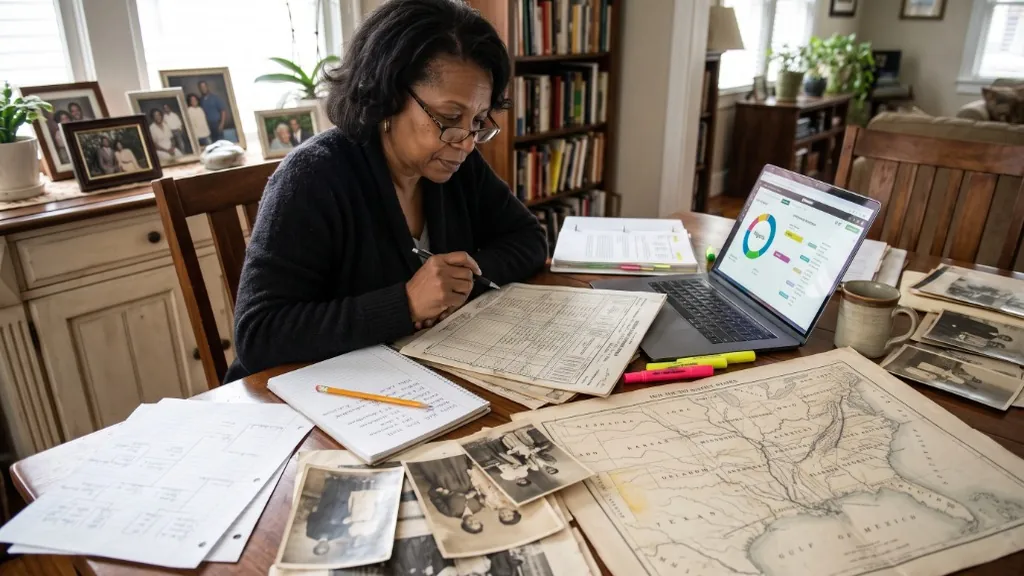
Once you have your groups, study them. Are several people in one color cluster tied to the same county in Georgia? Do multiple matches descend from a family in Halifax County, Virginia? Does one cluster include recurring surnames that also appear in oral family history? This is where your DNA stops being abstract and starts pointing toward archives, migration paths, and specific families.
Where the Leeds Method helps most
The best use of the Leeds Method is not sorting for the sake of sorting. It is identifying which branch to research next.
If you are trying to identify an unknown great-grandparent, one cluster may isolate that person’s side. If you are tracing an African American family through the 1870 Census and into slavery-era records, a cluster can reveal a county network, white associated families, or migration links that narrow your Freedmen’s Bureau and postwar search. If you have a mystery surname that appears only once in your tree, a color group can show whether that name belongs to your maternal grandfather’s people or somewhere else entirely.
This is especially powerful when paper records are incomplete. DNA does not replace archives, but it can tell you where to aim. That is the difference between opening fifty irrelevant record collections and searching one county with purpose.
What the Leeds Method cannot do on its own
There is a reason experienced genealogists treat this as an organizing method, not a final proof argument. A color cluster is a lead. It is not a documented conclusion.
Leeds method genealogy can show that certain matches likely belong together. It cannot tell you exactly how every person connects. It cannot explain every overlap. It cannot fix bad family trees copied across the internet. And it cannot substitute for census work, probate research, land records, military files, church registers, or local court records.
This is where many people lose momentum. They complete the chart, feel encouraged for a day, and then stall because the next step is unclear. A cluster only becomes useful when you translate it into an action. Search this county. Pull this census district. Compare these households. Check this Freedmen’s Bureau field office. Review this NARA microfilm set.
That translation step is where smart genealogy tools should help.
Common problems and what they usually mean
You got more than four groups
That does not automatically mean you made a mistake. You may be seeing half relationships, multiple marriages, endogamy, or match networks that represent great-grandparent lines rather than grandparent lines. It can also happen when your selected match range is too broad.
Your groups overlap heavily
This often points to endogamy, pedigree collapse, or a population with repeated cousin marriages across generations. In those cases, the Leeds Method still has value, but you may need to use smaller clusters and combine them with location-based research rather than expecting four clean divisions.
One group is much larger than the others
Sometimes one side of the family simply tested more. Sometimes your matches descend from a family with many documented descendants and active DNA testers. The imbalance is real, and it affects what you can learn quickly.
You cannot identify any group at all
That usually means the method needs support from outside evidence. Start with the matches who have usable trees, known counties, or recognizable surnames. Build sideways before trying to go backward.
Turning clusters into records research
This is the part too many genealogy articles skip. After clustering, choose one color group and build a working profile for it. Note the oldest known ancestors in the group, recurring surnames, counties, migration routes, and any shared military, church, or community ties.
Then compare that profile to your own known family timeline. If your grandmother’s people were in western Tennessee and one cluster keeps pointing to northern Mississippi and Shelby County, that is not random. It may reflect a migration pattern, plantation network, marriage route, or Reconstruction-era move.
For families affected by slavery, this matters even more. A DNA cluster tied to a county can help you focus on specific 1870 households, labor contracts, Bureau records, probate inventories, and nearby white families whose records may hold the names your own family was denied in earlier decades. The cluster does not erase the difficulty of that work. It narrows the field so the work has direction.
That is also where a platform like The 1870 Project fits naturally. If your DNA clusters suggest a county or family network but you do not know which archive series to check next, the real breakthrough is not another vague hint. It is getting the next best search action, down to the right locality and record set.
A better way to think about DNA matches
Most people start by treating DNA matches like answers. They are not. They are signals.
The Leeds Method helps you separate those signals into channels you can actually use. One channel may lead to your mother’s father. Another may expose a line your family never discussed. Another may connect your tree to a place your ancestors passed through for only one generation before moving on.
That is why this method remains useful even in a world full of automated clustering tools. Doing the grouping yourself forces you to see the names, places, and patterns that software can flatten. Human judgment still matters. Family history is full of edge cases, silence, reinvention, and records that were never built to preserve the truth equally.
Use the method with that in mind. Let it show you structure, then let records test the theory. When a cluster gives you a county, a surname network, or a line of shared ancestors, move quickly. Interview relatives. Save screenshots. Capture notes. Search the records while the clue is fresh.
Your family was here. The patterns are there too. Sometimes all you need is a cleaner way to see them.