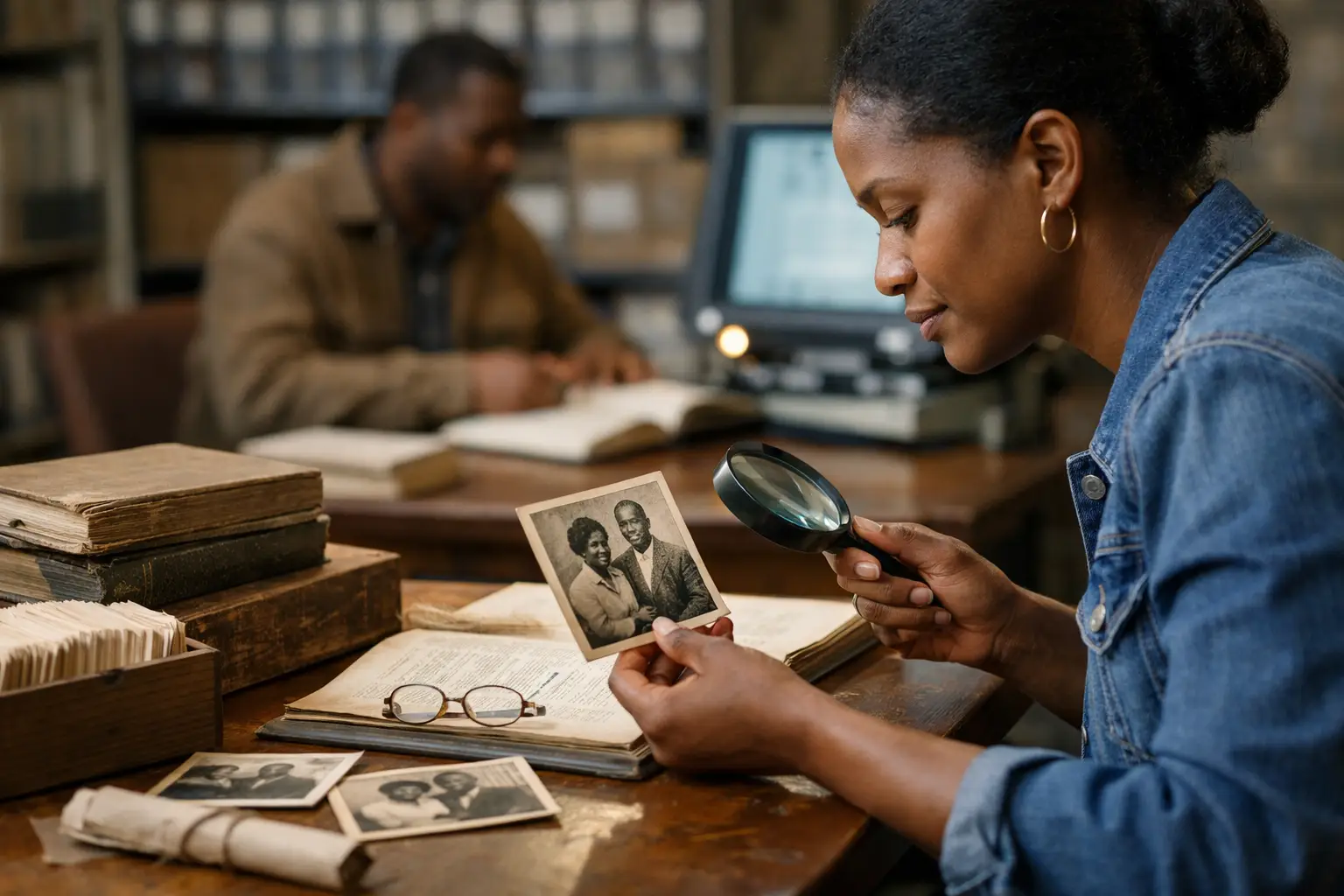
Research Plan for Missing Ancestors That Works

You do not need more random record searches. You need a research plan for missing ancestors that tells you what to look for next, where to look, and what each result should prove. That matters even more when an ancestor seems to vanish before 1870, changes names, moves across county lines, or appears in records that were never indexed well in the first place.
Most family history stalls for a simple reason: people collect clues without building a case. They save census pages, bookmark databases, maybe test with DNA, and still end up with the same question they started with. Who were this person’s parents? Where were they before the census? Why did the surname change? A good plan fixes that by turning one big mystery into a series of smaller questions you can actually answer.
What a research plan for missing ancestors should do
A real plan is not a to-do list full of vague ideas like “search more records” or “check DNA later.” It should define the person you are tracking, the time period that matters, the place where evidence is most likely to survive, and the exact records most likely to move the case forward.
Start by writing one focused research question. Not “find everything about Sarah Johnson,” but “identify the parents of Sarah Johnson, born about 1858 in Georgia, living in Macon County, Alabama, by 1880.” That kind of question changes your search behavior. It pushes you toward probate, marriage, labor, tax, church, and local records tied to one place and one problem.
This is also where many African American family histories require a different strategy. If your line hits the 1870 brick wall, the goal is not just to search backward by name. It is to reconstruct the community around the ancestor, identify possible slaveholding households, track surname adoption patterns, and use post-Civil War records that connect freed people to specific counties, employers, military service, and family networks.
Build the timeline before you chase new records
Before you search one more database, build a clean timeline. Put every known event in date order: birth estimate, marriage, children’s births, census appearances, land activity, military service, death, burial, and migration. Add the source for each fact and mark anything uncertain.
This sounds basic, but it is where missing ancestors start to reappear. A timeline exposes gaps. It shows that someone was in one county in 1872 and another by 1877. It reveals two men with the same name who are not the same person. It forces you to notice that an age changes by ten years, or that a supposed birthplace may actually be where the family lived after the war.
Use the timeline to separate facts from assumptions. If the only proof of a birthplace comes from a death certificate completed by a grandson, treat it as a clue, not settled truth. If a surname first appears in 1870, consider whether it was adopted after Emancipation or altered by a clerk. Small corrections at this stage save months later.
Place matters more than most beginners realize
A missing ancestor is usually not missing everywhere. They are missing from the exact search terms you used. That is why location should sit at the center of your plan.
Counties changed. Borders shifted. Courthouses burned. People crossed into the next county for marriage, church, work, or because that was where the nearest federal office operated. If you only search one county because that is where the family appears in one census, you can miss the record trail entirely.
Build a place profile for the ancestor. Note the county, nearby counties, state, major towns, rivers, rail lines, plantations if relevant, military posts, and migration routes. For formerly enslaved ancestors, the county is often more valuable than the surname. Freedmen’s Bureau records, labor contracts, marriage registers, complaints, rations, and bank records were tied to local offices and local communities. The right county can narrow an impossible search into a manageable one.
Use records in the order they can answer your question
The strongest research plan for missing ancestors prioritizes records by probability, not by popularity. Census records are useful, but they are not the whole job. The right order depends on the question you are asking.
If you are trying to identify parents, start with records created closest to the person’s life events: marriage records, death certificates, obituaries, church baptisms, funeral home files, probate records, and delayed birth records for children. If the issue is a pre-1870 identity, lean harder into Freedmen’s Bureau records, USCT service and pension records, labor contracts, cohabitation records, tax lists, and probate tied to local white families with matching community connections.
Land and probate are especially underused. Probate can name heirs, guardians, spouses, and relationships that never appear in a census. Land records can place a family in a specific district between census years. Tax rolls can prove continuity when census records fail. Church records can preserve names exactly as families used them, not as census takers heard them.
This is where precision matters. “Search military records” is too broad. “Check USCT pension applications for men in the same county and surname cluster” is a plan. “Review probate packets from 1860 to 1875 for slave schedules, estate distributions, and guardianship references in the target county” is a plan.
DNA belongs in the plan, not off to the side
Many researchers either overtrust DNA or avoid it because it feels technical. Both mistakes slow you down. DNA works best when you use it to answer a defined documentary question.
Start with your closest unknown or weakly understood line. Group matches by shared ancestors, counties, and surnames. Look for repeated locations even when surnames do not match. In African American research especially, location clusters can be more stable than names. A set of matches tied to one Georgia county may point you toward the right Bureau field office, the right plantation neighborhood, or the right migration path into Alabama or Mississippi.
The key is translation. DNA does not replace records. It tells you where to search harder. If a cluster of matches points to Edgefield County, South Carolina, your next step is not to stare at centimorgans longer. Your next step is to check local probate, labor records, Black church communities, and postwar contracts tied to that county. Good genealogy tools should shorten that leap from match list to archive target. The best ones do not just say “you have matches here.” They tell you which county hub matters and what source to pull next.
Family interviews can solve what databases cannot
People often wait too long to ask living relatives. That is a costly mistake. A cousin may not know exact dates, but they may know who “Uncle Ben” really was, why a woman used two surnames, where the family cemetery sits, or which county everyone said they came from before moving north.
Approach interviews like evidence gathering, not casual chatting. Ask for names, nicknames, military stories, church affiliations, land, migration, family disputes, old photos, funeral programs, and who kept the Bible. Then document the source of each memory. Memories can be wrong, but they often contain the detail that makes the records finally visible.
If reaching out feels awkward, use a simple message and ask one focused question at a time. People are more likely to respond to “Do you remember which county Grandma Clara said her father came from?” than to “Tell me everything you know about the family.”
How to know your plan is working
A strong plan creates momentum, even before it solves the whole case. You should see narrower questions, better places, and stronger source choices. You should stop repeating the same searches with slightly different spelling and start testing real hypotheses.
For example, you might conclude that your ancestor likely lived in or near one county by 1867, belonged to one church network by 1872, and had ties to one cluster of families who appear in probate and labor records. That is progress. Family reconstruction often works this way - not through one miracle record, but through a pattern strong enough to support the next move.
If your searches still feel scattered after a few sessions, the plan is too broad. Tighten the question. Reduce the geography. Pick one record set and one time span. The goal is not to search more. The goal is to search smarter.
That is exactly where a modern platform can help. The 1870 Project is built for this problem: not just showing you records, but helping turn clues from archives, DNA, and family conversations into the next best action, down to likely counties and the record sets to check. When records are hard, precision is what restores momentum.
Your family was here. Even when the paper trail is thin, the trail is rarely gone. Build the case carefully, follow the county, and let each clue tell you what to prove next.