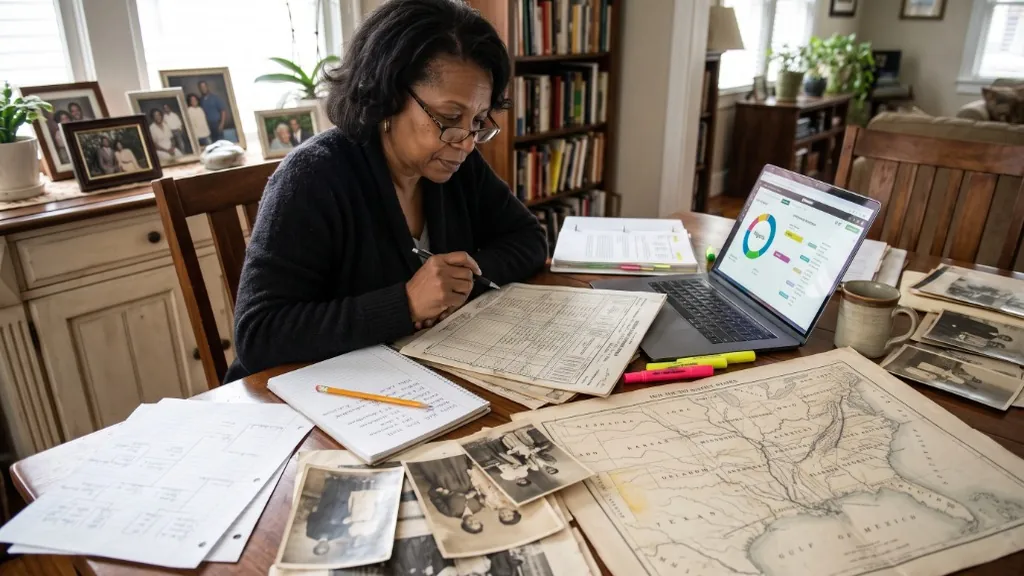
How to Use DNA Matches to Find Family

Most people open their DNA results, see hundreds or thousands of matches, and hit the same wall: now what? If you want to know how to use DNA matches in a way that actually moves your family research forward, the goal is not to stare at percentages and hope something clicks. The goal is to turn shared DNA into names, places, records, and the next best search.
That matters even more when your paper trail breaks before 1870, when a surname changes, or when family stories point in three different directions. DNA can help, but only if you read it as evidence, not as a magic answer.
How to use DNA matches without getting overwhelmed
Start small. Pick one research question before you touch your match list. Maybe you are trying to identify a great-grandparent’s parents. Maybe you want to know which county your African American family likely lived in just after Emancipation. Maybe you are sorting whether a match belongs to your maternal or paternal side.
Without a question, every match looks equally urgent. With a question, you can ignore most of the noise.
The next step is to focus on your closest useful matches, not simply your closest matches. A very close match with no tree, no response, and no shared surnames may be less helpful than a somewhat more distant match with a public tree, a known hometown, and grandparents you can place in the same county as your family.
This is where many beginners lose momentum. They assume bigger centimorgan numbers always mean faster answers. Sometimes they do. Sometimes they just mean a closer relationship on a branch you already know well.
Start with shared DNA, then move to shared context
Centimorgans tell you that a relationship exists. They do not tell you exactly which relationship it is. A match can fit several possibilities, especially in endogamous communities, in places where cousins married cousins, or in communities with repeated intermarriage over generations.
So after you note the amount of shared DNA, move immediately to context. Look at the match’s tree if they have one. Look at surnames, but do not stop there. Surnames can mislead, especially for formerly enslaved families whose names may have changed after the Civil War. Places are often stronger clues than names.
A county, church, plantation area, migration route, or cluster of neighboring families can tell you more than a single last name. If your family appears in Mississippi in 1880 and a cluster of DNA matches has roots in the same county or in a nearby county across the state line, that is not random. That is a research lead.
When people ask how to use DNA matches well, this is the answer they usually need: stop treating each match like a separate puzzle piece floating in space. Start treating matches like a network tied to place, time, and community.
Build clusters, not one-off guesses
The fastest way to make a match list useful is to group matches who also match each other. These are often called clusters. You do not need fancy charts at first. A simple working method is enough.
Choose one match who seems promising. Then check the people you both match. If the same names keep appearing together, you are likely looking at one branch of your family. Label that group with what you know so far, such as “maternal line from Edgefield County” or “possible descendants of Louisa’s siblings.”
This matters because a single match may be vague, but a cluster can point to a real family. Three or four matches with overlapping trees, shared locations, and connections to one another can narrow your search far better than one isolated cousin.
Clusters are especially valuable when your direct ancestor is missing from records. Your ancestor may not be named in the document you need, but a sibling, cousin, or in-law often is. DNA helps you find the broader family circle. Records then help you prove which person belongs where.
Use trees carefully, even bad ones
Many family trees online are wrong in some way. Use them anyway, but use them as leads, not proof.
A shaky tree can still give you a church name, a township, a military service clue, or a maiden name to test. If five matches all point back to families in the same North Carolina county, you now have a place to search land records, probate, tax rolls, Freedmen’s Bureau records, or federal microfilm.
Think like a researcher, not a collector. You are not trying to copy a tree. You are trying to extract clues and test them against records.
When DNA matches matter most for African American research
For many African American families, the hardest transition is crossing from known post-1870 ancestors into the years before Emancipation. That is where DNA matches can become more than interesting. They can become directional.
If several matches descend from Black families in the same county where your family lived in 1870, that cluster may point you toward the local records set that matters most. If another group of matches connects to a white family in the same place, that does not prove a specific relationship, but it may suggest a plantation, probate, deed, or estate paper trail worth examining.
This is where precision matters. General genealogy advice often stops at “look at your matches.” That is not enough when the record gap is real. You need to translate DNA evidence into a concrete archive path: which county, which record group, which roll of microfilm, which set of postwar labor contracts or bank files to check next.
That translation is exactly where a tool like The 1870 Project can save time. Instead of leaving you with a list of cousins and guesswork, it can point your DNA evidence toward likely counties and the archives and federal record sets that fit the pattern.
Contact matches, but ask better questions
A lot of researchers send one message that says, “How are we related?” and never hear back. That question is too broad. It asks a stranger to solve your puzzle for you.
A better message is short and specific. Mention the amount of shared DNA, the person or couple you are researching, and the place and time period you are working in. Ask whether their line includes a particular surname, county, church, or migration path.
Specific questions get specific answers. They also make it easier for a match to search their own notes, ask an older relative, or recognize a familiar family story.
If they do not respond, do not stall out. Many valuable matches never reply. Keep working the evidence you already have. Shared matches, public trees, obituaries, census records, death certificates, pension files, and county records often do the job without a single message back.
Watch for the common traps
The biggest mistake is forcing a conclusion too early. A DNA match can support a theory, but one match rarely proves it alone. You want multiple points of agreement: shared DNA, a believable relationship range, a place in common, and records that fit.
Another trap is ignoring half-relations, remarriages, and informal kinship structures. Families are rarely neat on paper. A person listed as a niece, cousin, or boarder may be central to the line you are trying to reconstruct.
You should also be careful with ethnicity estimates. They can be meaningful at a broad level, but they are usually much less useful than actual DNA matches for solving a genealogical question. If your goal is to identify ancestors, build from match evidence and records first.
Turn DNA matches into your next search action
The real skill is not learning every DNA term. It is learning how to turn a match into a next move.
If a cluster points to one county, search that county deeply. If several matches descend from siblings of your suspected ancestor, build out that collateral line. If a match’s tree includes a regiment, church, or employer connected to your family’s location, follow that thread into records. If a cluster overlaps with a surname that appears near your family in 1870, test whether that connection shows up in probate, land, marriage, or Bureau records.
That is how family history actually moves - not through random clicking, but through one solid inference followed by one targeted search.
You do not need perfect certainty to begin. You need enough evidence to choose the smartest next step. Your family was here. The names may be scattered, the records may be incomplete, and the path may not be straight. But a good DNA match list is not just a set of cousins. It is a map, if you know how to read it.